Imagine a strong engineer comes across your job opening.
They like the role, and the company sounds interesting. So before they apply, they do something you probably never see.
They open your company’s LinkedIn page.
Then they look at the founder’s profile. Maybe they check one or two employees too. They scroll through a few posts, look at what the company talks about, and try to get a feel for the people behind it.
It probably takes them less than two minutes. But in those two minutes, they’ve already formed an opinion about your company.
Do these people seem serious?
Does this look like a place where good people would enjoy working?
Does the founder seem involved?
Do they actually care about the people they hire?
And more importantly: Can I trust this company with the next few years of my career?
Most founders don't realize how much their LinkedIn presence influences these decisions. We often think of LinkedIn as a marketing channel: A place to announce funding, share company updates, post about new hires, or publish the occasional “we’re hiring” graphic.
But for a candidate, it can be something completely different. It is evidence.
Candidates Are Already Forming an Opinion
Before applying for a job, people want to know what they are getting themselves into.
Recent hiring research suggests that more than half of job seekers, around 54%, research a company before applying. LinkedIn and other professional networks are among the places candidates use to do that, along with the company's own careers page.
They aren't just looking for a list of products or impressive company announcements. They want to know what it might actually be like to work there.
Is the company growing?
Do the people seem happy?
Does the founder seem approachable?
Are employees talking about the work?
Does the company communicate clearly?
They are also trying to understand something that is difficult to put into a job description: What kind of company am I walking into?
This matters because hiring is already not a great experience for many candidates. Only around 26% of candidates say they have had a genuinely good hiring experience, while some have had such a poor experience that they would avoid the company in the future or would not recommend it to someone else.
That means trust matters from the very beginning.
If the first thing a candidate sees is a company page that looks abandoned, a job description that feels copied and pasted, and a founder profile that says almost nothing about the company, they may start making assumptions.
And once that first impression is formed, it can be difficult to change.
Your Job Post Is Sending a Message
A job description might look like a simple list of responsibilities and requirements, but to a candidate, it can say much more.
For example, imagine a job post that says:
“We are looking for a passionate software engineer with strong communication skills, experience with multiple technologies, and the ability to work in a fast-paced environment.”
There is nothing technically wrong with that, but it could describe thousands of companies.
A strong candidate reading it might still be wondering: What will I actually be doing?
What problem am I being hired to solve?
What would I work on during my first few months?
Why does this role exist in the first place?
Compare that with a company that says:
“We're rebuilding our payment system because our current system struggles as we scale. You'll work directly with the founding team to redesign it and help us support the next stage of growth.”
That immediately feels different: you can picture the work, you understand why the company is hiring, and perhaps most importantly, it tells the candidate that the company knows what it needs.
A generic job post can unintentionally make a company look unsure about what it wants. A specific one makes the company look thoughtful and prepared.
That difference matters.
What Your Founder’s LinkedIn Says
Candidates don't just look at the company. They look at the people running it.
A founder's LinkedIn profile can quietly influence whether someone wants to work at a startup. If the only posts they see are funding announcements, awards, company milestones, and “We're hiring!” graphics, they don't really learn much about the person behind the company.
Now imagine the founder occasionally sharing something real. Maybe it's a difficult product decision the team had to make. Maybe it's a lesson from building the company. Maybe it's a mistake they made and what they learned from it. Maybe they are having a thoughtful conversation with an engineer in the comments.
None of this needs to be carefully designed content. In fact, it usually works better when it isn't.
A candidate doesn't necessarily need a founder who posts every day. They want to see signs that there is a real person behind the company, like someone who understands the work, cares about the people building it, and has actually thought about where the company is going.
Silence isn't always a problem. But when there is nothing to learn, candidates have to fill in the blanks themselves, and people rarely fill in blanks in your favor.
1. Does an Incomplete LinkedIn Profile Really Cost You Candidates?
Not necessarily in an obvious way. You probably won't receive an email saying, “I didn't apply because your founder's LinkedIn profile was incomplete.” That's what makes this problem so difficult to see. Candidates who lose interest before applying simply disappear. You don't know they were ever considering you.
A half-complete founder profile or an inactive company page might seem like a small thing internally. But to someone who doesn't know your company yet, it can become another small reason to hesitate.
When a strong candidate has five other companies they could apply to, small reasons matter.
2. Should You Post More or Post Better?
Post better.
You don't need to turn your company's LinkedIn page into a content machine. One honest post about something your team actually learned can be more useful than ten generic hiring graphics.
For example, instead of: “We're growing! Join our amazing team!”
You could share: “We thought this feature would take two weeks. It took six. Here's what we got wrong.”
That tells a candidate much more. It shows how your team works. It shows that people are allowed to talk honestly about mistakes, and it gives someone outside the company a small glimpse into what working there might feel like.
You don't need to reveal confidential information. You just need to show something real.
The goal isn't more content. It's more evidence.
3. But What If We're Already Getting Plenty of Applications?
This is where things get interesting.
A company can receive hundreds of applications and still be struggling to attract the strongest candidates. Applicant numbers only tell you who applied; they don't tell you who considered applying and decided not to.
A highly experienced engineer might see your job post, visit your LinkedIn page, spend two minutes looking around, and decide: “Probably not for me.” You'll never see that person in your applicant numbers.
That's the invisible part of hiring.
The best candidates often have options. They don't have to convince themselves to join a company that doesn't give them enough reasons to believe in it.
Fix This Before You Do Anything Else
If your LinkedIn presence isn't sending the signal you want, don't try to fix everything at once.
Start with your most recent job post, and look at it from the perspective of someone who knows nothing about your company.
Can they understand why you're hiring?
Can they picture what they would actually be doing?
Do they know what problem they would be solving?
Does the post sound like a real person wrote it, or does it sound like it came from a template?
A simple rewrite can make a surprisingly big difference.
Then look at the founder's profile and think: Does it give someone a sense of who is actually building the company? Because it doesn't need to be perfect. It just needs to feel alive and genuine.
Here's What This Looks Like in Real Life
Imagine two startups are hiring for almost exactly the same senior engineering role.
The first startup has a generic job description. The founder hasn't posted anything in months; the company page is mostly old announcements and hiring graphics.
The second startup has a clear job description that explains the problem the engineer will work on; the founder occasionally shares what they're learning while building the company, and the company page feels active and reflects the people actually working there.
Neither company has spoken to the candidate yet, but the candidate already has a preference. They probably can't explain exactly why. They just trust one company a little more.
That's the power of these small signals. Hiring starts before the first interview.
Key Takeaways
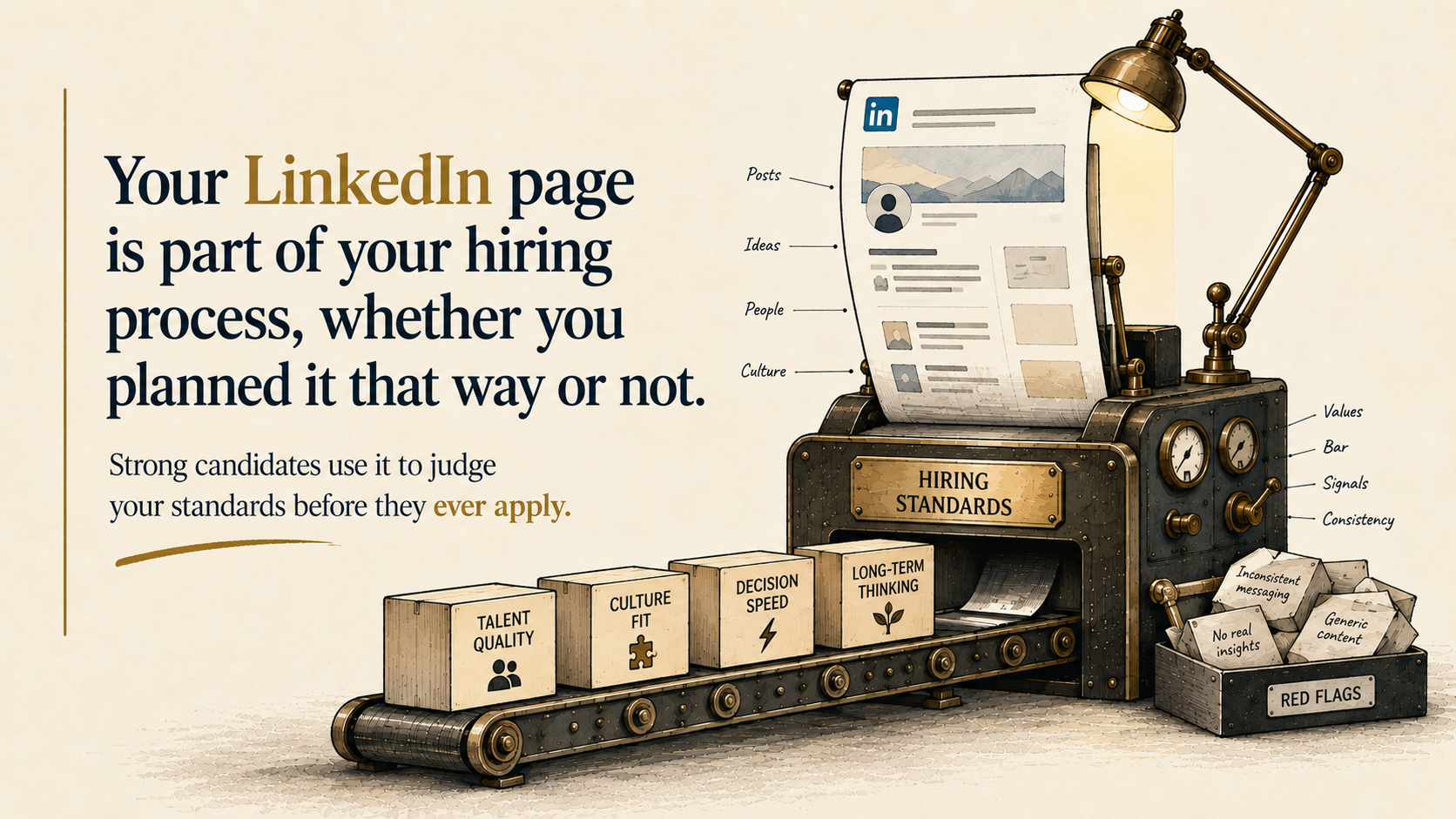
Your LinkedIn presence isn't separate from your hiring process. For many candidates, it is the beginning of the hiring process.
Your job post tells them how clearly you understand the role.
Your founder's profile tells them something about the people behind the company.
Your company page gives them a glimpse into what happens inside.
And the absence of information can be a signal too.
You don't need to post every day. You don't need perfectly designed graphics. You don't need to become a LinkedIn influencer.
You just need to give good candidates enough real information to think: “These people seem like they know what they're doing. I'd like to learn more.”
Because when someone has several opportunities in front of them, that's often the difference between applying and quietly moving on.
Hiring Starts Earlier Than You Think
Your LinkedIn presence isn't just marketing anymore. It's part of how candidates decide whether they want to work with you.
A specific job post, a founder who occasionally shares something real, a company page that actually feels like a living company. None of these things guarantee that you'll hire great people, but together, they make it much easier for great people to trust you.
And if you're already busy building a company, finding the right engineers shouldn't have to become another full-time job. That's where MyNextDeveloper helps connect startups with vetted engineers and AI talent, so you can spend less time searching and more time building.
Because sometimes, the best candidate isn't rejecting your company after an interview - they're never applying in the first place.
TL;DR
Before a strong engineer ever applies, they usually check your LinkedIn first, your job post, your founder's profile, maybe an employee or two. In about ninety seconds, they've already formed an opinion about how organized and serious your hiring process actually is, and that impression sticks. A generic, copy-pasted job listing quietly says "we didn't think this through," while a founder who only posts funding news says nothing real about what building there is actually like. The candidates you lose this way never even show up in your applicant numbers; they just quietly decide not to bother. Start with one clear, honest job post, and let your founder's profile show the people and thinking behind the company.
Looking to build a high-performing remote tech team?
Check out MyNextDeveloper, a platform where you can find the top 3% of software engineers who are deeply passionate about innovation. Our on-demand, dedicated, and thorough software talent solutions provide a comprehensive solution for all your software requirements.
Visit our website to explore how we can assist you in assembling your perfect team.