The AI engineer role went from almost unheard of to one of the most talked-about careers in just a few years. You had software engineers, data scientists, and ML researchers. Then, large language models went from lab experiments to production tools, and companies realised they had a problem for which nobody had a job title.
Someone needed to sit between “the model exists” and “the model works inside our product.” That person is the AI engineer.
The market moved fast. LinkedIn ranked AI Engineer as the number-one fastest-growing job title in the US for two years running. The global economy added 1.3 million new AI-related jobs in two years. Average AI engineer salaries hit $206,000 in 2025, up $50,000 from the year before.
The Gap Between the Two Roles
Here’s the clearest way to understand it.
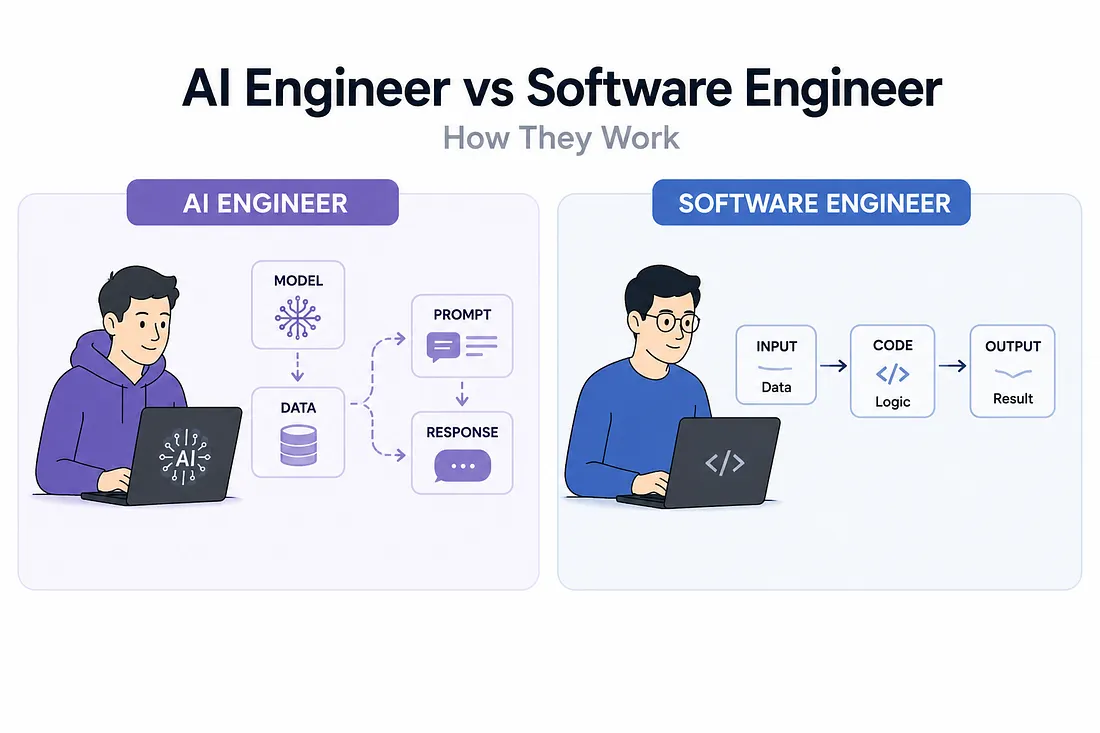
A software engineer builds deterministic systems. Put the same input in, get the same output out, every single time. Write a test, run it, and know whether it works.
An AI engineer builds probabilistic systems. The same input can produce a different output each time, depending on how the model interprets it. You can’t write a simple pass/fail test for that. You need an evaluation pipeline that checks thousands of outputs and asks, "Are these good enough to trust?"
That single difference — predictable vs unpredictable outputs — changes how you design, test, debug, and monitor everything you build.
The simplest way to put it: all AI engineers are software engineers, but not all software engineers are AI engineers. It’s a specialisation on the same foundation, not a completely different job.
What Founders and Hiring Managers Are Actually Asking
Q. What does an AI engineer actually do every day?
In 2026, the job is rarely “build a model from scratch.” It’s “make an existing model work reliably inside our product.”
Day-to-day, that looks like: building a RAG pipeline so a model can answer questions from internal documentation. Writing and testing the prompts that shape how the model behaves. Debugging why an AI agent works fine on steps one through three but breaks on step four. Building a system that catches bad outputs before they reach users.
According to LinkedIn’s 2026 data, the top skills for AI engineers are LangChain, RAG, and PyTorch. The job is about wiring models into workflows, not building the models themselves.
Q. What skills does an AI engineer have that a software engineer doesn’t?
The starting point is the same: Python, system design, APIs, and version control. The extra layer is what’s different.
AI engineers need prompt engineering, writing instructions that make a model behave consistently. They need vector databases and embedding models, which let an LLM access your data without retraining. They need evaluation frameworks because probabilistic outputs can’t be tested like functions. And they need agent architecture building systems where a model autonomously works through a multi-step task.
MLOps (model versioning, monitoring, cost control) is no longer a nice-to-have. It’s a baseline expectation.
Q. Do AI engineers replace software engineers?
No. AI products still need everything software engineering has always delivered: databases, APIs, authentication, and infrastructure. None of that changes because there’s an LLM in the product. What changes is that someone on the team needs to handle the probabilistic layer sitting on top of all that infrastructure.
The best teams right now are blended — software engineers who understand how to build around AI, and AI engineers who understand real-world production constraints.
Q. How long does it take a software engineer to become an AI engineer?
Less time than most people expect. Most AI engineers today are software engineers who have added LLM-specific skills; it’s the most common path into the role. The transition usually takes three to six months of focused learning. If someone already has strong Python and system design experience, they’re 60–70% of the way there already.
The Salary Gap Is Real and Growing
Here’s where the market sits right now:
A mid-level software engineer earns $110K–$170K. A mid-level AI engineer earns $130K–$200K. At the senior level, software engineers land between $160K–$220K, while senior AI engineers command $200K–$260K. LLM and generative AI specialists sit at $165K–$230K at mid-level, and higher from there.
AI engineers earn a 12–28% premium over software engineers at the same experience level. There are roughly 500,000 open AI roles worldwide, and only 7 in every 1,000 LinkedIn members qualify as AI engineering talent.
That gap is not closing anytime soon.
Three Things to Know Before You Hire
1. You need both roles, not a choice between them.
Treating an AI engineer and a software engineer as alternatives is the most common hiring mistake. Your backend still needs reliable infrastructure. Your AI features still need someone who knows how LLMs fail. That’s rarely the same person.
2. The best AI engineers come from software backgrounds.
Look for software engineers with documented production AI experience — a RAG pipeline they shipped, an evaluation system they built, an agent they deployed. A production mindset combined with AI skills is rare and valuable.
3. “AI experience” on a CV means very little without specifics.
Ask what broke in production and what they did about it. Ask them to walk through something they built end-to-end. Anyone can run a ChatGPT demo. Very few have shipped something that holds up under real usage.
In Simple Terms
Software engineering gives you a hammer. It does what you expect, every time.
AI engineering gives you something that can learn to swing a hammer — sometimes better than any human could, sometimes in directions you didn’t anticipate. Your job is to build the structure that keeps it useful, safe, and measurable.
Both are real engineering. The difference is that one of them is still writing its own rulebook in real time, and the engineers doing that work in production right now are exactly who the market is paying for.
TL;DR
An AI engineer is a software engineer who builds on top of AI models rather than training them — connecting LLMs to real products, handling unpredictable outputs, and making sure the whole thing doesn’t fall apart in production. The role didn’t exist three years ago; today it’s LinkedIn’s fastest-growing job title, with salaries averaging $206K and a 12–28% wage premium over engineers without AI skills. If you’re building a tech team right now, you almost certainly need both a software engineer to hold the infrastructure together and an AI engineer to manage everything sitting on top of it.
Looking to build a high-performing remote tech team?
Check out MyNextDeveloper, a platform where you can find the top 3% of software engineers who are deeply passionate about innovation. Our on-demand, dedicated, and thorough software talent solutions provide a comprehensive solution for all your software requirements.
Visit our website to explore how we can assist you in assembling your perfect team.