When our developers prepared for the Claude Developer – Foundations exam, it took them about one to two weeks, with two to three hours of study each day. That's a useful starting point, but preparation time will vary depending on your experience and the certification you're taking.
The first question is usually simple: What exactly should I study?
Anthropic has published exam guides, free preparation courses, and sample questions for all four certifications. The challenge is knowing which material to start with and how much time to give each topic.
Here's what you need to know before you begin.
Start with the exam guide, not the courses
It's tempting to jump straight into video lessons, but download your exam guide first. It tells you what's covered, which topics carry the most weight, and what Anthropic expects candidates to know.
You'll find the official guides here:
A few exam details are worth knowing early. All four exams use a scaled score from 100 to 1,000, with 720 required to pass. Questions can ask you to select one answer or several, and the required number of selections is stated in each question.
You don't have to complete a particular course before taking an exam. Anthropic also makes clear that no study resource guarantees a pass. The exam guide is your best reference for deciding what to learn.
The guides recommend different levels of experience. Developer – Foundations is aimed at people with one to five years of software engineering experience and at least six months working with Claude or similar language models. Architect – Foundations recommends six months or more of building with the Claude API, Agent SDK, Claude Code, and MCP. Architect – Professional recommends three or more years in systems architecture or platform engineering, plus six months using Claude in production.
These are recommendations, not formal entry requirements. Still, read the entire guide before booking your exam.
Which free courses should you take?
Anthropic's Partner Academy has a separate preparation path for each certification. Here's how much time to set aside.
The Associate – Foundations path has 8 lessons and runs 389 minutes, about 6.5 hours.
The Developer – Foundations path has 5 modules and runs 774 minutes, about 12.9 hours.
The Architect – Foundations path has 7 courses, and Anthropic doesn't state how long they take.
The Architect – Professional path has 5 modules and runs 733 minutes, about 12.2 hours.
The Associate course covers prompting, checking Claude's answers, integrating workflows, managing knowledge, responsible use, and troubleshooting. Its eight lessons take 389 minutes altogether.
For developers, the five modules cover model fundamentals, prompting, agents, tool use, Claude Code, MCP, production engineering, security, and testing. Note that the Developer – Foundations exam itself covers 8 domains, while the preparation path is organised into 5 modules. The longest modules are Production-Grade Prompting, Agents & Tool Use (209 minutes) and Production Engineering, Evals & Security (211 minutes).
The Architect – Foundations path includes seven courses: AI Fluency: Framework & Foundations; Building with the Claude API; Claude on Google Cloud; Claude Code in Action; Claude 101; Claude with Amazon Bedrock; and Introduction to Model Context Protocol. Anthropic doesn't publish a total duration for these courses.
Architect – Professional covers solution design, enterprise integration, production systems, responsible AI, stakeholder communication, and team productivity. Its five modules take 733 minutes in total.
These timings cover the courses themselves. You'll need additional time to practise and revisit topics you find difficult.
Pay attention to the marks
Once you've reviewed the guide, look at the exam weightings. They help you decide where your study time will make the biggest difference.
Developer – Foundations (53 questions)
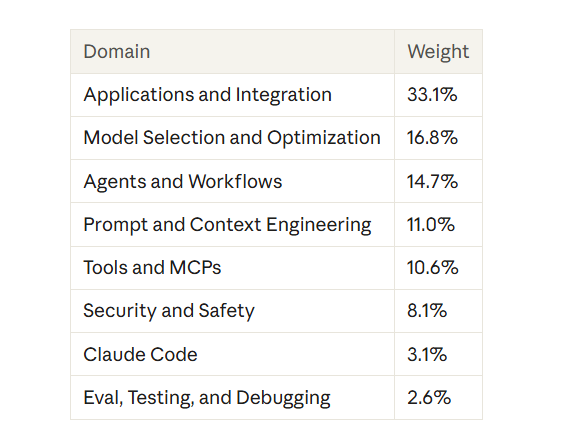
Applications and Integration account for roughly one-third of this exam. Its largest subtopics are Claude Application Design (8.6%), Software Engineering Foundations (7.4%), and Claude API Mechanics (6.8%). Give these areas particular attention rather than spending most of your time on Claude Code, which accounts for just 3.1%.
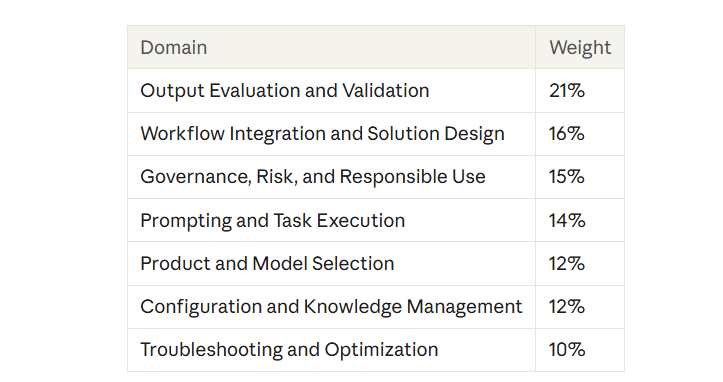
Associate – Foundations (60 questions)
Architect – Foundations (60 questions)
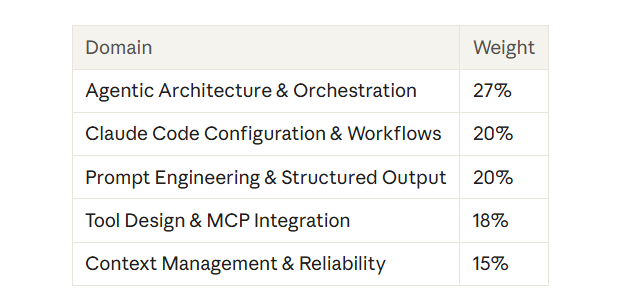
This exam uses scenarios to test your understanding. Four scenarios are selected from a bank of six, with questions based on each one. You won’t know which scenarios you’ll get, so make sure to cover all five exam domains in your preparation.
Architect – Professional (63 questions)
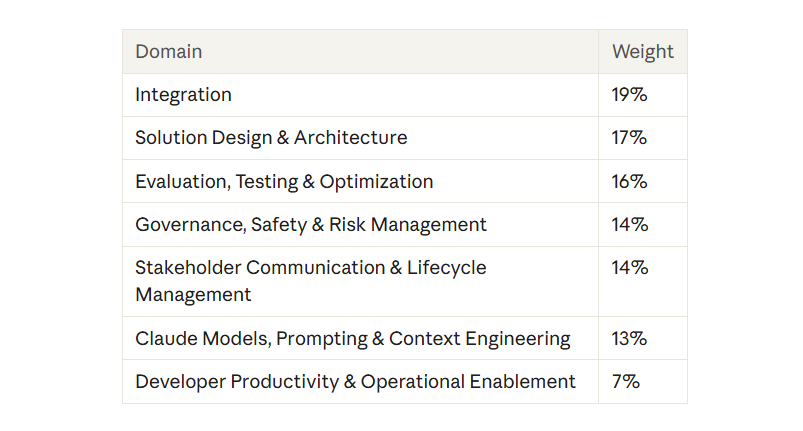
Use these percentages to set your priorities, but don't ignore the smaller topics entirely.
Before You Get Started
Are the courses free?
Yes. The preparation courses are free; you pay the exam fee when you register.
Do I have to finish the courses before booking?
No. There are no mandatory courses or prerequisites.
What should I know for Developer – Foundations?
The typical candidate is comfortable with Python and/or TypeScript, REST APIs, and command-line tools. Familiarity with language model fundamentals, agents, context management, and MCP is also recommended.
Choose the Path That Fits Your Work
Read your exam guide, work through the relevant courses, and use the weightings to plan your time. Don’t assume that finishing every lesson means you’re ready; you’ll also need to test how well you have retained the material.
In Part 4, we'll look at practice tests, a two-week study plan, and the mistakes candidates should avoid.
TL;DR
Preparing for a Claude certification doesn't have to take months or cost a fortune. Anthropic offers free exam guides and preparation courses for all four certifications. Start with your exam guide, check which topics carry the most marks, and plan your study time accordingly. Our developers prepared for the Developer – Foundations exam in one to two weeks, studying for two to three hours a day.
Use that as a reference, not a deadline, and remember that finishing the courses is only part of the preparation.
Looking to build a high-performing remote tech team?
Check out MyNextDeveloper, a platform where you can find the top 3% of software engineers who are deeply passionate about innovation. Our on-demand, dedicated, and thorough software talent solutions provide a comprehensive solution for all your software requirements.
Visit our website to explore how we can assist you in assembling your perfect team.