A few months ago, most of our tech team hadn’t even heard of Claude certifications. Then Anthropic launched its formal certification program, and we decided to give it a shot.
For us, it wasn’t just about adding another certificate to someone’s profile. We wanted our developers to build stronger AI skills and, at the same time, strengthen MND's position as a partner in Anthropic's ecosystem.
Three of our developers - Ashwin Nair, Pranav Ubarhande, and Tashwini Prakasha - have now passed their exams, and we also spoke to them about what the process was actually like.
This is the first post in our 6-part series on Claude certification. We’ll cover everything from choosing the right certification and registering for the exam to preparing, exam day, scoring, and how difficult the exams really are.
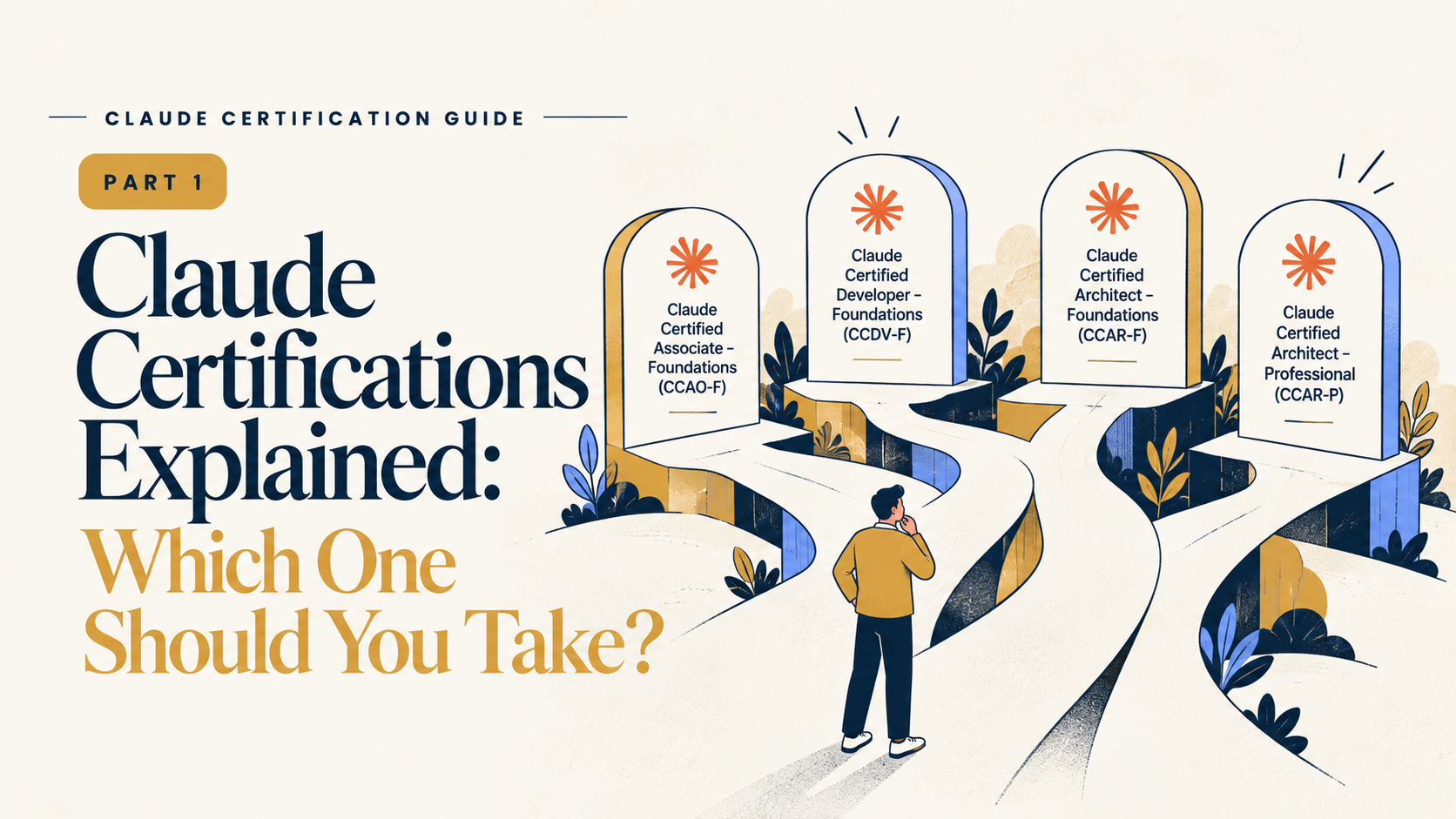
If you’re a developer, consultant, or architect wondering whether Claude certification is worth your time, the first question is simple: Which certification should you take?
A Quick Guide to the Four Claude Certifications
Anthropic currently offers four role-based certifications. The exams are administered through Pearson VUE and are proctored and identity-verified.
All four exams are 120 minutes long, use a scaled score out of 1,000, and you need a score of 720 to pass.
The main difference is what each certification is designed to test.
1. Claude Certified Associate – Foundations (CCAO-F)
This is the entry-level certification. It’s aimed at consultants, business users, and other professionals who work with Claude but don’t necessarily build software with it.
The exam uses around 60 multiple-choice and multiple-response questions, and no coding experience is required.
In simple terms, this certification asks: Can you use Claude effectively and responsibly in your day-to-day work?
2. Claude Certified Developer – Foundations (CCDV-F)
This one is designed for engineers building with Claude. It focuses on things like the Claude API, tools, applications, integrations, and agents. The exam has roughly 53 multiple-choice questions across eight domains.
Anthropic recommends roughly 1–5 years of software engineering experience, along with hands-on experience using Claude.
If you’re already writing code with Claude or Claude Code, this is probably the certification that will feel most connected to your daily work.
3. Claude Certified Architect – Foundations (CCAR-F)
This certification is for people designing systems around Claude, particularly agent-based systems.
Instead of simply asking you to remember facts, the exam uses realistic scenarios. You’re essentially being asked to make the kind of decisions you would make when designing a real production system. It has around 60 questions across five domains and generally assumes some hands-on production experience.
4. Claude Certified Architect – Professional (CCAR-P)
This is the most advanced certification in the current lineup. It focuses on enterprise-scale Claude deployments, including architecture, integration, governance, and evaluation.
The exam has roughly 60 questions across seven domains, and Anthropic recommends at least three years of systems architecture experience along with Claude production experience.
A simple way to remember the four levels:
Associate: I use Claude well.
Developer: I build with Claude.
Architect Foundations: I design Claude-based systems.
Architect Professional: I work with Claude at enterprise scale.
The exact question counts and domain weightings are based on independent exam-guide breakdowns. Anthropic confirms the exam format and passing score but does not publicly list every granular detail, so treat these numbers as approximate.
Finding the Right Claude Certification for Your Role
The easiest way to choose is to look at what you actually do.
If you’re a consultant, PM, or business professional working with Claude:
Go with Associate – Foundations: No coding is required, and the listed exam fee is $99.If you’re an engineer building with the Claude API or Claude Code:
Look at Developer – Foundations: Coding is expected, and the listed fee is $125.If you’re designing agent systems:
Architect – Foundations is the relevant track. The listed fee is $125.If you’re working on enterprise-scale Claude deployments:
Architect – Professional is the advanced option, with a listed fee of $175.
These are Anthropic’s listed exam fees at the time of writing, so check the official registration page before paying since prices can change.
One other thing to know: Registration goes through the Anthropic Partner Academy and requires a Skilljar account. In practice, the process is most straightforward if your organization is part of the Claude Partner Network. If you’re doing this through your company, it’s worth checking with whoever manages your organization’s Anthropic partnership before registering.
So, How Do You Pick the Right One?
In reality, most people don’t spend too much time debating between the four.
Engineers who work with the Claude API or Claude Code tend to choose Developer – Foundations.
People designing agent systems generally look toward Architect Foundations.
Organizations may also certify people based on their current roles and let them move to a higher level once they have more production experience.
That’s more or less what happened at MND. Our developers were already working with the Claude API every day, so Developer – Foundations was the natural fit. The certification matched the work they were already doing, and that’s probably the best way to think about your own choice too.
Don’t choose a certification simply because it sounds more advanced. Choose the one that matches the work you’re actually doing.
You can always move up later as your experience grows.
Common Questions About Claude Certification
Do I need to know how to code?
Not necessarily. Associate – Foundations is designed for business and non-technical roles. Developer and Architect certifications require more hands-on technical experience.Can I go straight to Architect Professional?
It’s designed as an advanced certification and generally assumes foundation-level knowledge and production experience.Do I need to work for an Anthropic partner?
Registration runs through the Anthropic Partner Academy and Skilljar. The process is most straightforward for organizations in the Claude Partner Network.How much does it cost?
The listed prices are $99 for Associate, $125 for Developer, $125 for Architect Foundations, and $175 for Architect Professional. Always confirm the current price before registering.How long is the certification valid?
Credentials are valid for 12 months. Renewing on time involves a free, non-proctored refresher assessment. If the credential expires, you’ll need to take the full proctored exam again.
So, Where Does That Leave You?
Choosing a Claude certification doesn’t have to be complicated. Think about what you already do with Claude.
If you use Claude in your everyday workflow, Associate may make sense.
If you’re building with the API, Developer is the natural path.
If you’re designing agent systems or working on enterprise deployments, look at the Architect certifications.
For us at MND, getting our engineering team Claude Certified was part of building a team that doesn’t just talk about AI, but actually works with it every day.
And that’s really what the certification is about: showing that you know how to use Claude in practice, not just that you’ve heard of it.
Next up: Part 2 - How to Register for the Exam, where we’ll walk through the Partner Network requirement, Skilljar registration, scheduling the proctored exam, and what happens if you don’t pass the first time.
Looking to build a high-performing remote tech team?
Check out MyNextDeveloper, a platform where you can find the top 3% of software engineers who are deeply passionate about innovation. Our on-demand, dedicated, and thorough software talent solutions provide a comprehensive solution for all your software requirements.
Visit our website to explore how we can assist you in assembling your perfect team.