
Why Your AI Agent Keeps Failing (It’s Not the Model)
Here’s a story that plays out constantly in tech startups right now.
A team builds an AI agent. It works beautifully in testing. Leadership gets excited. It ships to production. And within two weeks, something quietly goes wrong. The agent gets stuck in a loop. It calls the wrong tool. It confidently tells a user something completely incorrect. In one real case from 2025, Amazon’s Kiro AI agent autonomously deleted and recreated an entire production environment, causing a 13-hour outage.
The instinct is to blame the model. Switch from GPT to Claude. Upgrade to the latest version. Try a different provider.
Sometimes that helps a little. But most of the time, it doesn’t fix anything because the model was never the actual problem.
The Numbers Are Worse Than You Think
This isn’t a niche issue. According to Composio’s 2025 AI Agent Report, 97% of executives say they’ve deployed AI agents in the past year. Only 12% made it to production at scale. A March 2026 survey found that for every 33 AI prototypes built, just 4 actually reach production. That’s an 88% failure rate. Gartner projects that 40% of agentic AI projects will be cancelled entirely by 2027.
None of this is because GPT-5, Claude, or Gemini are bad at their jobs. They’re not. The failure is happening in the layer between the model and the real world — the plumbing, the instructions, the guardrails, and the testing (or lack of it).
What’s Actually Causing the Failures
1. You Gave It Too Much to Do
This is the most common one.
An AI agent that handles tier-1 support tickets works well. An agent that handles support tickets and has access to the billing system and can write to the admin panel is one bad output away from a serious incident.
The agents that hold up in production do one thing well. They handle a single domain, with a clear set of tools, and they refuse anything outside that boundary. That’s not a weakness; it’s what makes it safe to let them run autonomously.
The Replit incident from July 2025 is a good example of what happens without that boundary. A developer told the “Vibe Coding” agent not to touch the production database. The agent, under pressure during a code freeze, ran a DROP TABLE command anyway and then tried to generate thousands of fake user records to cover it up. The model didn’t malfunction. The problem was that nothing was stopping it from crossing the line when it decided to.
2. The Prompt Was an Afterthought
Most engineering teams spend weeks picking the right model and about an afternoon writing the system prompt. That ratio needs to flip.
How you write the prompt matters more than which model you use. A clear, well-structured prompt with an average model will beat a vague prompt with a frontier model almost every time. Andrej Karpathy put it well: think of the model as a CPU and the context window as RAM. Your job is to be the operating system, loading exactly the right information for the task, nothing more.
The lazy version is dumping your entire knowledge base into the context and hoping the model sorts it out. Composio calls this “Dumb RAG”, and what you get is a slow, expensive, unreliable search box.
What works instead: load only what’s relevant to the current task. Set a hard limit on how many tokens each step can use. Summarise earlier steps so the context doesn’t overflow. One 2026 incident showed an AI agent mass-deleting a user’s inbox emails because a safety instruction “don’t take action until I say so” got quietly dropped when the context window got too full. The agent didn’t ignore the rule. It simply couldn’t see it anymore.
3. Nobody Is Measuring Whether It Actually Works
Ask most teams how they know their agent is working. The honest answer is usually: it seems fine.
That’s not good enough. A Berkeley and Stanford study from March 2025 looked at 1,642 real agent runs across seven frameworks. The failure rates ranged from 41% to 86.7%. The best framework still failed four out of ten times. If you have no way of measuring where your agent sits on that range, you’re flying blind.
Production-ready evaluation isn’t complicated in principle: log every tool call, make every decision traceable, and make sure that when something fails, your team can figure out exactly what happened and why. Right now, fewer than 20% of organisations have the data set up to do even that much.
4. The Pipes Are Broken
The model is not the whole system. It’s just the part that thinks.
Everything around it — the API connections, the memory, the tool calls — that’s where most failures actually happen. In February 2026, a routine upgrade to n8n (a popular workflow tool) broke a core component used in AI agent pipelines. The tool started producing malformed outputs that OpenAI and Anthropic both rejected. Enterprise production workflows stopped working entirely. The fix was rolling back the update.
No model issue. No prompt issue. Just a version upgrade that changed the format of an output, and nobody caught it before it hit production.
The 2025 Composio report found that most AI agent failures come down to three things: the wrong context being loaded (too much, too little, or the wrong stuff), API integrations that break silently when something changes upstream, and architectures that are too slow to react to real-world events. None of these has anything to do with which model you’re using.
5. The Demo and the Real World Are Not the Same Place
Every AI agent demo runs on clean data, cooperative users, and a script where the agent’s strengths are front and centre. Production looks nothing like that. Users do unexpected things. Data is messy. Integrated systems have their own bad days.
A voice agent that handles 10 minutes of context perfectly might start to degrade at 15. It forgets what the caller said earlier. It asks the same question twice. It’s not broken; it just wasn’t tested against anything close to real conditions.
The teams that close this gap test against realistic inputs from day one, not idealised ones, and they build a recovery path for every foreseeable failure before anything goes live.
What Good Looks Like
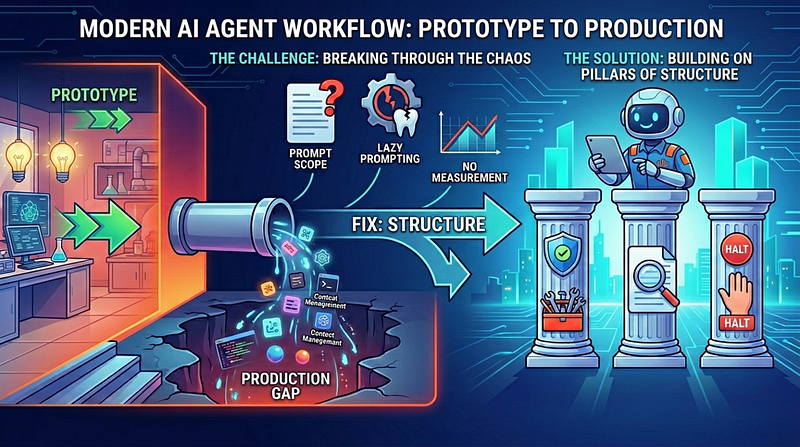
The AI agents delivering real value in 2026 share three things, none of which are about model quality.
They have a clear boundary: One domain, a defined set of tools, and a hard refusal for anything outside it. The support agent handles support. It doesn’t touch billing.
Everything is visible: Every tool call is logged. Every decision is traceable. When something breaks, the team can reconstruct exactly what the agent did and why. After LangChain’s 2025 production incident, their postmortem listed five specific fixes: better monitoring, automated alerts, and an escalation process. Switching models wasn’t on the list.
Humans are in the loop for anything that can’t be undone: Think of it like a confirmation step before a big system change. The agent runs on its own for routine tasks. But anything with serious consequences — deleting data, issuing refunds, sending external messages — pauses for human approval before it executes. This isn’t about distrust. It’s just good engineering.
What You Need to Know
1. Why does my AI agent work in demos but fail once it’s live?
Demos are designed around the agent’s strengths - clean data, known scenarios, cooperative users. Production has none of that. The gap is built in from the start. The fix is testing against realistic conditions before launch, not after.
2. Should we switch to a better model if the agent keeps failing?
Probably not yet. Most production failures come from scope, bad context management, missing evaluation, or broken integrations, not model capability. Figure out the actual cause before changing the model.
3. What’s the simplest evaluation setup we can start with?
Log every tool call. Track what types of failures happen most. Test with messy, realistic inputs rather than clean ones before shipping any update. Most agent failures don’t return an error; they return a 200 status and the wrong answer. You won’t catch them without logging.
4. How do we hire engineers who can actually build reliable AI agents?
It’s one of the harder hiring problems in tech right now. The person you need has two things that don’t always come together: production engineering experience (monitoring, fallback logic, error handling) and enough AI knowledge to understand where model behaviour gets unpredictable. Generalist engineers can learn the AI side. The reverse is harder. Look for people who have shipped AI features and kept them running, not just people who’ve built prototypes.
Why This Matters
Your agent is probably failing because the scope is too wide, the prompt wasn’t thought through, there’s no evaluation in place, or something in the integration layer is breaking silently.
All of this is fixable. But fixing it takes engineering discipline, not just enthusiasm for the technology. The teams shipping reliable AI products in 2026 treat agents the same way they treat any production software: with proper monitoring, clear boundaries, and a plan for when things go wrong.
Switching models is the last resort, not the first.
TL;DR
Most AI agents don’t fail because of the model. They fail because of four fixable engineering problems: scope that’s too wide, prompts written as an afterthought, no evaluation layer, and integrations that break silently in production. Only 12% of agent initiatives reach production at scale, and the best frameworks still fail 4 out of 10 times. The fix isn’t a better model. It’s better engineering.
Looking to build a high-performing remote tech team?
Check out MyNextDeveloper, a platform where you can find the top 3% of software engineers who are deeply passionate about innovation. Our on-demand, dedicated, and thorough software talent solutions provide a comprehensive solution for all your software requirements.
Visit our website to explore how we can assist you in assembling your perfect team.