Should Your Startup Build Its Own AI or Use an Existing Model?
Every founder building a tech product hits this question eventually. Do we build our own AI model, or use one that already exists?
It sounds straightforward. It isn’t. Build when you should have used an API, and you’ve burned months of engineering time on something available off the shelf. Use an API when you should have built, and two years later you’re staring at a $40,000 monthly bill, no ability to customise anything, and one pricing change away from broken unit economics.
Here’s how to actually think through it.
“Build Your Own AI” Means Three Very Different Things
This is where most conversations go wrong. People say “build our own AI” and mean completely different things.
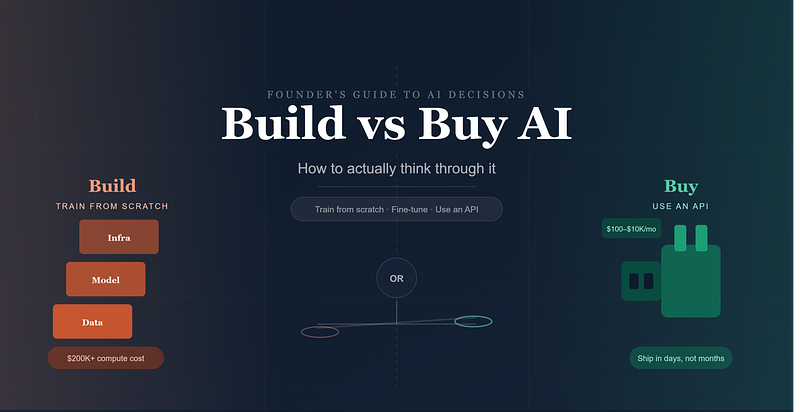
- Training from scratch means starting with raw data and building a new model from the ground up. We’re talking $200,000+ in compute costs alone before the engineering team, the data infrastructure, and the months before anything is usable. This is what OpenAI and Anthropic do with hundreds of millions of dollars. Almost no startup should be doing this.
- Fine-tuning an open-source model means taking a free model like Meta’s Llama, Mistral, or Qwen and training it further on your own data. Cost: $20,000–$80,000 depending on data size and compute. More accessible than most people think, and genuinely useful in the right situations.
- Using an API means connecting to OpenAI, Anthropic, or Google’s models and paying per use. Cost: $100–$10,000 per month depending on volume. This is where most startups start, and where many sensibly stay.
Most “build vs buy” debates are really about fine-tuning and API use. Knowing which one you’re actually choosing between is the first step.
Why Most Startups Should Start With an API
The biggest advantage is speed. You can have a working AI product running in days. The model is already trained, already capable, and handles most tasks well. No servers to manage, no ML engineers needed before you ship.
The performance gap between paid APIs and free open-source models has also narrowed significantly. Research from Epoch AI shows open-weight models now trail the best proprietary models by roughly three months in capability release timing. For most product tasks, such as summarising documents, classifying inputs, and writing code, the quality difference is marginal.
The ROI gap is harder to ignore. Companies using managed AI platforms typically see results within 1–6 months. Companies that build custom typically wait 12–24 months. When you’re early and every month matters, that gap is significant.
The downsides are real, though. OpenAI, Anthropic, and Google have all changed their pricing more than once. A startup that built its product around GPT-4’s 2023 pricing found itself in a very different financial position by 2025. And because you don’t control the model, its behaviour can shift between versions in ways that are hard to catch and harder to fix.
When Building Your Own Actually Makes Sense
- The cost maths changes at scale: API pricing is fine at low volume. But the same chatbot processing 15 million tokens per month could cost anywhere from $10 to $236 depending on the provider, and that compounds as usage grows. Past a certain point (roughly $3,000–$5,000 per month in API costs), it’s worth calculating whether running your own model would be cheaper over 12 months.
- Some industries can’t send data to third parties: Healthcare, fintech, and legal often have hard compliance requirements that make external APIs a non-starter. Fine-tuning on your own infrastructure keeps everything in-house.
- General-purpose models are exactly that general: Every startup using GPT-5 is using the same model. Fine-tuning lets you train yours on your specific domain and logic. There’s also a production problem informally called “instruction drift” — where a model gradually stops following long system prompts reliably over time. Fine-tuning bakes the behaviour into the model itself instead.
- Open-source is more serious than people think: Hugging Face now hosts over one million models. Fine-tuning has moved out of research labs and into product teams. The barrier is lower than it was two years ago.
What Most Mature Teams Actually Do
Most teams that’ve been at this for a while don’t pick one or the other. They route between the two.
Use a frontier API for complex, low-volume tasks, reasoning, synthesis, and edge cases where quality matters most. Route high-volume, repetitive tasks to a fine-tuned open-source model on your own infrastructure.
One SaaS analytics startup that ran everything through OpenAI’s API found costs spiralling by early 2025. They moved high-volume summarisation to a fine-tuned Llama model, kept GPT for complex queries, and cut their monthly AI spend significantly with no drop in product quality.
Let’s Dig Deeper
1. Should a pre-product-market-fit startup ever build its own AI?
Rarely. Your priority is validation speed. The engineering time you’d spend fine-tuning a model is almost always better spent on product. Start with an API. Revisit when you have real volume, real data, and a clear sense of where your actual differentiation lies.
2. When does building start making financial sense?
Usually around $3,000–$5,000 per month in API costs. That’s when it’s worth doing the 12-month maths on whether a self-hosted fine-tuned model would be cheaper, factoring in engineering time, GPU costs, and maintenance.
3. How do we hire engineers who can make and execute this decision?
It’s genuinely difficult. You need someone with production engineering experience and enough ML knowledge to evaluate model options, two skill sets that don’t always come together. Look for people who’ve shipped AI features in real products and maintained them, not just run experiments in notebooks.
The Decision Framework
Start with an API if you’re early-stage, still figuring out your product, and need to move fast. Think about fine-tuning or self-hosting when your API bill hits $3,000–$5,000 a month, when compliance rules out third-party APIs, or when a general-purpose model genuinely can’t do what you need. Almost no startup should be training from scratch.
The real question isn’t “build or buy.” It’s “what do we need to own, and what can we rent?”
TL;DR
Don’t build your own AI model unless you have a very specific reason to. For most startups, the smartest move is to start with an existing API - it’s fast, affordable at low volume, and lets you focus on your product. Once your API bill starts climbing past $3,000–$5,000 a month, or your industry has strict data rules, it’s worth thinking about running your own. Most teams that get this right end up doing both an API for the complex stuff and their own model for the high-volume repetitive work. Almost nobody should be training a model from scratch.
Looking to build a high-performing remote tech team?
Check out MyNextDeveloper, a platform where you can find the top 3% of software engineers who are deeply passionate about innovation. Our on-demand, dedicated, and thorough software talent solutions provide a comprehensive solution for all your software requirements.
Visit our website to explore how we can assist you in assembling your perfect team.