
What Is Model Collapse and Why It’s a Problem for AI
There’s a strange loop happening right now on the internet.
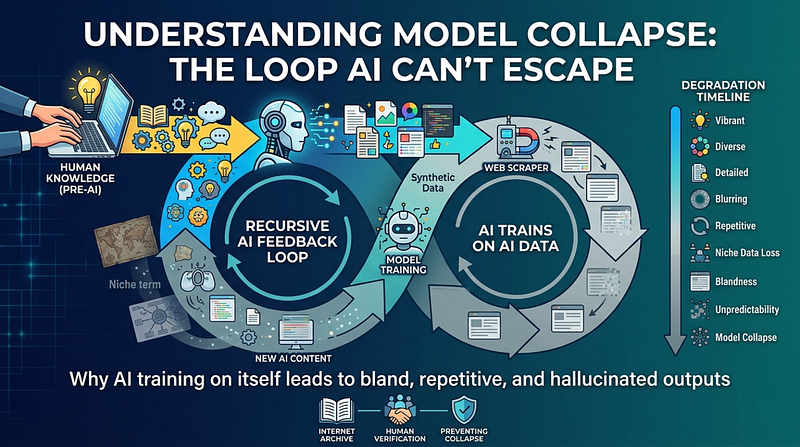
AI tools generate content. That content gets published online. Web scrapers collect it. AI models train on it. Those models generate more content. The scrapers collect it again.
Each cycle, something gets a little worse. Outputs become blander. Niche knowledge starts disappearing. The model’s understanding of the world quietly narrows.
This is model collapse, and it’s not a future risk; it’s already happening.
So What Exactly Is Model Collapse?
Model collapse is what happens when an AI model keeps training on content that was itself created by AI.
The term came from a 2023 research paper called “The Curse of Recursion” by researchers including Ilia Shumailov at Google DeepMind. Their work, later published in Nature, showed a clear pattern: when AI models train on AI-generated data repeatedly, they degrade. The model’s worldview narrows. Rare or unusual information disappears first. Responses drift toward safe, averaged-out answers. Eventually, given enough cycles, the outputs stop making sense entirely.
Think of a photocopier making copies of copies. The first one looks fine. By the tenth generation, details are blurry, and something essential has been lost. In AI, that something essential is diversity, the full range of human knowledge, edge cases, nuanced viewpoints. Once those start dropping out of the training data, they drop out of the model’s answers too.
Why Is This Happening Now?
Because the internet is filling with AI-generated content far faster than most people realise.
Ahrefs analysed nearly a million newly published web pages in April 2025 and found 74.2% contained detectable AI-generated content. A separate study of 65,000 articles found that AI-written pieces briefly outnumbered human-written ones in late 2024. Europol has estimated that up to 90% of online content could be synthetically generated by 2026.
At the same time, the supply of high-quality human-written text for training is running thin. AI labs have already scraped most of the usable public internet. The next generation of models will inevitably train on more synthetic content — not by choice, but because that’s increasingly what the web is made of.
The result is a feedback loop: AI trains on AI-generated data, which was trained on earlier AI-generated data, each round compressing and flattening what came before it.
What Does It Actually Look Like?
The signs are not dramatic. That’s part of what makes it hard to spot.
In July 2025, a Reddit user noticed something odd: dozens of blog posts about quantum computing had appeared across different websites, all citing the same journal article, one that didn’t exist. The posts were well-written and confident. Most were AI-generated. They hadn’t copied each other. They’d independently hallucinated the same fake citation because they’d all drawn from the same thinned-out data pool.
That’s model collapse in the wild. It doesn’t show up as broken English or obvious errors. It shows up as repetition, false confidence, and the quiet erosion of depth.
Research describes the process in two stages. First, rare and niche information starts disappearing, the long tail of knowledge that doesn’t appear in most documents. Then, more broadly, outputs lose coherence. A 2025 Apple study found that large reasoning models hit what the study called “complete accuracy collapse” on complex tasks after recursive training. The troubling part: the failure didn’t show up in standard benchmark tests because those benchmarks themselves contained AI-generated content.
Why Should Startups and Builders Care?
Because the tools you’re building with are downstream of this problem.
If the AI models powering your product were trained on degraded, looping synthetic data, that shows up in your outputs. In a coding tool, it means confidently wrong suggestions on edge cases. In a chatbot, it means polished answers that are subtly wrong. In a data tool, it means outputs that look fine but miss the unusual patterns that actually matter.
There’s also a specific risk for teams generating content at scale: blog posts, product descriptions, support responses. If that content gets indexed and scraped back into future training datasets, your outputs become part of the loop. You’re not just consuming synthetic data. You’re feeding it back in.
The other issue is benchmarking. A model going through collapse can still pass standard performance tests while quietly degrading in the real world, because the tests themselves may contain AI-generated content. Published accuracy scores won’t always catch it.
Is It Inevitable?
No, but avoiding it takes deliberate effort.
A 2024 study called “Is Model Collapse Inevitable?” found a clear answer: collapse happens when synthetic data replaces real data each training round. When synthetic data is added alongside the original human-generated data instead of substituting it, models stay stable. The key is never letting real data get crowded out of the mix.
A few things that actually help:
- Keep human-generated data in the mix: Research institutions and organisations like the Internet Archive are actively preserving pre-AI web content for this reason. Some companies are building proprietary human-written data pipelines through publisher partnerships.
- Track where your data comes from: Data provenance — knowing what’s human-written versus AI-generated — is becoming a serious part of responsible AI development, not a nice-to-have.
- Use human feedback during training: Integrating human review into fine-tuning helps realign models with real-world knowledge and catches the edge cases that synthetic data quietly erases.
- Filter before you train: Not all synthetic data causes the same damage. Content generated with quality controls degrades models far less than bulk, unfiltered output. The problem is undiscriminating scale, not synthetic data itself.
Let’s Address the Questions
1. Does model collapse affect the AI tools I use today?
Possibly at the margins. The most recent frontier models were largely trained before the synthetic content explosion and actively filter for it. But as training datasets get updated with more recent web data, the risk grows, especially for smaller or fine-tuned models that draw heavily from recent scrapes.
2. Is model collapse the same as hallucination?
Related, but different. Hallucination is when a model produces confidently wrong outputs, something any model can do. Model collapse is a structural, generational problem caused by recursive training on synthetic data. Collapse tends to make hallucinations worse and harder to detect over time.
3. What can startups building AI products do about it?
Don’t use AI-generated content as fine-tuning data without quality filtering. Keep a human-reviewed dataset for any domain-specific training. Test performance against realistic edge cases, not clean benchmarks. And ask the foundation model providers you build on what their training data filtering practices actually look like.
The Short Version
Model collapse is the long-term cost of a short-term convenience. Generating AI content at scale is easy. Maintaining the diversity and depth of human knowledge that models were built on is much harder.
For anyone building with AI, the practical takeaway is simple: the quality of what you ship is only as good as the data going into the models underneath it. Training data is infrastructure. It deserves to be treated as such.
TL;DR
AI models are trained on internet data. The internet is now increasingly full of AI-generated content. So newer models are trained on AI outputs, which were trained on earlier AI outputs, and each round, the quality quietly degrades. Rare knowledge disappears first. Answers become blander and less reliable. This is model collapse, and it’s already showing up in the wild. The fix isn’t complicated: keep real human data in the training mix, don’t let synthetic content crowd it out, and treat data quality like the infrastructure it actually is.
Looking to build a high-performing remote tech team?
Check out MyNextDeveloper, a platform where you can find the top 3% of software engineers who are deeply passionate about innovation. Our on-demand, dedicated, and thorough software talent solutions provide a comprehensive solution for all your software requirements.
Visit our website to explore how we can assist you in assembling your perfect team.