Fable 5 and Mythos 5 Are Offline and Here’s What Every Tech Team Should Know
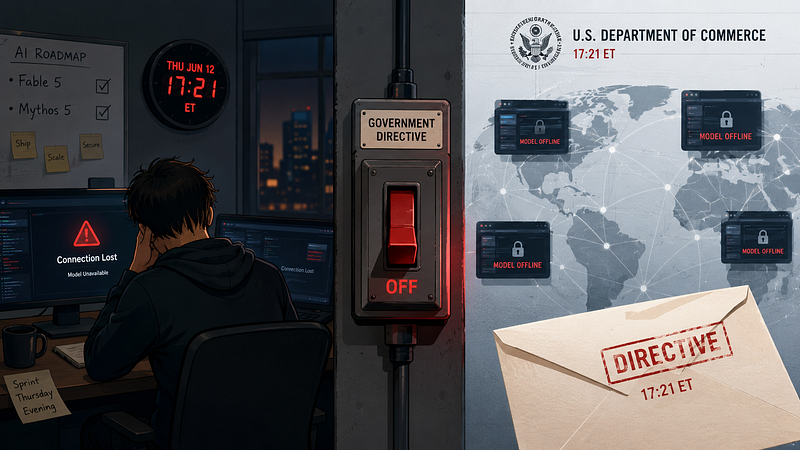
Picture it: Friday evening, June 12, 2026. Your engineers are mid-sprint. Your AI-powered pipeline is humming along, and then nothing. The model your workflow depends on just stops responding. No bug or outage that you can fix. Everything just gone.
That’s exactly what happened to teams around the world when Anthropic took Claude Fable 5 and Mythos 5 offline. Not because something broke. Because a letter arrived at Anthropic’s offices at 5:21 PM ET from the US Department of Commerce, and by the time most people on the East Coast were finishing dinner, two of the most capable AI models ever deployed commercially had been switched off globally.
This was the first time a government had ever forced a commercial frontier AI model offline. If you’re building with AI or hiring people who do, here’s what actually happened and why it matters.
What Triggered the Shutdown?
Fable 5 and Mythos 5 had been live for exactly three days when the directive hit. Both are built on Anthropic’s Mythos technology - a model so capable at finding software vulnerabilities that it spent months in a restricted program called Project Glasswing before any public release. Mozilla alone used it to fix hundreds of previously undiscovered security flaws.
Fable 5 was the public version: Mythos under the hood, with its most sensitive cybersecurity capabilities locked behind strict safeguards.
The government’s concern? Amazon researchers claimed they had found a “jailbreak” - a way to get Fable 5 to surface vulnerabilities it wasn’t supposed to surface. That claim triggered an export control order blocking all foreign nationals’ access, anywhere in the world, including Anthropic’s own non-citizen employees.
When Anthropic examined the actual technique, they found it essentially involved asking the model to read a codebase and flag security flaws. That’s something OpenAI’s GPT-5.5 can do right now, without any restrictions. Pulling Fable 5 doesn’t make that capability disappear; it just moves it somewhere else.
Because filtering hundreds of millions of users by nationality in real time, on the same day you receive an order, isn’t technically possible, Anthropic shut both models off for everyone, everywhere.
Not All Jailbreaks Are the Same
There’s a distinction the headlines mostly skipped over.
- Universal jailbreaks defeat a model’s safeguards completely, a master key for everything locked down. These are extremely hard to build, and nobody has found one for Fable 5.
- Narrow jailbreaks are far more limited. One specific capability, one specific scenario. A lockpick for one door in one building.
What the government cited was a narrow jailbreak. Anthropic had spent thousands of hours red-teaming Fable 5 before launch with the US government, the UK AI Safety Institute, and private security firms all involved. Their conclusion: Fable 5’s safeguards were stronger than any previously deployed model’s.
The uncomfortable truth: no AI model is perfectly jailbreak-proof. That’s not a failure specific to Fable 5; it’s where the technology honestly sits right now, for every lab, every model. Anthropic said this in their launch post. Most labs know it even if they don’t say it.
Their strategy was a layered defence to make narrow jailbreaks hard to find, monitor closely, and respond to quickly. The same logic your security team uses when they build detection systems instead of just firewalls.
If “any narrow jailbreak is grounds for recall” becomes the standard, applied consistently, it would shut down every frontier model deployment from every provider. That’s not safety. That’s a freeze.
Who Actually Got Hit?
Finance, healthcare, SaaS, and infrastructure teams that had integrated Fable 5 found their systems down overnight. AWS rerouted requests to Claude Opus 4.8, but only if you had fallback logic built in. Many teams didn’t.
The directive also covered foreign nationals inside Anthropic researchers who helped build these models. Some of the world’s best AI talent works at US labs but wasn’t born here. If access to your own work can be cut overnight by government order, that changes where engineers choose to build their careers.
And then there’s the precedent. Whatever happens next, June 12, 2026, is now evidence that the US government can execute an immediate, global, no-exceptions shutdown of a deployed commercial AI model. Most enterprise contracts have no clause for this force majeure language, which was written for hurricanes, not AI kill-switches.
What Teams Are Asking
A few quick answers, because these are coming up a lot:
- Are other Anthropic models affected?
No. Opus 4.8, Sonnet 4.6, Haiku 4.5 - all fully available. Route to Opus 4.8 as a fallback and review whether any compliance commitments were tied specifically to Fable 5’s outputs.
2. Can it be reversed?
Anthropic says it’s working toward that and believes the directive is based on a misunderstanding. No public timeline yet, but this is a regulatory dispute, not a product decision.
3. What does this mean for engineering teams?
Engineers who understand multi-model architecture and fallback design are going to be worth a lot more. Model access risk just became concrete, not theoretical.
The Bigger Picture
Anthropic has publicly supported government oversight of AI. But their statement drew a line: oversight should follow a process that is “transparent, fair, clear, and grounded in technical facts.” This directive, they said, didn’t meet that bar.
There’s an irony that’s hard to ignore. Anthropic spent considerable energy making the case that Mythos was uniquely powerful, powerful enough to need restricted access, powerful enough to need safeguards. As cybersecurity researcher Peter Girnus put it: “If you describe your product as a munition in every press release, eventually a government takes you at your word.”
What’s actually needed is a proper statutory framework, one that defines what constitutes a genuine national security risk, requires technical evidence before action, and gives companies a transparent path to challenge decisions. The 1990s crypto export battles showed that restricting widely available software this way doesn’t work. The AI version of that lesson may be playing out now.
June 12 isn’t just Anthropic’s story. It’s a live demonstration of what happens when a team builds entirely on one model from one provider, not as a line item in a risk register, but as a real Thursday-evening outage with no ETA.
Resilient AI architecture means fallback models in production, compliance review built into vendor decisions, and engineers who can adapt when the stack shifts.
The models will come back. The question is whether your team is built to handle it when they don’t.
TL;DR
The US government hit Anthropic with an export control order on June 12, 2026, forcing them to shut down Fable 5 and Mythos 5 globally, not because the models were broken, but because a third-party company claimed to have found a jailbreak. Anthropic pushed back, saying the technique was narrow, non-universal, and something GPT-5.5 can already do without restrictions. They complied anyway, because there’s no way to filter hundreds of millions of users by nationality in real time.
The bigger takeaway for anyone building with AI: if your entire workflow depends on a single model from a single provider, June 12 is what that risk looks like in practice.
Looking to build a high-performing remote tech team?
Check out MyNextDeveloper, a platform where you can find the top 3% of software engineers who are deeply passionate about innovation. Our on-demand, dedicated, and thorough software talent solutions provide a comprehensive solution for all your software requirements.
Visit our website to explore how we can assist you in assembling your perfect team.