
OpenAI Just Built Its Own AI Chip. Here’s Why That Changes Everything.
For the last few years, every AI conversation has been about models. How many parameters? What benchmarks? What can the model do that last month’s couldn’t?
But there’s always been something just as important sitting quietly in the background: the computers that make it all work.
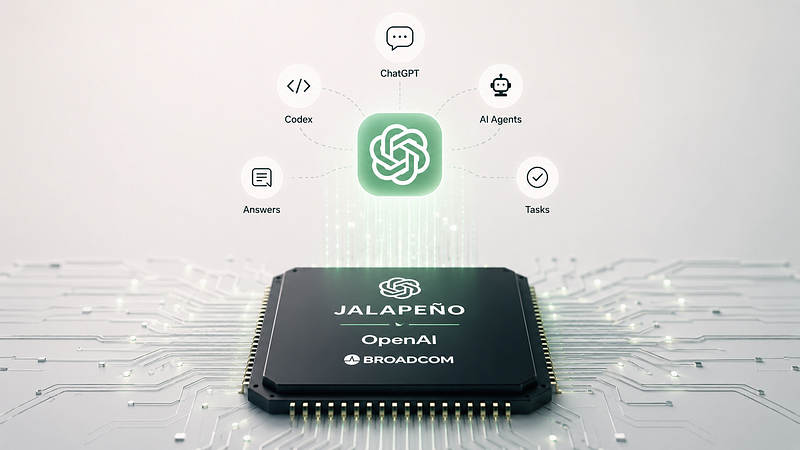
Every time ChatGPT answers a question, every time Codex helps someone write code, every time an AI agent completes a task, something physical is doing that work. A chip, somewhere, is processing all of that at extraordinary speed. And as AI gets more powerful and more people use it, the hardware underneath is becoming just as important as the software on top.
Which is why what OpenAI announced on 24 June 2026 is a bigger deal than it might initially seem.
What Is Jalapeño?
Jalapeño is OpenAI’s first custom-built AI chip, developed with Broadcom and manufacturing partner Celestica. It’s designed specifically for LLM inference, the process of running a trained AI model and generating a response when someone asks it something.
To understand why that matters, it helps to know one distinction. Training is when a model learns. It’s expensive, slow, and happens occasionally. Inference is what happens every time you use the model: every ChatGPT message, every Codex suggestion, every API call. That’s inference, and it happens billions of times a day.
Most chips in use today weren’t built for this. They’re general-purpose, designed to handle all kinds of tasks. Jalapeño was designed for one thing: running large language models as efficiently as possible.
A simple way to think about it: imagine two kitchens. One can cook any dish. The other is set up exclusively for pizza, every tool, every station optimised for that one job. The pizza kitchen runs faster, costs less per order, and handles far more volume. That’s the difference between a general-purpose GPU and a chip like Jalapeño.
How Was It Built, and How Fast?
Jalapeño went from initial design to manufacturing tape-out in just nine months. For context, it typically takes 1.5 to 2 years to design an ASIC from scratch. OpenAI and Broadcom claim this may be the fastest development cycle ever achieved in high-performance advanced semiconductors.
That speed wasn’t accidental. OpenAI used its own AI models to accelerate parts of the chip’s design and optimisation process, meaning the same models being served to users were helping build the infrastructure used to run future models. AI is helping design better AI hardware. That’s a genuinely interesting loop.
Engineering samples are already running ML workloads in the lab at production target frequency and power. Early testing shows Jalapeño will deliver performance per watt substantially better than current state-of-the-art alternatives. Broadcom CEO Hock Tan has cited cost savings of roughly 50% compared with typical AI GPUs in early testing. A detailed technical report is due in the coming months. Initial deployment is planned by the end of 2026, with Broadcom’s CEO describing “small prototype development” in late 2026, scaling from there.
Why Are AI Companies Building Their Own Chips?
The honest answer is control, cost, and scale.
General-purpose chips are built to handle everything reasonably well. But AI workloads are specific; they need particular memory patterns, particular networking, particular ways of balancing compute. When you’re running a model at the scale of ChatGPT, even small inefficiencies add up to enormous costs.
OpenAI now operates across the full stack: developing models, building products, and designing the infrastructure underneath: chip architecture, memory systems, networking, and deployment. Because each layer is optimised around the same goal, the whole system runs faster, more reliably, and at lower cost.
Greg Brockman said it plainly: “By designing more of the stack ourselves, we can serve more intelligence with greater efficiency and keep pushing advanced AI toward broader access.”
OpenAI isn’t alone. Google has its Tensor Processing Units. Amazon has Trainium. Meta has its own accelerators. What’s notable about Jalapeño is the speed — nine months, start to finish, and the scale of ambition. Hyperscalers are on track to spend over $700 billion on AI infrastructure in 2026. Broadcom’s CEO has set a target of over $100 billion in AI semiconductor sales by 2027.
What Does This Mean for Developers and Tech Startups?
For most developers, the immediate impact won’t be a new tool to install. It’ll show up quietly — faster response times, more reliable uptime, and eventually, lower inference costs.
But the bigger implication matters. Think about a startup building an AI product right now. Speed, cost, and reliability are the three constraints against which everything gets balanced. The faster and cheaper inference becomes at the hardware level, the more ambitious the product teams can build without worrying about whether the economics will hold.
Brockman told CNBC that OpenAI “cannot get compute fast enough.” Broadcom’s CEO backed that up, saying compute demand from their customers is “simply insatiable” and expected to remain elevated through 2028 and beyond. That kind of demand signal tells you how much AI product development is currently waiting on infrastructure to catch up.
The Questions Everyone Wants Answered
Q: What exactly is AI inference?
Inference is what happens every time you use a trained AI model. Training teaches it. Inference is the model putting that knowledge to work in real time, generating an answer, writing code, or completing a task. Every ChatGPT message is an inference. It happens billions of times a day, which is why making it more efficient matters so much.
Q: Does this mean OpenAI is replacing Nvidia?
Not exactly. ASICs like Jalapeño are purpose-built for specific workloads, less flexible than Nvidia’s GPUs, but cheaper per task for the jobs they’re designed for. More intensive tasks like training large models will likely still rely on GPU clusters. Jalapeño is optimised for inference at scale, where purpose-built hardware makes the biggest difference to cost and speed.
Q: What does this mean for startups building on AI APIs?
Broadly good news. As inference becomes cheaper and faster at the hardware level, that efficiency can flow through to API pricing and performance. The products that benefit most are those where response speed and cost-per-query directly affect the user experience, which is most AI products.
What Lies Ahead
The first wave of AI was about proving what models could do. The next wave is about making them available everywhere, reliably, and affordably.
Jalapeño is a signal that the companies shaping what comes next aren’t just thinking about the model. They’re thinking about everything that makes the model run — the chip, the memory, the networking, the data centre, the deployment system. Each layer is optimised to make the next one better.
For anyone building with AI right now, that direction matters. The products that reach the most people won’t just have the best models. They’ll be built on infrastructure designed to serve those models at a scale and cost that wasn’t possible before.
TL;DR
OpenAI just built its first custom AI chip called Jalapeño, made specifically for running its AI models — ChatGPT, Codex, and everything in between. Instead of relying entirely on general-purpose chips like Nvidia’s GPUs, OpenAI designed one that does this one job faster and more efficiently. They built it in just nine months, which is record time for this kind of hardware. The goal is simple: make AI cheaper to run, faster to respond, and available to more people. For developers and startups building on AI, that eventually means lower costs and better performance without changing anything on their end.
Looking to build a high-performing remote tech team?
Check out MyNextDeveloper, a platform where you can find the top 3% of software engineers who are deeply passionate about innovation. Our on-demand, dedicated, and thorough software talent solutions provide a comprehensive solution for all your software requirements.
Visit our website to explore how we can assist you in assembling your perfect team.