We've watched this pattern play out with founder after founder: they hire a remote developer from India for the obvious reasons - deep talent pool, strong CS fundamentals, competitive rates - and then get frustrated three weeks in because standups keep slipping, code reviews take a full day to turn around, and "quick syncs" become 48-hour email threads.
The problem usually isn't the developer. It's that nobody planned for the clock.
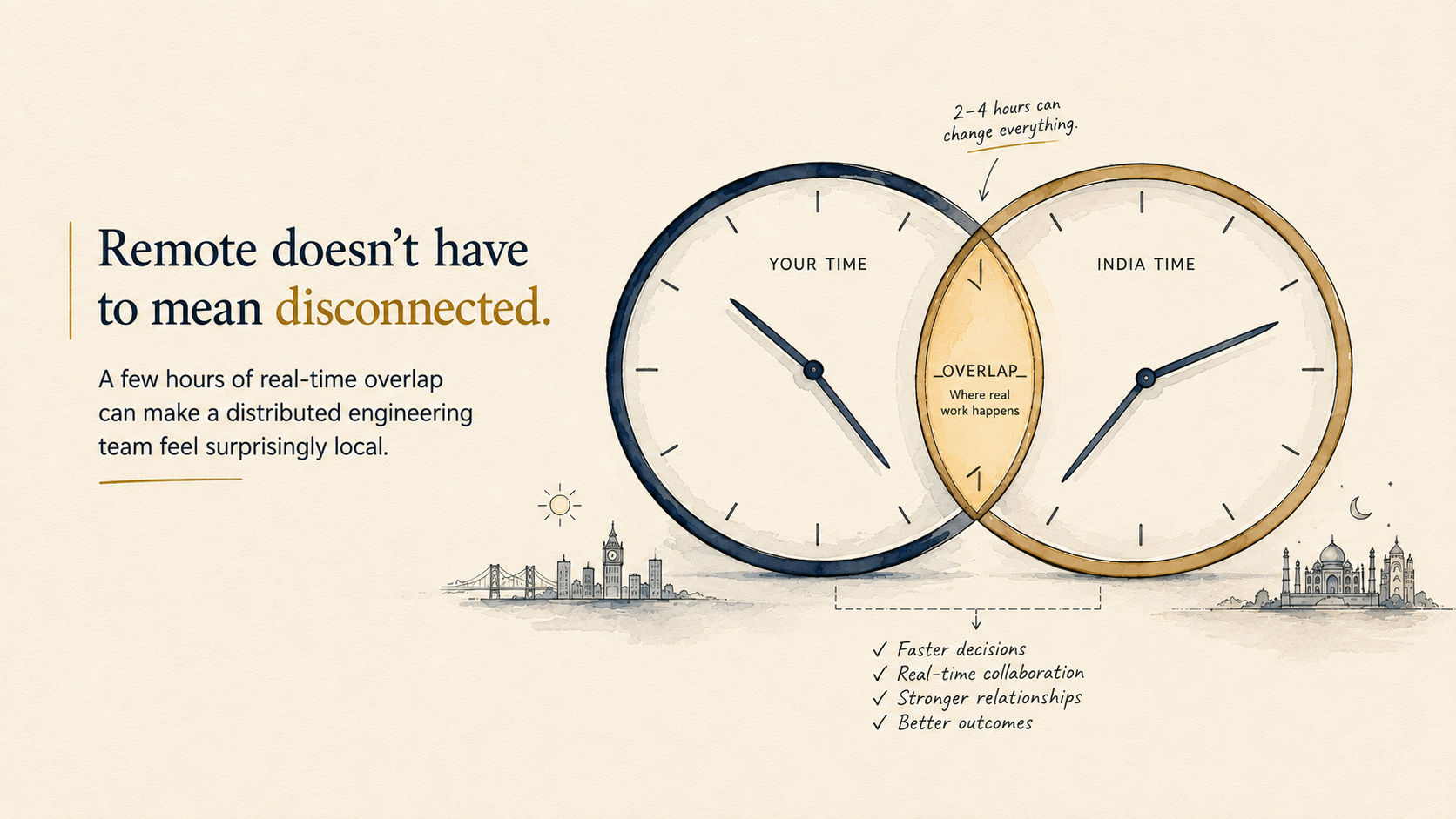
India runs on IST (UTC+5:30), one of the only half-hour offsets in the world, which alone trips up scheduling tools built around whole-hour zones. Depending on where your team sits in the US, that puts you somewhere between 9.5 and 13.5 hours apart, with the gap changing as daylight saving time shifts under you. Get the overlap wrong, and even a top 1% engineer ends up working in a vacuum. Get it right, and time-zone spread stops being a liability and starts working for you.
How Big Is the Time Difference Between the US and India, Really?
It depends on your coast and the season:
US East Coast: 9.5 hours (summer) to 10.5 hours (winter) behind IST
US Central: 10.5 to 11.5 hours behind
US Pacific: 12.5 to 13.5 hours behind
In practice, that means one comfortable overlap window: your morning is India's evening. A 9:00 AM call on the East Coast lands around 6:30–7:30 PM in India. On the West Coast, that same call happens closer to midnight IST, which is where a lot of "always available" contractor arrangements quietly turn into burnout.
Takeaway: if you're on the West Coast, don't assume you'll get the same overlap a New York-based team gets. You'll need to build your process around asynchronous handoffs, not synchronous meetings.
Why Does Overlap Actually Matter for Engineering Output?
It's tempting to think great engineers can just "figure out" async communication. Some can. But the data on distributed teams tells a more specific story:
Teams with four or more overlapping working hours ship features roughly 30% faster than teams with only two hours of overlap, according to research on distributed engineering teams referenced by Second Talent.
Gallup's 2025 workplace data found that teams with a structured five-hour overlap window report meaningfully higher engagement than teams without one.
On the flip side, more than half of remote workers surveyed by FlexJobs say time-zone separation actually speeds up project turnaround because tasks keep moving after their own day ends.
Both things are true at once. Zero overlap can genuinely work for well-scoped, well-documented tasks - bug fixes, QA passes, batch processing. But architecture decisions, debugging a production incident, or onboarding a new engineer need real-time back-and-forth. No amount of Notion documentation replaces a 20-minute conversation when someone's stuck.
Practical example: A Delaware-based SaaS startup we've worked with runs core overlap from 8:00–10:00 AM ET (roughly 6:30–8:30 PM IST). Standups, code review sign-off, and any blocking decisions happen in that window. Everything else - implementation, testing, documentation - runs async. Their India-based engineers effectively extend the team's working day rather than replace it.
How Much Overlap Do You Actually Need?
There's no universal number, but here's a practical framework:
0 - 1 hours overlap: Fine for isolated, well-defined tasks with a strong async culture and rock-solid documentation. Risky for anything ambiguous.
2 - 3 hours overlap: The realistic floor for most product teams. Enough for one meaningful sync per day.
4+ hours overlap: The sweet spot for teams doing active feature work, fast iteration, or anything customer-facing. This is where the 30% speed gain shows up.
If you're hiring one developer versus building a five-person pod, the bar is different too. A single senior engineer can often self-manage around a thin overlap window. A team needs more shared hours to avoid bottlenecking every decision on one Slack thread.
Where Can We Find Developers Who Actually Overlap With Our Hours?
This is the question we get most often, and it's a fair one: India's tech workforce is enormous (industry estimates put it at between 5 and 6 million developers, second only to China globally), but availability during your working hours is not evenly distributed.
A few things to look for:
Ask directly about working-hour flexibility before you sign anything: Many senior Indian engineers already work adjusted hours (11 AM–8 PM IST or later) specifically to serve US and European clients. Don't assume; confirm in writing.
Prioritize engineers with prior US-client experience: They've already built the muscle for async handoffs and know how to write a status update that doesn't need a follow-up call.
Test communication before you test code: A candidate who documents clearly and flags blockers early will save you more time than one who's marginally faster but goes quiet for 14 hours.
This is a big part of why we built MyNextDeveloper the way we did - every engineer in our network is pre-vetted not just on technical depth, but on time-zone flexibility and communication style, so founders aren't discovering the schedule mismatch three weeks into a project.
Key Takeaways
India's UTC+5:30 offset puts you 9.5 - 13.5 hours apart depending on your US coast and the season, plan around your morning and their evening.
4+ hours of daily overlap is linked to meaningfully faster feature delivery; treat that as your target, not a nice-to-have.
Zero-overlap arrangements can work for narrow, well-scoped tasks but break down for architecture, debugging, and fast iteration.
Vet for communication and schedule flexibility as rigorously as you vet for technical skill; it predicts project success just as strongly.
West Coast teams need a different playbook than East Coast teams; the overlap window isn't the same for both.
What This Means for Your Team
Time-zone overlap isn't a scheduling footnote; it's a structural decision that shapes how fast your team ships, how included your remote engineers feel, and how much you'll actually get for what you're paying. Founders who plan for it upfront get the best of both worlds: India's deep, cost-effective engineering talent, plus a working rhythm that doesn't fall apart the first time something urgent comes up.
If you're building or scaling a remote engineering team and want developers who are already vetted for both technical depth and working-hour compatibility, that's exactly the gap MyNextDeveloper was built to close, connecting startups with pre-vetted, top-tier engineers who fit how your team actually works, not just what your budget allows.
TL;DR
India's top-tier engineers are world-class, but hire without planning for the 9.5–13.5 hour gap, and even great talent can't move fast. Teams with 4+ overlap hours ship features ~30% faster than those with 2. The fix isn't more talent; it's the right overlap window plus engineers already vetted for async communication.
Looking to build a high-performing remote tech team?
Check out MyNextDeveloper, a platform where you can find the top 3% of software engineers who are deeply passionate about innovation. Our on-demand, dedicated, and thorough software talent solutions provide a comprehensive solution for all your software requirements.
Visit our website to explore how we can assist you in assembling your perfect team.