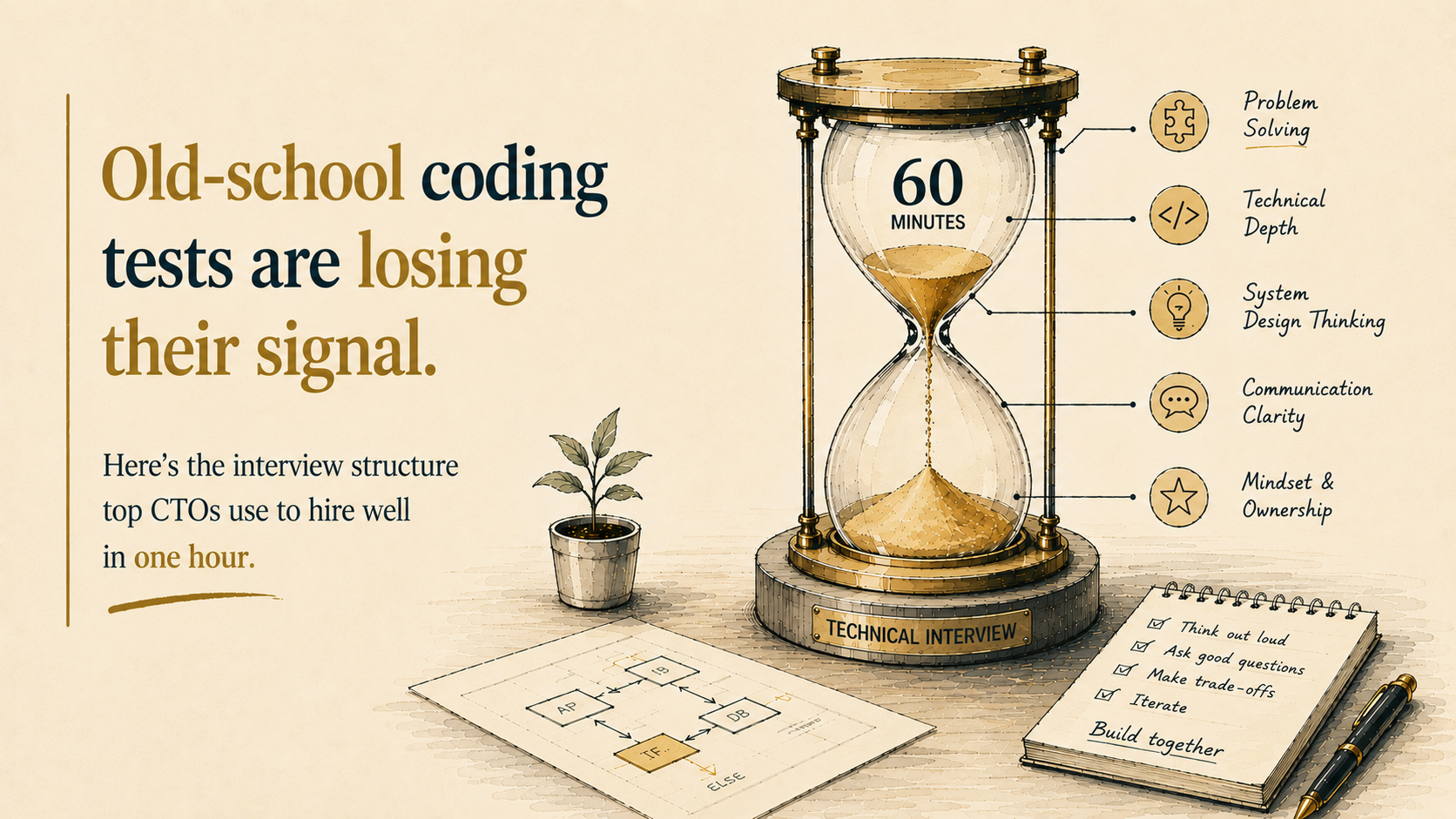
Sixty minutes - that's all the time most startup leaders get to figure out if someone can actually do the job they're about to hand them. No panel of interviewers, no week of back-and-forth, just one hour and a decision that could shape the next year of the company.
What's interesting isn't the time pressure itself. It's how much harder that hour has gotten. The old-school coding test that used to separate strong engineers from weak ones can now be solved almost instantly by typing the question into an AI chatbot, and a lot of candidates are quietly doing exactly that.
We talk to startup tech leaders about this all the time, and the ones who do it well have landed on a surprisingly similar approach. Here's what that hour actually looks like, explained without the jargon.
Why the Old Way of Testing People Stopped Working
For years, two things told a hiring manager whether someone was good: watching them solve a coding puzzle live, and giving them a take-home assignment to finish on their own time.
Both of those are breaking down fast. A recent industry study of over 19,000 interviews found that nearly 4 out of every 10 technical candidates showed signs of using AI to cheat, and people applying for technical roles did this about four times more often than people applying for sales roles. Separately, a survey of 400 engineering leaders found that 71% of them now say it's genuinely harder to tell if someone is actually skilled, because AI tools can produce a polished-looking answer without the person understanding a thing about it.
In simple terms: it's not that engineers got worse. It's that the old tests stopped being able to tell the difference between someone who really knows their stuff and someone who just knows how to ask a chatbot the right question.
What Actually Works Instead
Instead of generic puzzle questions, the strongest hiring managers now do something much more practical: they ask the candidate to solve a real problem the actual team is dealing with right now, out loud, together, like two coworkers talking it through.
This matters more than it sounds. Nobody's testing whether the candidate lands on one "correct" answer. They're watching how the person thinks, whether they ask good questions, and whether they can explain their reasoning when someone pushes back a little.
How the Best Interviewers Actually Spend the Hour
The first 10 minutes: Start with something real, not a rehearsed script.
Instead of the usual "tell me about yourself," a good interviewer will ask about one specific thing on the candidate's resume: why they built something a certain way, and what they'd do differently now. This does two helpful things at once. It gets a real, honest answer instead of a memorized one, and it naturally confirms this is genuinely the person who did the work, which matters more than people realize; 17% of hiring managers have already run into a fake, AI-generated video pretending to be a real candidate.
The next 25 minutes: Work through a real problem together.
Not a trick question, but a real, messy decision the company's own team is actually dealing with. The goal here isn't to see if the candidate gets the "right" answer. It's to see whether they ask smart, sharp questions, sometimes even better questions than the interviewer expected.
The next 15 minutes: Keep asking "why."
This is where things get revealing. If someone made a choice, a good interviewer will ask why, and then ask why again about their answer, and maybe once more after that. Someone who genuinely understands their own thinking holds up just fine under this. Someone who's secretly leaning on an AI tool for their answers usually starts to stumble, because they never really understood the reasoning behind the "correct" answer in the first place.
The last 10 minutes: One honest, real question.
Something like: Tell me about a time something went wrong and how you handled it. One good question here beats five rushed ones. By this point, the real work of the interview is already done.
Questions People Actually Ask Us
Should companies stop giving take-home assignments completely?
Not entirely, but they shouldn't be used alone anymore. A take-home project without a real conversation about it afterward is one of the weakest ways to judge someone in 2026, simply because AI tools can produce something that looks great without the person understanding it.
How can you tell if someone's secretly using AI during a live interview?
Watch for a mismatch between speed and depth. If someone gives a fast, perfect-sounding answer but can't really explain it when you ask a simple follow-up question, that's a bigger warning sign than someone who takes their time but can defend everything they say.
What's the single best sign someone will actually be good at the job?
Whether they can talk through a real, messy decision they've actually faced before, in their own words, even when you push back a little. That tells you far more than any puzzle question ever could.
Should most of the hour focus on technical stuff, or more on personality and fit?
Technical ability should take up most of the hour, roughly 80% of it, but the last few minutes on how someone handles people and pressure still matter. Skip that part entirely, and you risk hiring someone technically strong who's genuinely difficult to work with on a small team.
A Simple Example
Picture two people interviewing for the same role. One gives a fast, polished, confident answer, but freezes up the moment they're asked a genuine follow-up question about their own reasoning. The other takes a bit longer, asks a couple of smart clarifying questions along the way, and can explain and defend every choice they made, even under a little pressure.
The second person is almost always the better hire, even though the first one looked more impressive on the surface.
Key Takeaways
Old-school coding tests and take-home projects don't tell you as much as they used to, now that AI can produce a good-looking answer without real understanding behind it.
Working through a real, current problem together, out loud, is now one of the best ways to judge someone quickly.
Asking "why" a few times in a row is a simple, effective way to spot someone who doesn't really understand their own answer.
Someone who asks a smart, unexpected question is often a better sign than someone who gives a flawless answer.
Most of the hour should stay focused on real skills, with just a few minutes at the end for a genuine, honest question about how they handle people and setbacks.
TL;DR
Old-school coding tests and take-home projects have stopped being reliable, and nearly 4 in 10 technical candidates now show signs of using AI to cheat; a polished answer can come from a chatbot as easily as a person. The best startup CTOs fixed this by ditching generic puzzles for real, messy problems the team is actually facing, worked through live and out loud. The real tell isn't a flawless answer; it's whether someone can defend their own reasoning when you keep asking "why," and whether they ask sharper questions than expected.
Why This Matters
An hour was never really enough time to judge someone properly, and it's only gotten harder now that a confident-sounding answer can come from anywhere, including a chatbot. The people who hire well aren't running longer interviews. They're running smarter ones, built around real problems and honest conversation instead of rehearsed scripts either side could have prepared in advance.
If building and running that kind of hiring process isn't the best use of your time right now, that's exactly where MyNextDeveloper comes in - connecting startups with carefully vetted, top-tier engineers and AI talent who've already been tested the way the best hiring leaders actually test.
Looking to build a high-performing remote tech team?
Check out MyNextDeveloper, a platform where you can find the top 3% of software engineers who are deeply passionate about innovation. Our on-demand, dedicated, and thorough software talent solutions provide a comprehensive solution for all your software requirements.
Visit our website to explore how we can assist you in assembling your perfect team.