We've sat across the table from enough founders to notice a pattern: the technical vetting gets all the attention, and the hiring model gets almost none. Someone needs an engineer, so they post on Upwork, call an agency, or ask around for a "dedicated" hire, often without really considering which structure fits the actual problem.
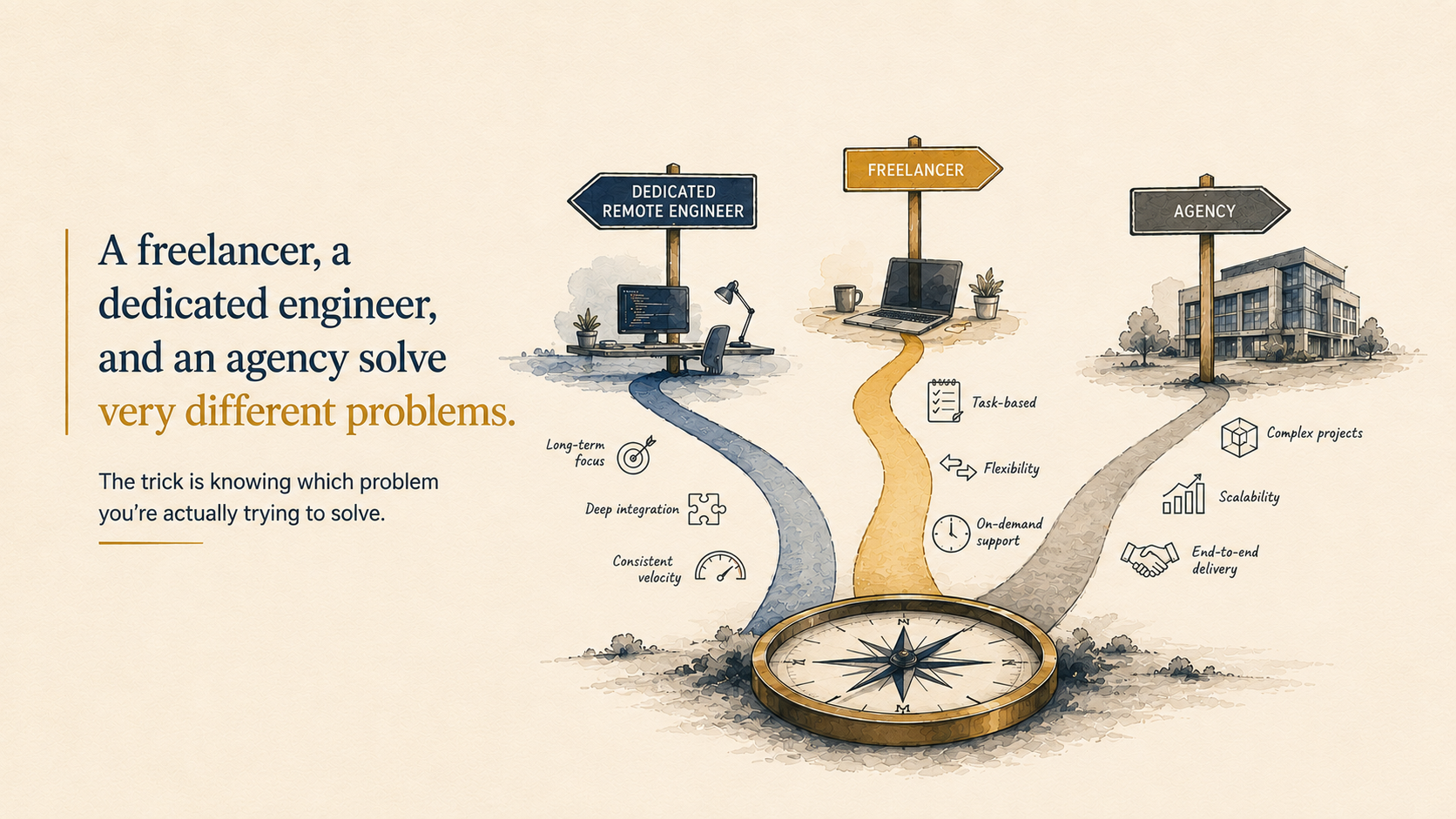
That decision matters more than most people think. A freelancer, a dedicated remote engineer, and an agency aren't just three price points on the same spectrum. There are three different operating models, each suited to a different stage of the company, budget, and risk tolerance.
Get the model wrong, and you'll feel it in ways that have nothing to do with code quality - missed context, slow ramp-up, a codebase nobody truly owns. Get it right, and hiring stops being a gamble and starts being a lever you can pull predictably.
What's the Actual Difference Between These Three Models?
A freelancer is an independent contractor you hire directly, usually for a defined task or project. They set their own hours, often juggle multiple clients, and are priced anywhere from roughly $15/hour for junior talent to 150 - 200+/hour for senior specialists in high-demand areas.
A dedicated remote engineer works exclusively on your product, integrated into your team's daily workflow - standups, sprint planning, code reviews - even though they're sourced and often employed through a third party that handles payroll, compliance, and vetting. They function like a full-time hire without you standing up a legal entity in their country.
An agency hands you a packaged team: developers, a project manager, sometimes QA and design, all coordinated to deliver a defined scope. You're buying an outcome, not a person.
The distinction that actually matters isn't cost; it's ownership. Freelancers own a task. Dedicated engineers own a codebase. Agencies own a deliverable.
When Should You Hire a Freelancer?
Freelancers are the right call when the work is narrow, the timeline is short, and you don't need long-term continuity.
Good fits:
A one-off landing page or marketing site
A single API integration
A short-term code audit or security review
Prototyping an idea before you've committed to a real build
Where it breaks down: A freelancer juggling three other clients isn't going to hold deep context on your architecture, and if they disappear mid-sprint, you have no backup. This is the "bus factor" problem that shows up constantly in freelance engagements. One capable freelancer can typically run one, maybe two, parallel projects at a time. That's fine for a landing page. It's a liability for your core product.
Practical example: an early-stage founder needing a Stripe integration wired up in two weeks is a textbook freelance job. The same founder trying to build their entire MVP through a rotating cast of freelancers usually ends up rebuilding half of it six months later.
When Should You Hire a Dedicated Remote Engineer?
This is the model for teams that need real ownership without the overhead of local hiring.
Good fits:
Core product development that needs long-term codebase ownership.
Extending an existing engineering team with specialized skills (AI/ML, DevOps, mobile).
Startups that already have a product manager or technical lead in-house and just need more hands that think like employees, not contractors.
The appeal is structural: a dedicated engineer shows up in your Slack every day, joins your standups, and builds institutional knowledge the way an employee would, while a staffing partner handles the parts that would otherwise require setting up a foreign legal entity, which alone can run $20,000–$150,000 depending on the country. That's a major reason international hiring has climbed the way it has; more than half of companies now hire across borders specifically to avoid that overhead.
Cost context: dedicated developers sourced through India-based agencies typically run $15–$65/hour, compared to $35–$130/hour for Eastern Europe and $150+/hour for premium US-based marketplace talent, a meaningful gap when you're trying to extend runway without cutting quality.
When Should You Hire an Agency?
Agencies make sense when you need a team, not an individual, and you don't want to manage the pieces yourself.
Good fits:
Shipping a full MVP with a fixed scope and budget.
Projects requiring multiple disciplines - design, QA, backend, DevOps - coordinated together.
Founders who want delivery accountability sitting with the vendor, not with themselves.
Where it breaks down: Agencies are typically staffed project-to-project, so institutional knowledge can reset when your engagement ends or the agency reassigns people internally. You also lose some direct control; you're managing a relationship, not a person.
Rough budget signal: Agencies tend to fit best for production builds in the $50,000+ range with 8–20 week timelines. Below that, you're often paying for process overhead you don't need yet.
How Fast Can You Actually Get Started With Each Model?
This is where the models diverge sharply, and it's worth planning around:
Freelancer: Days, sometimes hours, on open marketplaces. Fastest to start, least reliable long-term.
Dedicated engineer (via a vetted network): Typically, a shortlist within about a week, working within two to four weeks, much faster than building an in-house hiring pipeline from scratch.
Agency: Two to three weeks to kick off once scope is locked, but re-onboarding can happen every time you start a new engagement.
In-house hiring: 30–90 days just to hire, then another three to six months before someone is fully productive — the slowest path, and the one most startups can't afford to wait on.
Takeaway: if speed matters more than anything else right now, dedicated hiring through a pre-vetted network usually beats both the marketplace gamble of freelancing and the slower ramp of an agency engagement.
How Do We Vet a Freelance Developer Before Hiring?
A few non-negotiables, regardless of platform:
Skip generic trivia questions. Ask for a real-world code review or a small paid trial task pulled from your actual backlog.
Check for evidence of sustained client relationships, not just a long list of one-off gigs; it signals reliability.
Confirm availability explicitly. "I can start Monday" means very little without a stated weekly hour commitment.
Key Takeaways
Freelancers are built for scoped, short-term tasks, not ongoing product ownership.
Dedicated remote engineers offer the closest thing to a full-time hire, minus the legal and payroll overhead, and are typically the fastest path to sustained product velocity.
Agencies are the right call when you need a coordinated team and delivery accountability, not just an extra pair of hands.
Speed to start favors freelancers; speed to sustained productivity favors dedicated hiring.
The real decision variable isn't cost; it's how much ownership the work requires.
The Bottom Line
There's no universally "best" model here, only the model that matches what you're actually trying to build. A landing page doesn't need a dedicated engineer. A core product roadmap shouldn't be run on a rotating freelance bench. And a full MVP with multiple moving parts is often better handed to a coordinated team than assembled piecemeal.
The founders who scale efficiently aren't the ones who picked the cheapest option; they're the ones who matched the model to the moment.
If you're weighing this decision right now and want dedicated, pre-vetted engineers who integrate like employees from day one without the overhead of building that pipeline yourself, that's the exact gap MyNextDeveloper was built to close for startups hiring top 3% software and AI talent.
TL;DR
Freelancer, dedicated engineer, or agency - the real decision isn't cost; it's ownership. Freelancers fit scoped, short-term tasks; dedicated engineers fit ongoing product work with near-employee integration; agencies fit full builds where you want the vendor holding delivery accountability. Match the model to what you're actually building, not just your budget.
Looking to build a high-performing remote tech team?
Check out MyNextDeveloper, a platform where you can find the top 3% of software engineers who are deeply passionate about innovation. Our on-demand, dedicated, and thorough software talent solutions provide a comprehensive solution for all your software requirements.
Visit our website to explore how we can assist you in assembling your perfect team.