A year or two ago, asking an engineer whether they used AI to write code might have been a useful extra question, but today, it is becoming a normal part of how software gets built.
The change has happened surprisingly quickly. JetBrains' 2026 Developer Ecosystem Survey, based on more than 15,000 professional developers, found that 90% of developers were using AI coding agents at work at least weekly between May and July 2026, with 68% using them every day. Claude Code alone was being used at work by around 39% of professional developers worldwide, up from 18% in January. In the US, that number reached 47%.
That doesn't mean every developer has suddenly stopped writing code themselves. It means the way developers work is changing. Instead of writing every line manually, many engineers now use AI to explore ideas, write parts of a feature, fix bugs, understand unfamiliar code, run tests, and work through problems faster.
For startups, that creates a pretty important question: If your engineers are already working this way, should your hiring process still evaluate them as if AI doesn't exist?
AI Has Changed the Way Engineers Work
For a long time, GitHub Copilot was the name most people associated with AI-assisted coding. It became a familiar part of the developer toolkit, particularly because it worked directly inside the tools developers were already using.
But the market has changed quickly.
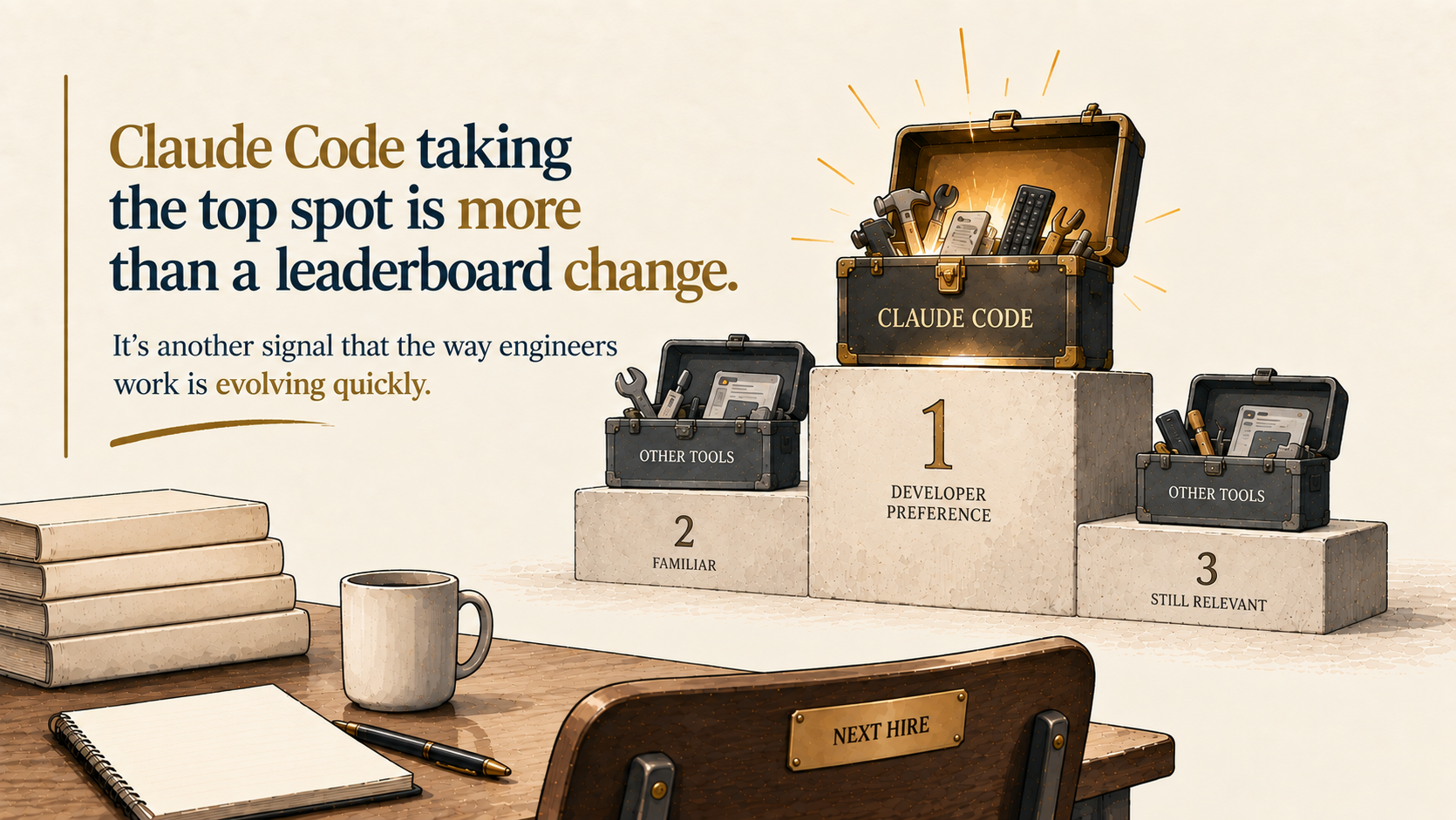
According to JetBrains' latest survey, GitHub Copilot's workplace adoption fell from 29% a year earlier to 21% in May-July 2026. Claude Code, meanwhile, grew from 18% in January to 39% during the same period. GitHub Copilot is still much more widely known, with 79% of developers globally having heard of it, but awareness and actual usage are no longer the same thing.
That's an important distinction for anyone hiring engineers.
You don't necessarily need to care which AI tool is currently number one. Tools will keep changing. What matters is that AI coding agents have moved from something developers experimented with to something many now use as part of their normal working day.
In other words, the tool may change, but the new way of working is already here.
What This Means for Your Team
This matters even more when you're hiring for a startup.
A small engineering team doesn't have the luxury of spending months building every feature manually. You need people who can understand a problem, make good decisions, move quickly, and know when something needs a closer look.
AI can help with some of that work, but it doesn't replace the person making the decisions. That's actually the most important part of this shift.
A developer can ask an AI agent to build something in minutes. But consider what happens next:
1. What happens when the answer looks correct and isn't?
2. What happens when the AI misunderstands an important requirement?
3. What happens when it changes something in one part of the application and quietly breaks something somewhere else?
Those are engineering questions, and they're becoming more important, not less.
JetBrains' research shows that developers using these tools still vary significantly in how much they let AI do. Among developers who use Claude Code most, for example, about 32% report that agents generate more than 80% of their code. That means there is no single “AI developer” workflow. Some people use agents heavily, while others still do most of the coding themselves.
So the goal of your interview shouldn't be to find someone who lets AI write everything. It should be to understand how they use it and whether they know when not to trust it.
Don't Just Ask If They Use AI, Ask How They Use It
If you're updating your interview process, one of the easiest changes is also one of the most useful. Stop treating AI experience as a simple yes-or-no question.
Have you used Claude Code?
Yes.
That doesn't tell you much.
Instead, ask the candidate to tell you about a real situation:
1. Where did they use an AI coding tool?
2. What were they trying to build?
3. What did they let the tool handle?
4. What did they check themselves?
5. Did the AI make a mistake? How did they catch it?
The answer can tell you far more than the name of the tool they use.
Someone who says, "I use AI to generate code faster," hasn't really told you how they work. But someone who says, "I let the agent handle the first version, but I noticed it was making the wrong assumption about how our database relationships worked, so I stopped it and rewrote that part myself," is giving you something much more useful.
That person is showing judgment — and that's the skill startups should care about.
AI Fluency Doesn't Mean AI Dependence
There is also a trap here. Just because someone uses AI heavily doesn't automatically make them a better engineer. In fact, the opposite can happen when someone accepts everything an AI tool produces without understanding it.
The best engineers aren't necessarily the ones who ask AI to do the most work. They're the ones who know which work to give it, how to guide it, and how to check what comes back. That distinction is becoming increasingly important as coding agents become capable of handling larger pieces of work.
Anthropic's analysis of roughly 400,000 Claude Code sessions found that people generally make the planning decisions, like deciding what needs to be done, while Claude handles much of the execution. The research also found that people with greater domain expertise tend to get more work done per instruction.
That is a useful way to think about the future of engineering. The value isn't simply in typing code faster. It's in knowing what should be built, giving the right direction, spotting problems, and deciding whether the result is actually good enough to ship.
What Should “Senior Engineer” Mean Now?
This shift also raises a bigger question about seniority.
Traditionally, a senior engineer was someone who could solve difficult technical problems independently, make architectural decisions, review other people's work, and help a team move forward. Those things still matter, but now there is another layer.
A strong senior engineer should increasingly know how to work effectively with AI tools without handing over their judgment to them.
They should be able to break a large problem into smaller pieces, give an AI agent useful direction, review the result, spot subtle mistakes, and understand when doing something manually is actually safer or faster.
That's a different skill from simply knowing how to write code, and it is something your interview process can actually test.
The Difference Shows Up Quickly
Imagine you're interviewing two developers for the same role.
The first candidate tells you they've been using AI for the past year and says it helps them “code much faster.”
The second candidate tells you about a recent project where they used an AI agent to work through a database migration. The agent produced most of the initial implementation, but the candidate noticed that it had misunderstood how historical records were connected. They caught the issue during testing, changed the approach, and reviewed the final migration manually before it went anywhere near production.
The second candidate hasn't just demonstrated that they know how to use an AI tool. They've demonstrated something much more valuable: judgment. They know when to delegate, when to question the result, and when to take control themselves.
That's the kind of signal your hiring process should be looking for.
What Founders Should Change
You don't need to completely rebuild your interview process overnight. Start with a few simple changes.
Ask candidates how AI fits into their normal workflow. Give them a practical problem and allow them to use the tools they would normally use. Then focus your questions on the decisions they made, not just the code they produced.
Ask what the AI got wrong, what they checked, and what they wouldn't trust an AI agent to handle without supervision.
Those questions give you a much clearer picture of how someone will actually work on your team.
And don't turn the interview into a test of who knows the most AI tools, as tools will change. The important skill is learning how to work with them without losing the ability to think independently.
This Is About More Than Claude Code
The biggest shift isn't that Claude Code has become popular. It's that AI-assisted development is becoming part of the normal definition of software engineering.
JetBrains found that 90% of professional developers were using AI coding agents at work at least once a week by mid-2026. That doesn't mean traditional engineering skills have disappeared. It means the job now includes another layer of working with machines that can handle increasingly large parts of the implementation.
So if your hiring process still asks candidates to prove only how well they can write code without AI, you may be measuring only part of how they'll actually work once they join you.
The question is no longer simply: “Can this person write good code?”
It's becoming: “Can this person use every available tool, including AI, while still making good engineering decisions?”
That's a much more useful question for a startup to answer.
And if you don't have the time to redesign your hiring process around the way engineers actually work today, that's where MyNextDeveloper helps by connecting startups with vetted engineers and AI talent who understand modern development workflows and can contribute from day one.
TL;DR
AI coding tools have quickly become a normal part of how developers work, especially at startups. That means hiring engineers based only on how well they code without AI no longer tells you the whole story. What matters now is whether they know how to use AI effectively, spot its mistakes, and make good decisions themselves. The best engineers aren't just using AI to write code faster — they know when to trust it, when to question it, and when to take over.
Looking to build a high-performing remote tech team?
Check out MyNextDeveloper, a platform where you can find the top 3% of software engineers who are deeply passionate about innovation. Our on-demand, dedicated, and thorough software talent solutions provide a comprehensive solution for all your software requirements.
Visit our website to explore how we can assist you in assembling your perfect team.