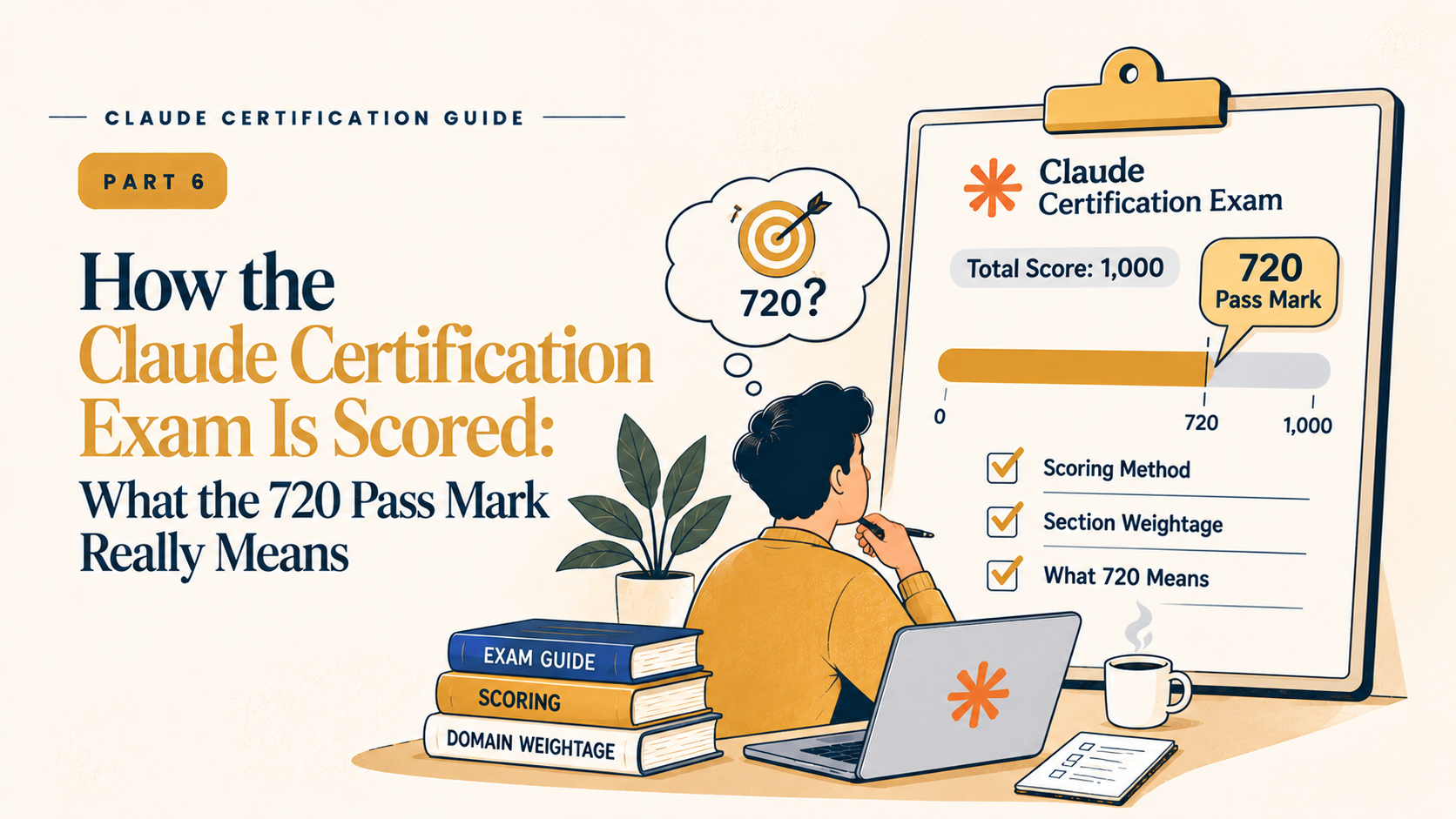
Every Claude certification exam has the same pass mark: 720. But 720 out of what, and does it mean you need to get 72% of the questions right?
No, and that's the first thing worth clearing up.
This part explains how the exam is scored, what a scaled score actually is, what your score report tells you, and what the guide doesn’t say. It’s drawn from the official exam guides, and we’ve labeled clearly where we’re explaining general scoring practice instead of something Anthropic has stated about its own exams.
How Anthropic Scores the Exam
All four guides give the same pass mark and report your result the same way. The Developer – Foundations guide, which we read in full, adds these details:
A fixed standard, not a curve:
The exams are criterion-referenced: "each candidate is measured against a fixed performance standard, not against other candidates." You pass by showing the skills in the exam blueprint, and nobody else's result affects yours.
A pass mark set by experts:
The passing score comes from a formal standard-setting study in which subject matter experts judged the level of performance expected of a minimally qualified candidate.
A scaled score of 100 to 1,000, with 720 to pass:
Your result is reported as pass or fail, along with your scaled score.
The total score decides:
Pass or fail is based on your total scaled score only. Domain-level results are shown to you but "not used to determine your pass or fail result."
In other words, you don't have to pass each domain separately. You have to reach 720 overall.
What “Scaled Score” Really Means
A scaled score is not a percentage. It's a raw score (the number of questions you answered correctly) converted onto a fixed scale, so that the same pass mark applies however you were tested.
Anthropic’s guides don’t describe the conversion they use, but Anthropic’s FAQ does confirm the purpose: scaled scoring equates scores across exam forms that may have slightly different difficulty. Here’s how scaled scoring works in general on professionally developed certification exams, based on explanations from Pearson’s certification programs and from the testing company PSI.
Different versions of an exam can differ slightly in difficulty: If one version is a little harder, requiring the same raw number of correct answers would be unfair.
Scaling fixes that: The number of correct answers needed to pass can differ slightly from one version to another, but each version's pass point is mapped to the same scaled score. On these exams, that shared point is the 720, though Anthropic hasn't said how many versions of each exam exist.
The result is a fair, comparable pass mark: A 720 means the same level of performance whichever version you sat.
Two things follow from this. First, 720 out of 1,000 does not mean 72% correct, and you can't convert it into a percentage. Second, anyone who tells you exactly how many questions you need to get right is guessing, because Anthropic hasn't published the raw-to-scaled conversion.
What Your Score Report Shows
Anthropic’s FAQ says you’ll see your score on screen at the end of your exam, whether you test online or at a test center, and you can find the full report in your Pearson account.
Your report shows your pass/fail result, your scaled score from 100 to 1,000, and the percent of items you answered correctly in each content domain. The domain percentages are there to help you understand your performance, and they don't affect whether you pass. There's also no minimum score per domain in the guide.
Here's how to use them:
If you passed, you don't need to do anything with them, though they show where your skills are strongest.
If you didn't, they're your study plan for the retake. Start with the domains where your percentage was lowest, especially the heavily weighted ones.
The domain weights in the Developer – Foundations guide are described as the approximate proportion of scored items drawn from each domain. On the Developer exam, for example, Applications and Integration make up about a third of the items and Claude Code about 3%. All else being equal, a gap in a heavy domain tends to cost you more than the same gap in a light one.
What the Guide Leaves Out
What the Developer Guide leaves unstated is just as useful to know:
How raw scores convert to the 1,000-point scale.
How multiple-response questions are scored, for example, whether you get partial credit or need every correct option.
Whether some questions are unscored, for example, trial items being tested for future exams.
How much each question is worth. The guide says nothing about items carrying different weights.
The details of the standard-setting study, such as the method used or the size of the expert panel.
Two of our certified developers noticed the same thing. One pointed out that the passing score is 720 out of 1,000, but that how answers are scored is never explained, and he suspected questions carry different weights, which the guide neither confirms nor rules out.
Another noted that you never find out what each question is worth while you're sitting the exam. Neither was bothered: the result matched what they expected, and there were no surprises on the day.
How to Study Knowing What You Know
Aim for solid coverage across the board, with extra effort where the weight is:
You need 720 overall, so a weak domain isn’t fatal on its own, but the heavier domains give you more room to gain or lose.
Don't try to calculate a pass from a percentage:
Practice-bank scores aren't on the same scale as your real result, so use them to spot weak areas and not to predict a pass.
Answer every question:
The guide mentions no penalty for wrong answers, so an unanswered question is the only one guaranteed to earn no credit.
Read how many answers to select:
Because the guide doesn't explain how multiple-response items are scored, the safest approach is to select exactly what the question asks for and think each option through.
Build in a margin:
Since you can't see how close you are to the line, prepare to be comfortably above it, not just scraping through.
If You Don’t Pass: Retakes and Appeals
You can retake the exam up to four times in a rolling 12-month period, with a 14-day wait after your first attempt, 30 days after your second, and 90 days after your third. Each attempt costs the full exam fee. Use the wait to work through your lowest domains from the score report.
If you believe something went wrong with your result, you can appeal through Pearson VUE support within 14 days of being notified of it, or within 14 days of your exam date for a result concern. Note that the standard-setting outcome (the 720 pass mark itself) and the content of individual exam items can’t be appealed. That said, Anthropic’s policies page says that if a question you believe was faulty affected a failed result, the remedy is a free retake rather than a changed score. You can also report a problem with a question to Pearson without it affecting your result.
Once you pass, your credential is valid for 12 months, and on-time renewal is a free, non-proctored assessment. See Part 2 for the full retake and renewal details.
FAQ: Claude Certification Scoring
Is 720 the same as 72%?
No. A scaled score is a converted score on a 100 to 1,000 scale, not a percentage of correct answers.
Is the exam graded on a curve?
No. It's criterion-referenced, so you're measured against a fixed standard and not against other candidates.
Do I need to pass every domain?
No. Pass or fail depends only on your total scaled score. Domain percentages are for information.
Do all four exams use the same pass mark?
Yes. The guides for all four certifications give a pass mark of 720 on a 100 to 1,000 scale.
Will I see which questions I got wrong?
The guide describes only pass/fail, your scaled score, and percent correct by domain. It doesn't mention item-level feedback.
How long until I get my result?
You’ll see your score on screen at the end of your exam, whether you test online or at a test center. A copy of your score report is also emailed to you and available in your Pearson account, and if you pass, Credly emails you to claim your badge.
What's next in this series?
The final part covers difficulty: what's actually hard on each exam, and common mistakes to avoid.
The Short Version
The scoring system is simpler than it first looks: one fixed pass mark of 720, one total score that decides everything, and domain percentages that exist to help you improve. What you can't see is the conversion behind the scale, so don't spend your prep time trying to reverse-engineer it. Cover every domain, weight your time by the blueprint, and aim to clear the bar with room to spare.
TL;DR
Every Claude certification exam uses the same pass mark of 720 on a scale of 100 to 1,000, but that isn't 72% of questions right. It's a scaled score, and Anthropic doesn't publish how raw scores are converted, so nobody can say exactly how many answers you need. There's no curve, and only your total score decides the result. Your report also shows a percentage for each domain, which is there to help you study if you need a retake. Answer every question, pick exactly the number of answers asked for, and aim to clear the bar by a comfortable margin.
Looking to build a high-performing remote tech team?
Check out MyNextDeveloper, a platform where you can find the top 3% of software engineers who are deeply passionate about innovation. Our on-demand, dedicated, and thorough software talent solutions provide a comprehensive solution for all your software requirements.
Visit our website to explore how we can assist you in assembling your perfect team.c