
What happens after the AI hype budget runs out

For three years, AI got a free pass inside most companies. CTOs skipped procurement reviews. Finance teams were told that hesitation was itself a risk. Boards signed off on big budgets because the demos looked incredible and nobody wanted to be left behind.
Then the monthly invoices arrived.
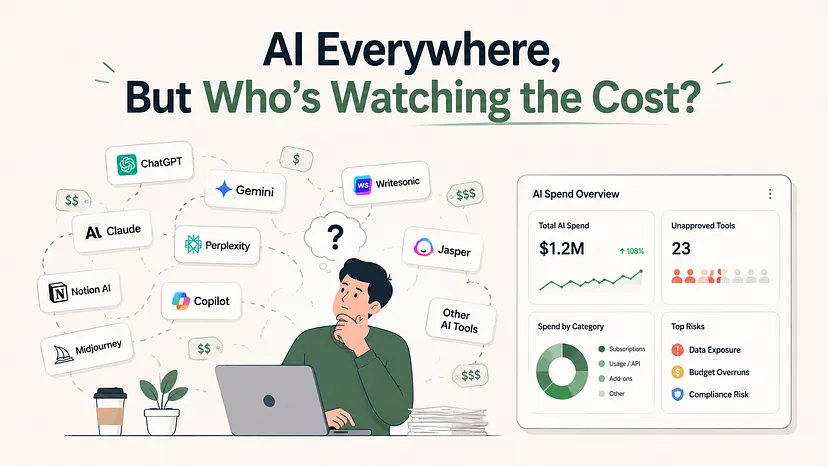
Some companies burned through their entire annual AI budget in three months. Others discovered that the tools their teams loved were running up bills nobody had planned for. The mood shifted from “how do we go faster?” to “what are we actually getting for this?”
This isn’t the end of AI. It’s the end of AI without accountability. And if you’re building a tech startup right now, this shift matters more than any model release.
The Numbers Are Hard to Ignore
Before getting into what’s going wrong, here’s where things actually stand:
- An MIT study found that 95% of AI pilots deliver zero measurable financial impact
- S&P Global found 42% of companies abandoned most of their AI projects in 2025, up from just 17% the year before
- IBM found that only 25% of AI initiatives deliver the ROI they promised
- Less than 1% of executives report an ROI above 20% - most see 1–5%, and that’s usually just time saved, not revenue gained
- The share of companies treating AI costs as a serious financial concern doubled from 31% to 63% in a single year
These aren’t numbers from AI sceptics. They’re from the companies spending the most on it.
Three Stories That Explain What’s Happening
- Klarna got the headlines. Then came the reality check.
In early 2024, Klarna announced its AI was doing the work of 700 customer service agents. By early 2026, they had begun hiring human agents again. The AI handled simple questions fast, but the moment a customer needed actual judgment, context, or empathy, it made things worse. Satisfaction scores dropped. App store reviews filled with complaints about “talking to a robot.”
The lesson: handling more tickets is not the same as serving customers better.
2. Uber’s problem was the opposite: AI worked too well.
Uber gave 5,000 engineers access to an AI coding tool in December 2025. Everyone used it. By April 2026, the entire year’s AI budget was gone. They had to cap how much each engineer could spend per month. Uber wasn’t saying AI didn’t work; they were saying it worked so well that the bill became unmanageable. When something is cheap per use, but everyone uses it constantly, the total cost explodes. That’s a real risk most companies didn’t plan for.
3. Walmart built its own tool and hit the same wall.
Walmart created an internal AI assistant called Code Puppy. They controlled everything, no third-party vendor, full cost visibility. By June 2026, they still had to cap usage after the bills blew past projections. Building it yourself doesn’t automatically solve the problem.
Q&A: What Founders Are Actually Asking
Q. Is AI still worth investing in as a startup?
Yes, but the question has shifted. In 2023, it was “Should we be doing something with AI?” In 2026, it’s “which specific bets actually pay off?” The areas where ROI is documented: fraud detection, logistics optimisation, first-line customer support, and AI-assisted software development. If your use case fits, the business case is there. If it doesn’t, you need a clear measurement plan before committing serious money.
Q. Why do so many AI pilots never reach production?
The technology rarely fails. The organisation usually has messy data, workflows that weren’t redesigned, teams that weren’t trained, and governance that was never set up. About 80% of the work to get from pilot to production has nothing to do with the model itself.
Q. How long before we see real returns?
Most well-run AI deployments reach payback somewhere between 14 and 28 months. If your board is expecting results in 6 months, that expectation will cause problems and kill good projects for the wrong reason.
Q. What does good AI governance look like in practice?
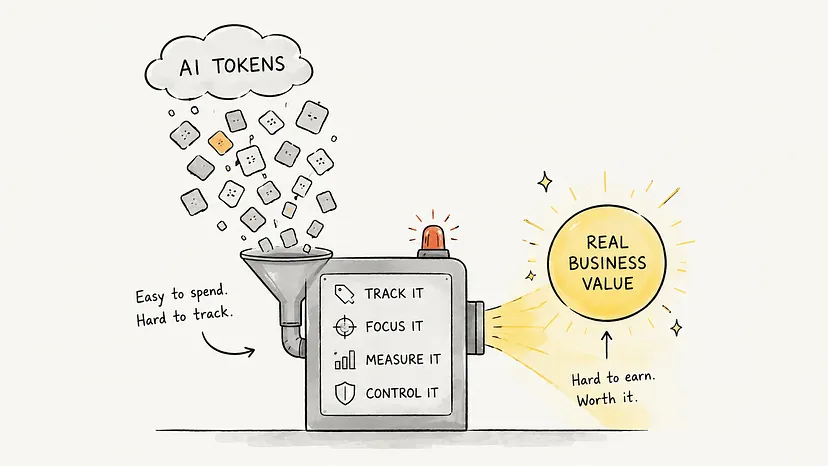
It means someone owns the AI cost line. It means deciding upfront how you’ll measure success. It means a short list of use cases you’re actually going to finish, not a long list of experiments. Only 14% of companies have this in place. They’re the ones seeing results.
What Winning Teams Are Doing Differently
- They measure outcomes, not activity
Usage stats tell you people are using the tool. Revenue impact, faster cycle times, and reduced cost per output tell you it’s working. These are very different numbers. - They treat AI costs like cloud infrastructure
Cloud costs also seemed manageable until suddenly they weren’t. Companies that handled cloud well built dedicated cost management practices early. AI needs the same: budget by use case, track it actively, and have someone accountable for the bill. - They go deep on fewer things
The smarter move is picking two or three use cases, proving them properly, then expanding. One thing that actually works beats ten things that sort of work. - They invest in data before models
McKinsey’s research consistently shows that top-performing companies spend more on data infrastructure than on AI itself. Clean, connected, well-governed data is where the real work is. The model is usually the cheapest part.
The Bottom Line for Startups
The post-hype correction makes things harder in one way and easier in another.
- Harder: Enterprise buyers are more cautious. Sales cycles are longer. “Does this actually work?” is a question that now needs numbers, not a demo.
- Easier: Most competitors are still selling hype. If you can show proof like real results, real customers, and real metrics, you stand out immediately.
Only 25% of AI initiatives deliver expected ROI, and just 16% have scaled enterprise-wide. Those numbers aren’t a reason to stop; they’re a reason to be in the 25%.
The hype cycle rewarded whoever moved fastest. The accountability cycle rewards whoever can prove it works.
Which side is your AI strategy on?
TL;DR
Companies spent billions on AI without asking whether it actually worked, and now the bills are forcing that conversation. The data is stark: 95% of AI pilots deliver no measurable financial impact, and 42% of projects were abandoned in 2025 alone. The startups that win from here won’t be the ones who moved fastest during the hype; they’ll be the ones who can prove their AI actually moves the needle.
Looking to build a high-performing remote tech team?
Check out MyNextDeveloper, a platform where you can find the top 3% of software engineers who are deeply passionate about innovation. Our on-demand, dedicated, and thorough software talent solutions provide a comprehensive solution for all your software requirements.
Visit our website to explore how we can assist you in assembling your perfect team.