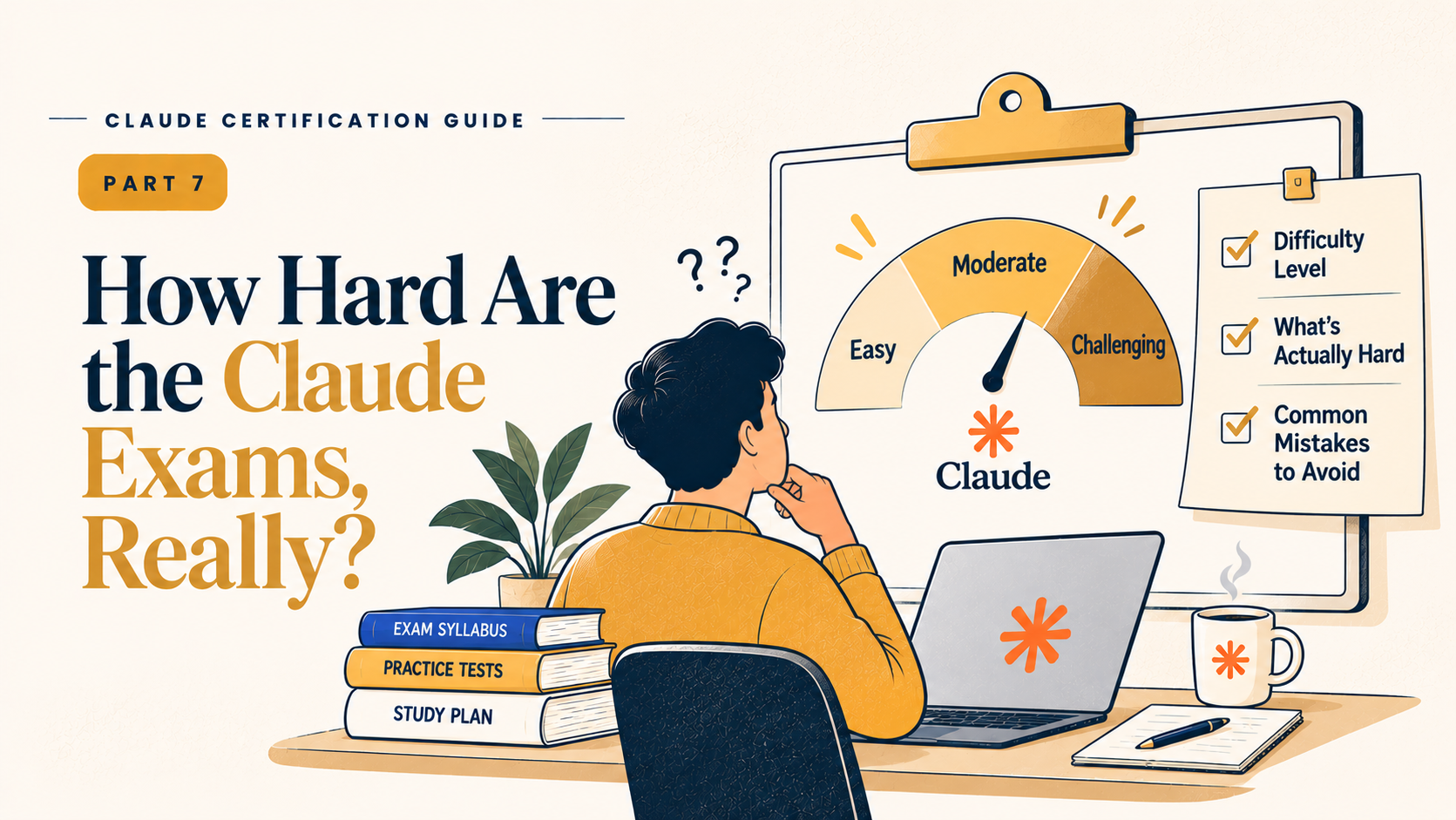
The most common question about any certification is the simplest one: how hard is it?
For the Claude exams, the honest answer is that it depends on which exam you take and how much you've already built with Claude.
Here's what we can say for sure. Anthropic's exam guides say what experience each exam expects. Our three developers who passed Developer – Foundations rated it between 4 and 7 out of 10, and Anthropic hasn't published a pass rate, so anyone who quotes you one is guessing.
This is the final part of our series. We've tried to keep what's officially written down apart from what's one person's story, and we say so whenever we only have one account.
What Anthropic's Guides Say About Difficulty
None of the guides rate how hard their own exam is. But each one describes the typical person who takes it, and that's the best official clue about how demanding the exam is. The Developer and Professional guides say the experience is recommended, not required. The Developer, Associate, and Professional guides also say there's no single course you must take, and that no resource can promise you a pass.
Here's the experience each guide recommends:
Associate – Foundations: regular, hands-on use of Claude in a professional setting, a foundational grasp of structured problem-solving and workflow design, and a practical understanding of AI's limitations, including hallucinations, context constraints, and data sensitivity.
Developer – Foundations: one to five years in software engineering, at least six months of hands-on work with Claude or similar AI models, and skill in Python or TypeScript, REST APIs, and command-line tools.
Architect – Foundations: six or more months of building with the Claude API, the Agent SDK, Claude Code, and MCP.
Architect – Professional: three or more years in systems architecture or platform engineering, plus at least six months of hands-on work with Claude or similar systems in production.
Read from top to bottom; it's a ladder. Associate asks for everyday use. The two middle exams ask for hands-on building. Professional asks for the most experience.
Real Ratings From People Who Passed
All three of our developers took Developer – Foundations and gave it a score out of 10.
Ashwin said 4 to 5. He found the real exam much more straightforward than the third-party practice questions he'd been worrying about. Tashwini said 5. She didn't think it was very hard, and she'd say it's mainly difficult if you've never worked with the Claude API. The official prep course covered what she needed. Pranav said 6 to 7. After reading Reddit and LinkedIn threads, he expected something much harder, but he found it easy compared with the practice questions.
Notice the pattern: all three found the practice questions harder than the real exam. Their scores also span a few points, so difficulty is personal. This is three people on one exam, so treat it as color and not data.
Exam by Exam: Where the Difficulty Sits
Anthropic doesn't rank the four exams by difficulty, and we've only taken one of them. So this section sticks to what each guide shows, and it says so when we're relying on other people's accounts.
Associate – Foundations (60 questions)
There's no coding. The biggest area is Output Evaluation and Validation at 21%, followed by Workflow Integration and Solution Design at 16% and Governance, Risk and Responsible Use at 15%. The guide's advice is about judgment: how to structure prompts, how to break a task into steps, and when to escalate or ask a person to review. If you already use Claude at work, the challenge is probably judgment more than technical depth.
Developer – Foundations (53 questions)
This is the one our team took. Most of the weight, 33.1%, is on Applications and Integration, which covers how the API works, how to design applications, and basic software engineering. You need real hands-on time building with the API. Our three candidates found it manageable with the official courses and practice.
Architect – Foundations (60 questions)
Every question is tied to a real-world scenario. You get four, picked at random from a bank of six. The biggest area is Agentic Architecture and Orchestration at 27%. The six scenarios that make up the bank are a customer support resolution agent, code generation with Claude Code, a multi-agent research system, developer productivity tools, Claude Code in CI/CD, and structured data extraction, so the guide's prep advice is to build and reason through examples of each. One candidate account we read called the questions fair but long and tiring. That's one person's view, and we haven't taken this exam.
Architect – Professional (63 questions)
It has seven domains, covering governance, talking with stakeholders, and lifecycle management, as well as integration and architecture. It asks for the most experience of the four. We haven't taken it either.
What About Pass Rates?
We couldn't find a pass rate from Anthropic or Pearson VUE for any of the four exams. A few numbers float around online, and you shouldn't treat them as facts.
One prep blog gives a pass-rate range for Architect – Foundations, but its author says it's a rough guess from online posts, not a measured number. Some practice sites show candidate stories that all say "passed," but they're written by people who chose to share. That shows who posts, not how many people pass.
Comparisons with practice tests point both ways. Our Developer candidates, and most of the CertSafari stories we read, found the real exam easier than the practice questions. One prep blog says the opposite about the short practice exam for Architect – Foundations. Those are different practice materials for different exams, so don't assume one pattern fits all.
So plan for the exam your guide describes, and don't let a headline percentage make you relaxed or scared.
Six Mistakes That Catch People Out
Judging your readiness by one practice score.
Practice banks aren't on the exam's scoring scale, and our candidates found theirs harder than the real thing. Use them to find weak areas, as we covered in Part 4.
Skipping the hands-on building.
Every guide's advice tells you to build something: a Claude application for Developer, an agent and a data extraction pipeline for Architect – Foundations, and an end-to-end solution for Professional.
Spreading your time evenly.
On the Developer exam, Claude Code is 3.1% of the exam and Applications and Integration is 33.1%. Put your hours where the weight is.
Rushing the wording.
One of our candidates said some questions were long, with a few key words deciding the best answer. People on CertSafari warn about words like "is not" and "best." Those are personal accounts, but the advice costs nothing: read every question twice.
Trusting other people's ratings too much.
Our three candidates rated the same exam anywhere from 4 to 7. Your own experience matters more.
Underestimating how tiring scenario exams are.
If you're taking Architect – Foundations, practice reading long, scenario-based questions. This comes from one candidate's account, so take it as a tip and not a rule.
Your Pre-Booking Checklist
Before you book, ask yourself:
Have I read my exam guide in full and checked myself against every area?
Have I built at least one thing with Claude that matches what the guide suggests?
Can I explain why the right answer is right, and why the others are wrong, on the official sample questions?
Are my practice results steady across areas, and not just strong overall?
Have I done Pearson's system test and sorted out my ID and testing space (see Part 5)?
If you can say yes to most of these, you're in good shape. If not, you've just found your next few days of study.
Quick Answers About Claude Exam Difficulty
Do I need to be a developer?
Only for the developer-focused exams. The Associate guide recommends regular hands-on use of Claude at work.
Which exam is the easiest?
Anthropic doesn't rank them. The guides do show different recommended experience, and Architect – Professional asks for the most.
How long should I prepare?
Our three candidates each prepared for about two weeks, and two of their colleagues said they took 7 to 10 days. It depends on how much hands-on experience you already have.
What if I don't pass?
You can retake it up to four times in a rolling 12 months, with waits of 14, 30, and 90 days, and each retake costs the full exam fee. Your score report shows percent correct by domain. That doesn't decide pass or fail, but it's a good guide for what to revise.
Your Experience Decides How Hard It Is
The exam is as hard as your hands-on experience is thin. Read your exam guide, build something real with Claude, and use practice questions to spot gaps. That's what our team did, and it matches what the official guides recommend.
At MyNextDeveloper, our engineers are Claude-certified and use Claude in their day-to-day work. If you're exploring AI-assisted development for your product, we'd be happy to talk.
TL;DR
How hard the Claude exams are depends on which one you take and how much you've already built with Claude. Our three developers rated the Developer exam between 4 and 7 out of 10, and all three found the practice questions harder than the real thing. Anthropic doesn't publish a pass rate, so any number you see online is a guess. Each exam's guide says what experience it expects, from everyday Claude use for the Associate exam up to three or more years of architecture for Professional. Read your guide, build something real, and use practice questions to find gaps, not to predict your result.
Looking to build a high-performing remote tech team?
Check out MyNextDeveloper, a platform where you can find the top 3% of software engineers who are deeply passionate about innovation. Our on-demand, dedicated, and thorough software talent solutions provide a comprehensive solution for all your software requirements.
Visit our website to explore how we can assist you in assembling your perfect team.