Most startups don't have a "which AI model is smartest" problem. They have a "why is our AI bill so high" problem. We see the same pattern again and again.
A team plugs the biggest model into everything. It works, then usage grows, and the invoice grows faster.
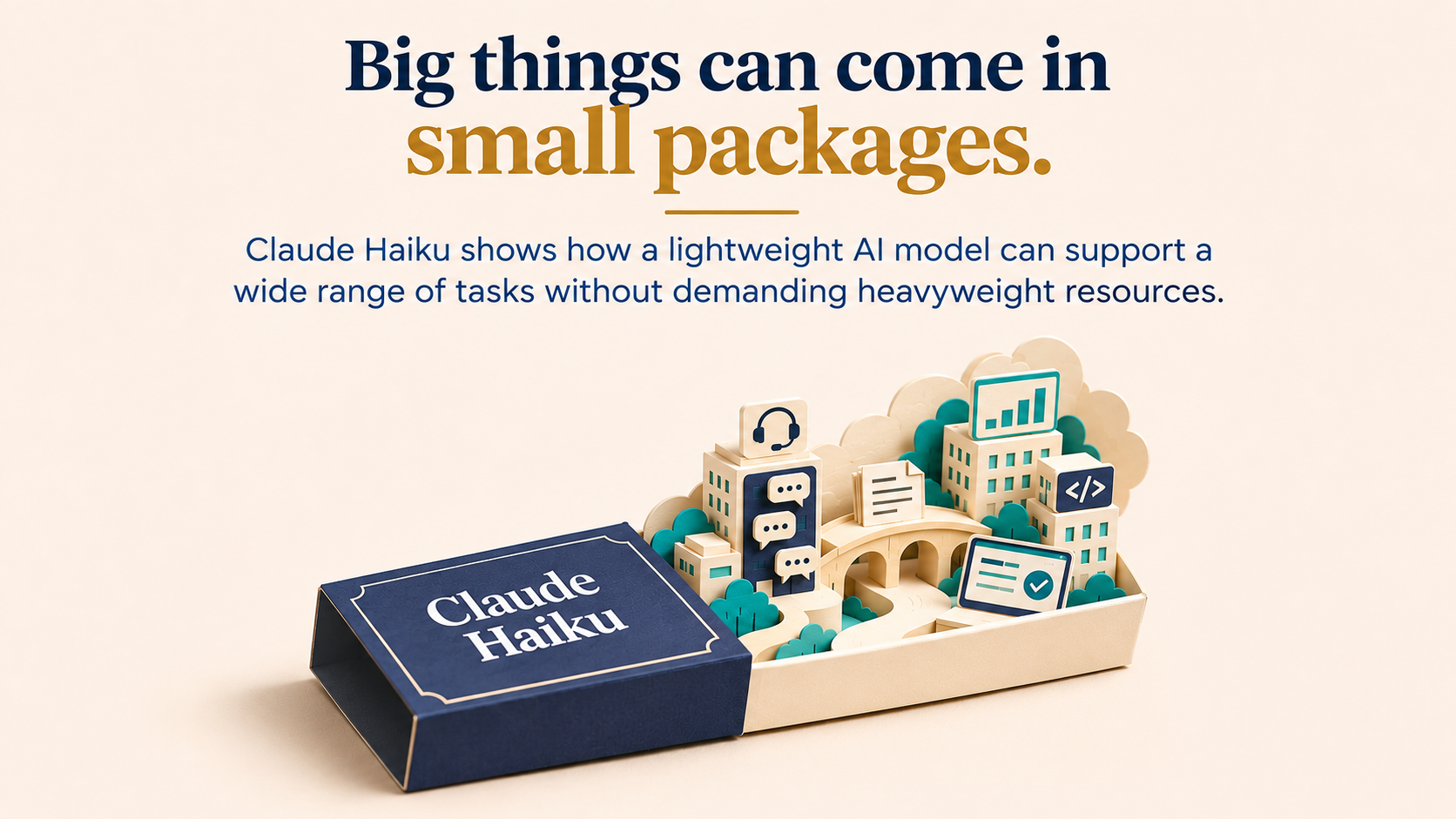
Claude Haiku is built for this moment. It's the small, fast model in the Claude family, and Haiku 5.5, released on October 7, 2026, made it much cheaper.
This post covers what Haiku does well, what it really costs, and where the cost can sneak up on you.
What Is Claude Haiku and Who Is It For?
Claude comes in a few sizes. Haiku is the smallest and fastest. Sonnet is the all-rounder. Opus handles harder, more complex work.
Think of it like staffing. You don't ask your senior architect to answer "where's my invoice?" emails; you hand that to someone quick and focused, and that's Haiku.
The latest version has a 1M token context window and up to 128K tokens of output, up from 200K and 64K on Haiku 4.5. It's also available through Claude Platform, AWS, Google Cloud, and Microsoft, so most teams can try it in the cloud they already use.
Why Claude Haiku 5.5 Matters for Your AI Budget
Here's the headline: for prompts up to 100K tokens, Haiku 5.5 costs $0.10 per million input tokens and $0.50 per million output tokens, against $1 and $5 on Haiku 4.5. For comparison, Sonnet 5.5 is $2 and $10, and Opus 5.5 is $4 and $20.
The cheap rate also covers most real work. Anthropic says prompts up to 100,000 tokens made up around 90% of requests to the previous Haiku.
A quick cost example
This is our own illustration at list prices, and your token counts will differ. Say you tag support tickets, with about 2,000 input tokens and 300 output tokens each, across 100,000 tickets a month:
Haiku 4.5: about $350
Sonnet 5.5: about $700
Haiku 5.5: about $35, or about $46 if token counts run 30% higher.
Same job, a fraction of the cost.
Two Catches Every Startup Should Know
Why Prompts Over 100K Tokens Cost 5x More
Haiku 5.5 has a huge context window, but don't stuff it. Prompts over 100,000 tokens are billed at $0.50 input and $2.50 output for the whole request. That's five times the rate.
A big window is a safety net, not a plan.
Why the Same Text Now Uses About 30% More Tokens
Anthropic notes that Haiku 5.5 uses the newer tokenizer shared with Claude 4.7 and later models, so the same text produces about 30% more tokens than on Haiku 4.5. Anthropic says its "around 75% cheaper on average" figure already accounts for this, so the "90% cheaper" headline shrinks a little in practice. It's still a big drop. Just measure your real bill, not the price list.
Best Use Cases for Claude Haiku in a Startup
Haiku shines on work that is high in volume, repeatable, and easy to check.
For example:
Tagging and sorting support tickets, feedback, and emails.
Summarizing sales calls, long threads, and documents.
Extracting data from resumes, invoices, and forms.
First drafts that a human reviews before sending.
Routing, meaning deciding which requests need a bigger model.
Take hiring. A recruiter might get 400 applications for one role. Haiku can pull skills, years of experience, and location into a clean sheet in minutes. A person still makes the call. We would never let a small model reject candidates on its own.
Where Haiku isn't the right pick: hard architecture decisions, tricky debugging, and long multi-step planning. Use Sonnet or Opus there. Saving money on the wrong task just costs you later.
The Haiku-First Ladder: A Simple Model Routing Plan
You don't have to choose one model; rather, use it as a ladder.
List your AI tasks and count how often each one runs.
Move the top two or three high-volume tasks to Haiku.
Test 100 real examples against a bigger model.
Send only the failures up to Sonnet or Opus.
Track total tokens per task, not just the price per token.
Haiku 5.5 is also the first Haiku-class model with adjustable effort, and the default is medium. That means you can turn up the thinking on harder cases without switching models.
A Cheap Model Still Needs a Good Builder
A cheap model doesn't wire itself into your product. Someone has to build the routing, write the tests, and watch the token costs.
Most early-stage teams don't have that person yet. That's a hiring gap, not a tooling gap, and it's where many AI projects stall.
Key Takeaways
Haiku is built for fast, high-volume, low-risk work.
Haiku 5.5 is far cheaper than Haiku 4.5 for short prompts.
Watch the 100K token line and the higher token counts.
Use a ladder: Haiku first, bigger models only when needed.
Test on your own data before you commit.
Start Small, Measure, Then Scale
The smartest model isn't always the right model. For most startups, the best AI setup is boring: a cheap, fast model doing the repetitive work, and a stronger one saved for the hard calls.
Haiku 5.5 makes that setup easier to afford. Start small, measure everything, and let real usage tell you when to scale.
If you're building this and need engineers who can design the routing, evals, and cost controls, MyNextDeveloper connects startups with pre-vetted software engineers and AI talent. It's a good place to start when the idea is clear, but the team isn't there yet.
TL;DR
Claude Haiku is Claude's small, fast model, and Haiku 5.5 is much cheaper than the last version. For short prompts, it costs $0.10 per million input tokens and $0.50 per million output tokens, against $1 and $5 before. It works best on high-volume, repeatable jobs like tagging tickets, summarizing calls, pulling data from resumes and forms, and drafting first versions.
Two catches can raise your bill: prompts over 100K tokens cost five times more, and the same text now uses about 30% more tokens. We recommend a simple ladder: run the repeat work on Haiku, test on your own data, and send only the hard cases to Sonnet or Opus. A cheap model still needs good engineers to build the routing and cost controls around it, which is where many startups get stuck.
Looking to build a high-performing remote tech team?
Check out MyNextDeveloper, a platform where you can find the top 3% of software engineers who are deeply passionate about innovation. Our on-demand, dedicated, and thorough software talent solutions provide a comprehensive solution for all your software requirements.
Visit our website to explore how we can assist you in assembling your perfect team.