Every piece of text Claude writes for you from here on may be carrying an invisible signature, one you can't see, but one that platforms, regulators, and eventually anyone with the right tool can detect.
That's not speculation. Anthropic confirmed in an updated support article published August 11, 2026, that Claude will now embed machine-readable watermarks into the text it generates, alongside signed provenance metadata for files. If your team uses Claude to draft anything — blog posts, job descriptions, code comments, outreach emails - this changes something about how that content behaves once it leaves your workspace.
We want to break down exactly what's changing, why it's happening now, and what it actually means for how startups use AI-generated content going forward.
Why Anthropic Is Doing This Now
The trigger is regulatory, not voluntary. The EU AI Act's transparency obligations under Article 50 took effect on August 2, 2026, requiring AI providers to mark generated or manipulated content in ways other systems can identify. Non-compliance carries penalties of up to €15 million or 3% of global annual turnover, whichever is higher, which is not a fine most companies treat as optional.
Anthropic's response goes further than the letter of the law requires. Rather than limiting watermarking to EU users, the company is applying it globally, everywhere Claude is offered, regardless of where the request originates. Google already watermarks Gemini's text output through its SynthID system; OpenAI has focused its watermarking efforts on images and audio so far and hasn't detailed a text approach. Anthropic is now the first major lab to commit publicly to marking written output at this scale.
How the Watermark Actually Works
Two separate mechanisms are involved, depending on what Claude generates:
Text watermarking:
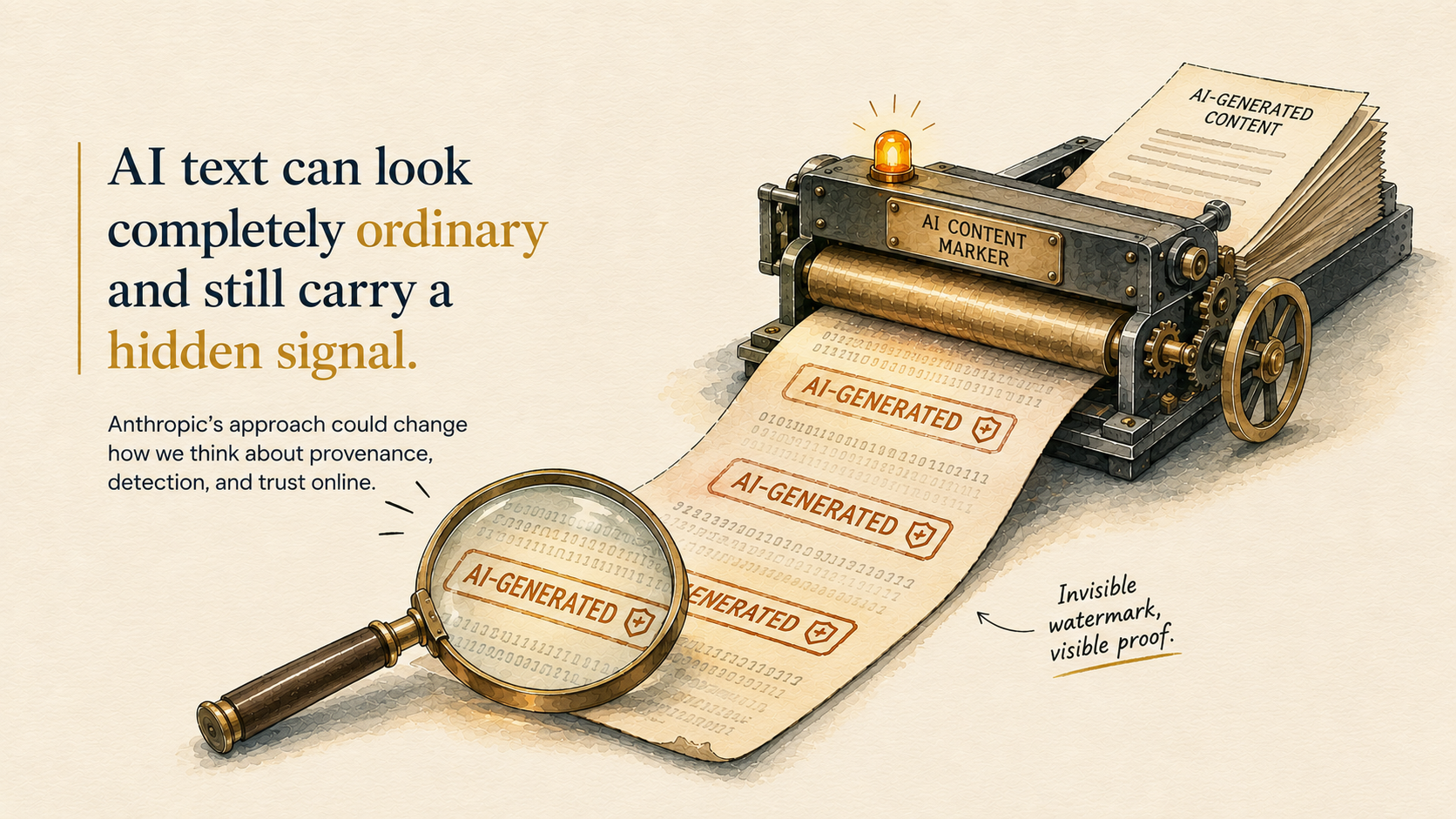
Claude weaves an imperceptible, statistical signal directly into generated text. It doesn't change how the text reads, and Anthropic says it won't affect quality. Because it's embedded in the text itself rather than attached as metadata, it travels with the content when copied and pasted elsewhere and may survive some editing.
File provenance metadata:
For generated files like SVGs, PNGs, and JPGs, Claude attaches signed metadata using the C2PA standard, the same open framework used across the broader content-authenticity industry.
This applies to models launched on or after August 2, 2026, and covers every surface: Claude the chat interface, the API, Claude Code, Claude Cowork, and Claude Tag. Anthropic says it's working to extend the capability to older models, but there's no committed timeline for that yet.
What a Watermark Can and Can't Tell You
This is the part most coverage has undersold, and it matters more for business use than the watermark itself does.
A mark means Claude touched the content. It doesn't mean Claude wrote it. If someone drafts a press release themselves and asks Claude only to fix punctuation or translate it, the resulting text can still carry a Claude mark. Anthropic is explicit about this limitation: the signal indicates processing, not authorship.
The reverse is equally true. Heavy editing, translation, or short passages can weaken or eliminate the watermark entirely, and older models won't carry one at all yet. So unmarked text is not reliable proof a human wrote it, and marked text is not reliable proof an AI wrote it start to finish. Anyone treating this as a clean authorship detector is going to be wrong in both directions.
What Founders Want to Know
Q. Does this affect the content my team publishes that Claude helped draft?
Yes, potentially. If you use Claude to write a blog post, LinkedIn update, or job description and publish it with minimal editing, that content will likely carry a detectable signal going forward. Platforms are moving fast in this direction already: Substack has partnered with a detection provider to flag AI content, and LinkedIn has been testing a feature to surface posts that read as AI-generated.
Q. Should we stop using Claude for public-facing content?
No, but it's worth being deliberate about disclosure norms now rather than after a platform flags something. Many audiences don't mind AI-assisted writing when it's disclosed; the backlash tends to hit companies that seem to be hiding it.
Q. Does this affect code written with Claude Code?
Anthropic's documentation lists Claude Code among the covered surfaces, though the practical implications for source code specifically are still being worked out industry-wide. Worth watching, not worth panicking about yet.
Q. Can the watermark be removed?
Anthropic hasn't published the technical specifications that would let outside researchers verify how resistant the watermark is to editing, and it has acknowledged the signal isn't foolproof. A heavy rewrite or translation can knock it out; light editing likely won't.
Q. Is a detection tool coming for teams that want to check their own content?
Anthropic has indicated that a text detection API is in development, which would let developers verify marks programmatically rather than relying on guesswork. No public release date has been confirmed yet.
Why This Matters Beyond Compliance
This is a preview of a broader shift, not an isolated policy update. Platforms are building AI detection into their infrastructure faster than most product teams are building disclosure policies to match. Startups that treat AI-generated content the way they'd treat any other compliance surface, with a clear internal policy on when disclosure is required, will be far better positioned than the ones scrambling after their first flagged post.
Key Takeaways
Anthropic will watermark text generated by Claude models released on or after August 2, 2026, driven by EU AI Act Article 50 obligations, applied globally.
Text watermarks are embedded in the content itself and can survive copy-paste and light editing; file metadata uses the C2PA standard and can be stripped through format changes.
A watermark signals that Claude processed the content, not that Claude authored it from scratch, and the reverse gap applies too.
Platforms including Substack and LinkedIn are already building AI detection into their own systems, independent of what Anthropic does.
Startups should build a disclosure policy for AI-assisted content now, rather than reacting after a platform flags something.
What This Means Going Forward
Watermarking isn't really about catching anyone. It's about a regulatory environment that's tightening faster than most product roadmaps anticipated, and startups that treat this as background noise are going to be caught flat-footed by the next platform policy change, not the last one.
Navigating this kind of shifting compliance and provenance landscape takes engineers who actually understand how AI systems, content authenticity standards, and regulation intersect, not just people who know how to prompt a model well. That's increasingly the kind of technical judgment MyNextDeveloper looks for when we match startups with vetted engineers and AI talent built for where this space is actually heading.
TL;DR
Anthropic confirmed Claude will now weave an invisible watermark into AI-generated text, plus signed metadata into files, applied worldwide, not just in the EU, even though EU AI Act rules are what forced the move. The catch: a watermark only proves Claude touched the text, not that it wrote the whole thing, so a human draft that Claude just proofread can still get marked. It works across every Claude surface - chat, API, Claude Code, Cowork - for models launched on or after August 2, 2026, with older models getting support later. For startups, the real takeaway isn't the watermark itself; it's that platforms like Substack and LinkedIn are already building AI detection in, so having a disclosure policy now beats scrambling after something gets flagged.
Looking to build a high-performing remote tech team?
Check out MyNextDeveloper, a platform where you can find the top 3% of software engineers who are deeply passionate about innovation. Our on-demand, dedicated, and thorough software talent solutions provide a comprehensive solution for all your software requirements.
Visit our website to explore how we can assist you in assembling your perfect team.