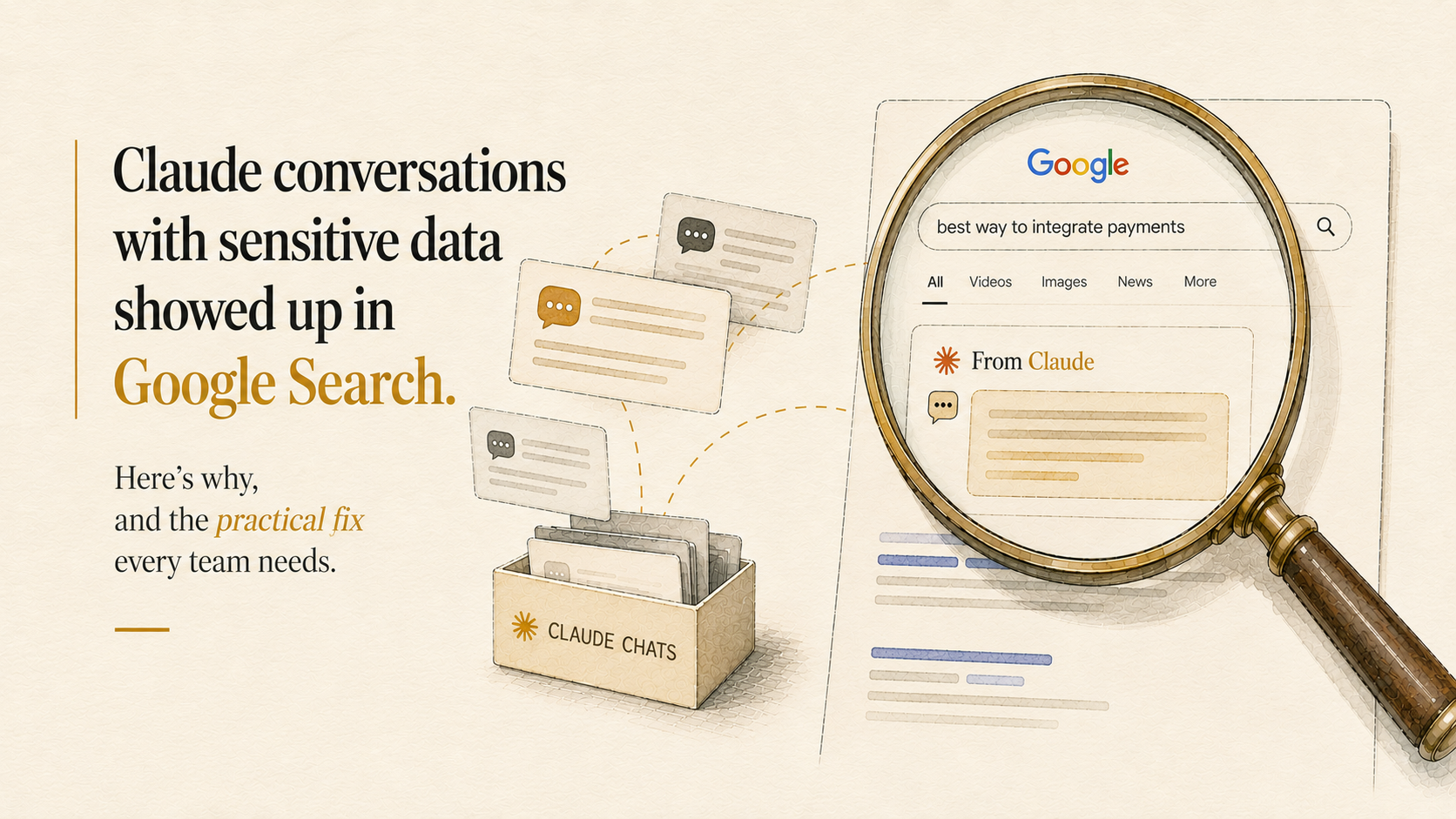
Someone on Reddit typed a simple search operator into Google. What came back was a long list of shared Claude conversations, some containing health records, private company documents, and even the names and phone numbers of children.
That's not a hypothetical. It happened in late July 2026, and it's the kind of story that should make every startup using AI tools in daily workflows stop and check their own settings, not just read the headline and move on.
We want to walk through exactly what happened, why it happened, and the practical steps your team should take right now, because this isn't really a story about one company's bug. It's a story about how "share" and "private" mean different things than most people assume.
What Actually Happened
Reddit and X users discovered that typing a search operator like site:claude.ai/share into Google surfaced a long list of shared Claude conversations and Artifacts - the interactive apps, documents, and tools users build inside Claude. Some of what turned up included crypto wallet keys, names, addresses, and work notes, alongside more sensitive material like health records and private company documents.
Anthropic's position was direct: the company doesn't share chat directories or sitemaps with search engines, and shareable links aren't guessable or discoverable unless someone chooses to share them themselves. That's true, and it's also not the whole picture. Once a user generates a public link and posts it somewhere a search engine can crawl — a forum, a social post, a comment thread — that page becomes public web content like any other, and it gets indexed the same way.
This wasn't even the first time. A similar issue surfaced roughly a year earlier, when Google had indexed just under 600 Claude conversations before those pages disappeared from search results. The pattern repeating suggests this is a structural risk in how AI sharing features work generally, not a one-off mistake.
Why This Isn't Just Anthropic's Problem
This same failure mode has now shown up across nearly every major AI chat product. OpenAI briefly tested letting users opt in to having ChatGPT conversations indexed by search engines, then reversed the experiment within days after acknowledging it created too many opportunities for people to accidentally share things they didn't mean to. Separately, a security researcher was able to scrape roughly 100,000 ChatGPT conversations that had been set to shareable. Google's own Bard chatbot had the identical issue back in 2023, when shared links were found indexed and searchable using the same kind of site-specific search query.
The common thread across all of these: a "share" button that behaves more like publishing than messaging, and users who don't realize the difference until it's too late.
What Startups and Founders Actually Need to Know
Does this mean Claude conversations are public by default?
No. Claude conversations and Artifacts are private by default. The exposure only affects conversations a user explicitly generated a public link for, then posted somewhere crawlable. If you've never clicked "share" on a conversation, it isn't part of this.
How do I check if my team has exposed anything?
Inside Claude, go to Settings, then Privacy, then Shared Chats. That page shows every conversation or Artifact you've generated a public link for, and lets you revoke access. This takes five minutes and should be a standing item on any startup's security checklist, not a one-time reaction to a headline.
Should my team stop using Claude's share feature entirely?
Not necessarily, but treat it the way you'd treat any public web content. If a conversation contains customer data, financial details, health information, or anything about a real person who hasn't consented to being findable, don't share it, full stop. Use it for genuinely shareable material: a prototype, a public-facing draft, something you'd be fine with a stranger reading.
What's the actual fix here, since Anthropic can't control every site a link gets posted to?
The honest answer is that no AI provider fully controls this, because indexing happens once content becomes reachable from a crawlable page, not through the AI company's own systems. The mitigation is on both sides: providers can make sharing intent clearer and links harder to guess, and users need to treat "generate a link" as "consider this public," not "share with a few people."
Is this a reason to avoid AI tools for sensitive work entirely?
No, but it's a reason to be deliberate about which tool handles which kind of data, and who on your team understands that distinction. This is increasingly a real skill gap, not a footnote, especially for startups handling customer or health data inside AI-assisted workflows.
The Practical Lesson for Startups
Picture a recruiter using Claude to draft candidate feedback notes, then sharing the conversation link with a hiring manager over Slack instead of copy-pasting the text. If that link gets posted somewhere public later, even accidentally, a candidate's private feedback is now one search query away from anyone. That's not a far-fetched scenario. It's exactly the pattern that caused this incident in the first place.
The fix isn't complicated: default to copy-paste for anything containing real names, real data, or real people, and reserve shareable links for content you'd genuinely be fine seeing indexed.
Key Takeaways
Reddit users discovered shared Claude conversations and Artifacts indexed on Google using a simple search operator, some containing sensitive personal and business data.
Claude conversations are private by default; exposure only affects links users explicitly generated and then posted somewhere crawlable.
This same failure pattern has hit ChatGPT, Bard, and Claude more than once, suggesting it's structural to how AI sharing features work, not isolated to one company.
Anyone using AI tools for candidate, customer, or health-related work should default to copy-paste over shareable links for anything sensitive.
Checking Settings > Privacy > Shared Chats should be a routine part of any startup's security hygiene, not a one-time reaction.
Conclusion
This incident isn't really about Anthropic having a bug. It's about a gap between how AI sharing features are designed and how people intuitively use them, and that gap keeps producing the same kind of headline across every major AI product. The startups that come out ahead here aren't the ones avoiding AI tools. They're the ones building basic data hygiene into how their team actually uses them.
That kind of judgment - knowing which tool to trust with which kind of data and building workflows that don't leak by accident - is increasingly part of what separates a strong technical hire from an average one. If your team is scaling and needs engineers who already think this way about AI tooling and data handling, that's exactly the kind of talent MyNextDeveloper helps startups find.
TL;DR
Someone found a way to Google their way into other people's private-feeling Claude conversations - health records, company docs, even kids' names, all sitting in plain search results. Turns out "share" and "private" aren't the same thing, and this has now bitten Claude, ChatGPT, and Google's own Bard at different points. Nothing was hacked; people just didn't realize a shared link can end up as public as any other webpage once it gets posted somewhere Google can see it. The fix is boring but real: don't share sensitive stuff as a link, copy-paste it instead, and go check your own shared chats settings today, not "someday."
Looking to build a high-performing remote tech team?
Check out MyNextDeveloper, a platform where you can find the top 3% of software engineers who are deeply passionate about innovation. Our on-demand, dedicated, and thorough software talent solutions provide a comprehensive solution for all your software requirements.
Visit our website to explore how we can assist you in assembling your perfect team.