Nobody has heard of your company yet, and honestly, that’s okay.
You might look at that as something you need to fix later, once you have more employees, more customers, more funding, or a bigger marketing budget.
But there’s another way to look at it. This is actually when your reputation starts being built.
Whether you realize it or not, people are already forming opinions about your company. They might see your founder’s LinkedIn profile, visit your website, read a job post, talk to someone who interviewed with you, or simply hear about the company from a friend.
At ten employees or fewer, you don't have a big employer-branding team taking care of this. You have something much simpler: the decisions you make, the way you communicate, and the way you treat people, and candidates are paying attention to all of it.
Candidates Notice More Than You Think
When people hear “employer brand,” it can sound like something only big companies worry about. You imagine expensive careers pages, professional photos, company videos, employee stories, and a team dedicated to making the company look great. But you don't need any of that when you're just starting out.
In fact, trying to look like a huge company when you're still a team of five can sometimes have the opposite effect. People don't expect a five-person startup to have everything figured out. They do expect it to be honest.
That's important because candidates care about a company's reputation long before they ever get to an interview. A LinkedIn survey found that 92% of candidates consider a company's reputation before applying. Separately, 81% of job seekers say they wouldn't join a company with a bad reputation, even if they were unemployed.
Think about what that means. You might spend weeks trying to find the right person, but the candidate could make a decision about you in a few minutes, and you might never know they were interested in the first place.
Being Small Might Actually Be Your Advantage
For years, the biggest technology companies had an obvious advantage when it came to hiring.
Everyone knew their names, people recognized the logo, they knew the salaries were competitive, they knew the companies had resources and prestige, and startups often had to compete with that.
But the way people think about careers is changing.
Large technology companies have gone through significant layoffs, and many experienced professionals are now more open to considering smaller companies. At the same time, recent research suggests that candidates increasingly care about things like meaningful work, ownership, and having an impact, not just having a famous company name on their résumé.
One survey found that 58% of candidates consider impact and ownership their top career priority, compared with 23% who prioritize brand prestige.
That's good news for startups, because you can offer something a large company often can't.
A person joining a ten-person company might have a real say in what gets built. They might work directly with the founder. They might own an important part of the business instead of being one person in a team of hundreds.
Being small isn't automatically a disadvantage. You just have to explain why being small is worth it.
So What Does “Building a Name” Actually Mean?
It doesn't mean making your company look bigger than it is. It means giving people enough real information to understand what kind of company you're building.
For example, when a founder talks publicly about a difficult decision they made, or when a founder shares a lesson from something that didn't work, or when a job post clearly explains what the person will actually be working on, candidates learn something, and when you promise to get back to someone after an interview and actually do it, even when the answer isn't good news, that tells candidates something too.
These small things add up.
Be Visible, But Be Real
You don't need a founder posting on LinkedIn every day, but when they do, it should feel like there's an actual person behind the company, not another polished announcement. Share a real decision, a lesson, a mistake, or something you're figuring out.
Candidates don't need a perfect founder. They want to understand who they might work with.
Give People a Real Reason to Join
“Join us on our mission to change the future” sounds nice, but it doesn't tell someone much.
A much better answer is something like: “You will be one of the first five people on the team, you will work directly with the founders, and you will own this product from the ground up.”
Now the candidate can understand the opportunity. They can decide whether that kind of responsibility excites them.
Do What You Say You Will Do
This is probably the simplest part of building a good reputation.
If you say your company values transparency, be transparent. If you say you will respond by Friday, respond by Friday. If you say the hiring process has three steps, don't suddenly add five more without explaining why.
At a small company, these things matter even more because there aren't hundreds of other interactions to balance them out.
One bad experience can become someone's entire impression of your company.
Show Proof Instead of Making Claims
Almost every company says they're fast-moving, they have a great culture, and employees get ownership. Those words don't mean much on their own.
Instead of saying, “We move fast,” tell people what that actually looks like.
Maybe your five-person team launched three major features in six months, engineers speak directly with customers, and maybe a new hire owns an entire product area from their first month.
Specific examples are much easier to trust than big promises.
What If We Don't Have Much Yet?
This is one of the biggest concerns we hear from early-stage founders. Maybe you don't have millions in revenue, you don't have famous customers, you don't have dozens of employees posting about how great the company is, and that's okay because you don't need to pretend you do.
Talk about how you work instead.
Explain how decisions get made, what someone joining today would actually own, talk about what you're trying to build and why you believe it matters, and be honest about the risks too.
Someone joining a five-person startup already knows there's uncertainty. You don't need to hide that.
Does This Matter If We're Only Making a Few Hires?
It does, and probably more than you think. If you're hiring hundreds of people every year, one bad candidate experience becomes a very small part of the overall picture.
At a five- or ten-person company, it's different. Every candidate interaction carries more weight, where one person has a bad experience and tells three friends; another has a great experience and recommends your company to someone they know.
Those stories travel, and because your company is small, they can become part of your reputation surprisingly quickly.
What If Candidates Know the Big Companies, Not You?
You don't necessarily have to compete. Instead of trying to convince someone that you're better than a famous technology company, show them what they can do at your company that they probably can't do there.
Maybe they will work directly with the founder, they will have ownership over an entire product, they will see their work reach customers within weeks instead of months, they will help shape the culture instead of simply joining one. That's a much stronger story than trying to look like a smaller version of a big company.
Don't compete on what you don't have. Compete on what you genuinely offer.
Start With What You Have
You don't need a branding agency, you don't need a huge content budget, and you don't even need to post every day. You can start small.
Have your founder share something real every couple of weeks — talking about a decision you're making, sharing something you learned, explaining a problem you're trying to solve, or discussing something that didn't work. Most importantly, make sure the experience candidates have matches what you're saying publicly.
Over time, those small signals start to form a picture, and that picture becomes your reputation.
The Difference Is in the Details
Imagine two five-person startups are hiring for the same position.
The first company describes itself as “a fast-growing startup disrupting the industry.” The founder hasn't posted anything in months, the job description is generic, and candidates don't hear back after their interviews.
The second company is also only five people.
But its founder occasionally shares what they're learning. The job post explains exactly what the new hire will work on, candidates know what the interview process looks like, and even when the company doesn't have an update, they hear back.
Neither company is famous or has a huge employer-branding budget, but one feels much easier to trust, and when a strong candidate has other options, that feeling can be enough to decide where they apply.
What Founders Should Remember
You don't need thousands of employees to have an employer brand. You already have one.
It's being built every time a candidate interacts with your company.
It's in the job description you publish.
It's in the way your founder talks about the business.
It's in how quickly you respond to people.
It's in whether your promises match reality.
It's in what former candidates tell their friends.
And at a company with fewer than ten employees, those things matter even more because every interaction carries more weight.
You don't need to look impressive. You need to be believable.
Build It Before You Need It
The best time to build a reputation isn't when your company is already well known. It's now.
Before you have hundreds of employees. Before you have a big HR team. Before candidates have heard ten different stories about your company.
Be honest about what you're building.
Give people a real reason to join.
Show the work instead of making empty promises.
And most importantly, treat candidates the way you'd want your future employees to be treated.
Because your reputation isn't something you launch one day.
It's something you're building with every decision, every conversation, and every candidate you meet.
And if you'd rather spend your time building the company than figuring out how to find the right people for it, that's where MyNextDeveloper helps by connecting early-stage startups with vetted engineers and AI talent who are looking for meaningful work, real ownership, and the chance to build something from the ground up.
TL;DR
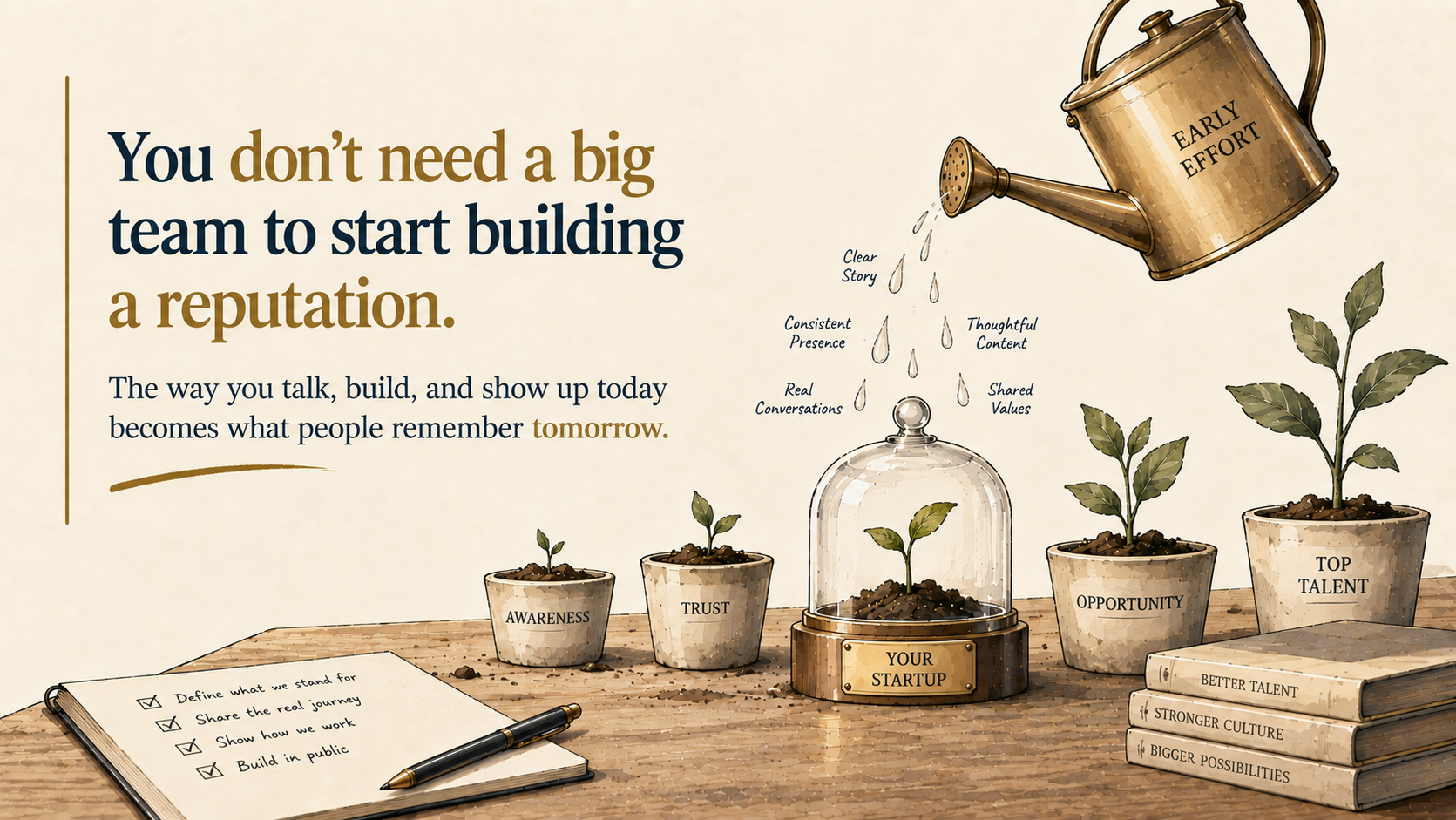
You don't need a big team, big budget, or famous name to build a reputation people trust. At an early-stage startup, your reputation is built through small things: how your founder shows up, how clearly you explain the job, whether you keep your promises, and whether the experience matches what you say publicly.
You don't have to look like a big company. You just have to give people a real reason to believe in yours.
Looking to build a high-performing remote tech team?
Check out MyNextDeveloper, a platform where you can find the top 3% of software engineers who are deeply passionate about innovation. Our on-demand, dedicated, and thorough software talent solutions provide a comprehensive solution for all your software requirements.
Visit our website to explore how we can assist you in assembling your perfect team.