
AI vs. Google: Who Will Answer Your Questions in 2026?
Imagine this…
It’s 2026. You are in the middle of a conversation with a friend, arguing that oat milk is the best for coffee. The first thing that comes to your mind is your phone. Would you use Google as we have done for decades, or would you simply speak to your AI assistant and expect a prompt, straight, and customized reply?
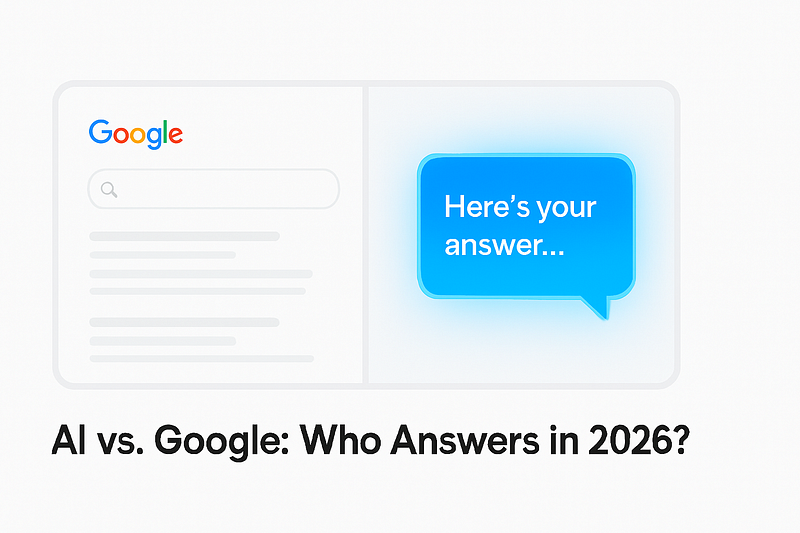
That seemingly insignificant decision — whether to use Google or AI — marks the spot where the future of search is unfolding. And believe me, the manner of our getting solutions is going to change more in the following two years than it has in the last twenty.
Google: The Old Giant, Still Standing Tall
Google has essentially been our go-to source for answers for ages. Actually, by mid-2025, it was still in the lead with around 89% of the worldwide search traffic. However, such a level of supremacy does not just fade away with the blink of an eye.
Nevertheless, Google is well aware that the situation it finds itself in is changing. This is the reason why it has been implemented:
- AI Overviews — Small, AI-produced summary at the very top of the search result page. Often, half of a user’s screen is already covered with the summary before any links are identified.
- AI Mode — A Gemini-powered interactive feature that allows users to perform follow-up questioning, view graphics, and further probe without exiting the current page.
In other words, Google isn’t just a “search engine” anymore. It’s morphing into what some call an answer engine — a tool that gives you results directly, no extra clicking required.
The Rise of AI-First Answer Engines
While Google is struggling to reinvent itself, new players are gaining attention, and they don’t say a word.
- OpenAI’s ChatGPT, Perplexity, and Claude — The tools that allow you to ask questions in natural language and get answers that feel like a conversation.
- You.com — A chat-first, more private alternative that is always a few steps ahead due to citing live sources.
- Microsoft & Cloudflare — The two giants that are working on decentralized web standards as a way to reduce reliance on Google.
A kicker: People are already switching. A recent survey revealed 55% of U.S. users now use AI tools instead of Google for everyday tasks like trip planning, troubleshooting, or even writing help. In the UK, it is 62%. This change is not minor — it is a landslide movement.
2026: The Year Search Splits in Two
Well, what will be the consequences if we proceed a bit into the future?
- Google is not going to disappear. It still rules over the infrastructure, the ads, and the brand loyalty. However, Gartner forecasts a 25% decrease in traditional search volume by 2026. (Bounteous).
- AI will take over more territory. As a result, platforms like ChatGPT become “one-stop shops” for users’ queries. The opinion of some analysts is that AI-powered search may outperform traditional methods four years later, i.e., by 2028 (Exploding Topics).
Think of it this way: you’ll still “Google” things, but maybe for maps, shopping, or fact-checking. For direct advice, creative planning, or complex explanations, you’ll turn to AI.
The Hidden Impact: Brands and Content Creators
The change doesn’t only affect the way you search. It alters the entire internet system.
Right now, websites are struggling to increase their visibility through SEO keywords, backlinks, and rankings. However, the question is, if AI is the one delivering the answers, then who gets the credit?
Enter Answer Engine Optimization (AEO).
The content visible in 2026 needs to be:
- Organized like FAQs.
- Simple for AI to quote directly.
- Supported with reliable sources.
The fallout is that if your brand is not part of the AI responses, then it is as good as dead. That is how high the stakes are.
So, Who Wins — Google or AI?
The real answer is: neither “wins,” because both are evolving into something new.
- Google will still be the core of the internet, but it is gradually becoming AI-powered, shifting from a place for links to a tool that directly provides answers.
- The AI platforms are positioned as easy-to-reach spots for assistants, guides, and even copilots — more personalized and conversational.
- Users (that’s us!) get the biggest advantage. You will be able to access quicker and more intelligent answers than you ever have before, whether you are planning a trip, repairing your laptop, or deciding whether oat milk is worth it.
Looking to build a high-performing remote tech team?
Check out MyNextDeveloper, a platform where you can find the top 3% of AI engineers who are deeply passionate about innovation. Our on-demand, dedicated, and thorough software talent solutions provide a comprehensive solution for all your software requirements.
Visit our website to explore how we can assist you in assembling your perfect team.