Freelancers got your app or website built. That's not a small thing, and it's not something to feel bad about. A lot of great companies started exactly that way.
But there's a moment, usually right around the time your product starts actually taking off, when the same approach that got you this far quietly starts holding you back. Most founders don't see it happening in the moment. They just notice the symptoms: a bug that takes three days to fix because nobody remembers why something was built a certain way, a freelancer who stops replying halfway through a project, or a website that feels like it was stitched together by five different people who never once talked to each other.
Because, honestly, it probably was.
Here are seven honest signs that it's time to stop patching things together with freelancers and start building a real team — plus what that actually costs, in plain numbers.
1. You're Spending More Time Managing People Than Actually Building Your Product
If most of your week is spent chasing people down for updates, re-explaining the same thing to a new freelancer, or trying to make five different people's work fit together, that's a full-time job now. It's just not the job you started your company to do.
Freelance work is built for short, clearly defined tasks. That's what makes it great for a quick project. It's also exactly what makes it exhausting once you need something bigger and longer-term. The moment you're spending more energy managing people than building your actual product, the "cheap and flexible" option has quietly become expensive in a different way: your time.
2. Your Product Feels Like It Was Built by Strangers, Because It Was
Every freelancer works a little differently. Different habits, different shortcuts, different opinions on how things should be done. None of them were in the room when the last person made a decision, so nothing quite lines up.
The result is something that technically works, but that nobody, including you, fully understands anymore. Every new person who touches it has to spend weeks just figuring out what's already there before they can even start improving it.
A real team, working together over time, naturally builds things the same way, because they're actually talking to each other and building on what came before.
3. One Person Knows How Everything Works, and They Don't Work for You Full-Time
This is the risk most founders don't think about until it's too late. If the only person who understands how your payments work, or how your data is stored, is a freelancer who might not take your next project, you don't really own that part of your business. You're borrowing it.
Ask yourself honestly: if that person disappeared tomorrow, how long would it take someone else to understand what they built well enough to safely fix or improve it? If your answer is "weeks," that's not bad luck. That's the actual cost of never having anyone stick around long enough to really know your product.
4. Your Business Has Grown Past "One-Off Projects"
Early on, most of the work really is one-off: build the website, set up the login page, connect the payment system. Once you have real customers, the work takes on a different shape. It's no longer "build this one thing." It's "keep this whole system healthy, watch it, and improve it, for years, not weeks."
Freelancers are built for the first kind of work. Nobody signs up for a freelance gig that means "quietly take care of this forever." That kind of ongoing care is exactly what a real team is for.
What Does This Actually Cost in a Simple, Honest Comparison?
Here's where a lot of founders get surprised.
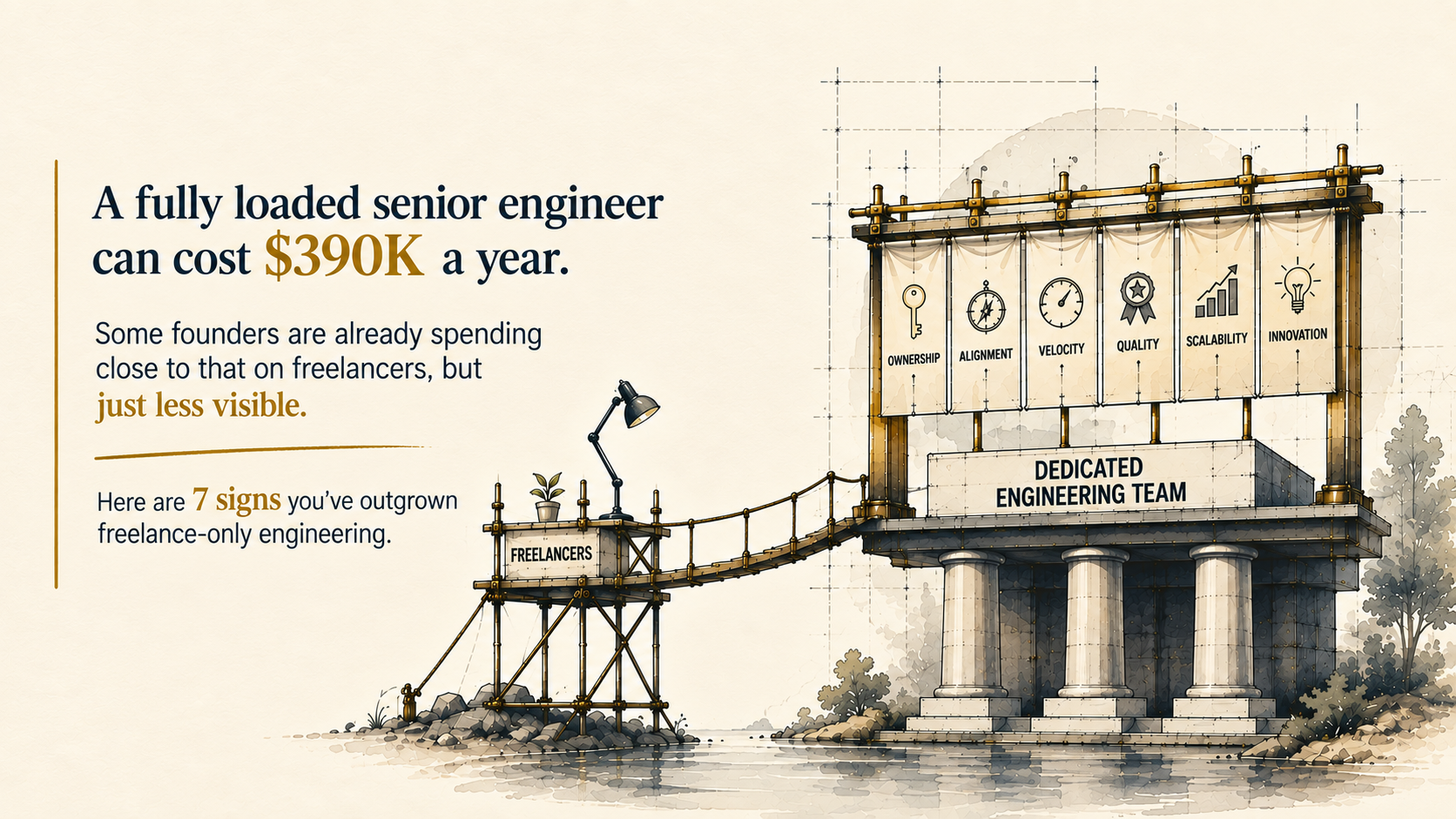
A full-time engineer with a $200,000 salary doesn't actually cost your company $200,000 a year. Once you add in things like health insurance, taxes, and other basics every employer has to cover, that same hire usually costs somewhere between $280,000 and $390,000 a year in total.
Meanwhile, skilled freelancers, especially ones with specialized skills in newer areas like AI, are increasingly charging $100 to $300 an hour for their time, and that's because freelancers have to charge more per hour to make up for not having steady work, benefits, or job security.
5. Your "Cheap" Freelancer Spending Has Quietly Added Up to Almost the Same Cost
Add up everything you've paid different freelancers over the last year, including all the time each new person needed just to get up to speed. A lot of founders are shocked to find they've already spent close to what a full-time hire would have cost, just spread across more people, with far less to show for it in terms of someone who actually knows the product well.
6. You Need People Who Understand "Why," Not Just People Who Follow Instructions
Freelancers are great at doing exactly what you ask them to do. They're much less equipped to make good judgment calls when things are unclear, because they don't know where your business is headed next month or next year, and honestly, it's not their job to think that far ahead.
Once your business needs people making real decisions with the bigger picture in mind, not just finishing today's task, that's simply a different kind of person to hire.
7. Investors or Bigger Customers Are Starting to Ask Who's Actually on Your Team
At a certain point, "we use a rotating group of freelancers" stops sounding scrappy and smart, and starts sounding like a risk to people considering investing in you or signing a big contract with you. Bigger customers in particular often want to know there's a real, stable team behind the product they're trusting, not a revolving door of contractors.
Key Takeaways
Freelancers are great for short, clear, one-off tasks. They're not built for taking care of something long-term.
A full-time engineer usually costs more than the salary number suggests, once you add benefits and taxes, but skilled freelancers charge a premium too, so the gap is often smaller than people assume.
If only one person understands a key part of your product, and they're not committed long-term, that's a real risk to your business, not just an inconvenience.
A messy, inconsistent product and constant people-management are early warning signs, not just annoyances.
Bigger customers and investors increasingly care whether you have a real, stable team, not just a list of contractors.
TL;DR
Freelancers are great for shipping a quick MVP, but there's a moment, usually right as things start taking off, where that same setup quietly starts holding you back. The warning signs: you're spending more time managing people than building, your codebase looks like it was stitched together by strangers, one contractor holds all the key knowledge, and investors or big customers start asking who's actually on your team. The real surprise is cost: a full-time engineer often runs $280K–$390K a year fully loaded, but skilled freelancers now charge $100–$300/hr too, so the gap is smaller than founders assume.
What This Means for the Future
None of this means hiring freelancers early on was a mistake. For most companies, it's exactly the right call. The mistake is treating freelancers as a permanent solution instead of a helpful starting point, and not noticing when your business has quietly outgrown that approach.
If two or more of these sound familiar, that's actually a good thing. It usually means your business is doing something right, and it's ready for the next step. When you get there, MyNextDeveloper helps startups make that move properly, connecting founders with carefully vetted, top-tier engineers and AI talent who are ready to stick around and actually own what they build, not just check a task off a list.
Looking to build a high-performing remote tech team?
Check out MyNextDeveloper, a platform where you can find the top 3% of software engineers who are deeply passionate about innovation. Our on-demand, dedicated, and thorough software talent solutions provide a comprehensive solution for all your software requirements.
Visit our website to explore how we can assist you in assembling your perfect team.