
Tokenmaxxing crashed, and here’s what startups actually owe their boards about AI spend
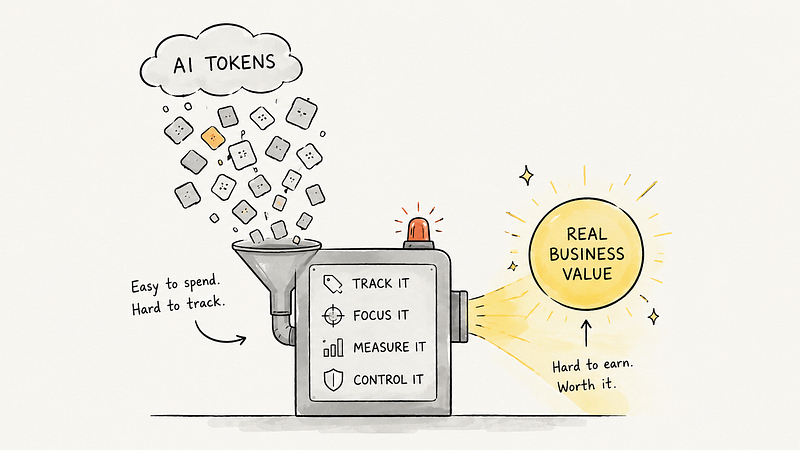
Not long ago, companies were running internal leaderboards to see which team could burn the most AI tokens in a month. Meta had one. Amazon had one. NVIDIA’s CEO publicly said he’d be “deeply alarmed” if a $500K software engineer wasn’t spending $250K a year on tokens.
That era has a name: Tokenmaxxing, and it’s over.
In April 2026, companies started calling the FinOps Foundation, saying they were already 3x over their entire 2026 token budget, barely four months into the year. The conversation shifted overnight from “go fast and burn tokens” to “we need guardrails, how do we control this?”
Uber burned through its entire 2026 AI coding budget by April. Microsoft cancelled Claude Code subscriptions across key product divisions. And somewhere in there, a company no one has named yet reportedly racked up a $500 million Claude bill because nobody set a usage limit.
For startups, this isn’t just a big-company problem. It’s the board conversation that’s heading your way.
What Tokenmaxxing Actually Was (And Why It Made Sense at the Time)
Tokenmaxxing described the push to burn through as many AI tokens as possible, treating heavy usage as a shorthand for productivity. The logic wasn’t entirely crazy - early AI adoption required experimentation, and when CEOs were publicly demanding teams move fast and use the best models regardless of cost, “burn more tokens” was effectively company policy.
The problem is what happened next.
A study of 2,444 companies found that for every $1 enterprises spend on AI tokens, $0.44 goes toward fixing bugs generated by AI, $0.27 toward rewriting AI-produced code, and $0.11 toward review and merge delays. That’s $0.82 of every dollar going toward cleaning up the output, not creating value from it.
The engineering analytics firm Faros AI found that code churn — lines of code deleted versus added — increased by more than 800% under high AI adoption. More tokens, more waste, more rework.
Tokenmaxxing didn’t measure productivity. It measured activity. Those are not the same thing.
Q&A: The Exact Questions Your Board Is Now Asking
Q. What did we actually spend on AI last quarter?
This sounds basic. Most startups can’t answer it cleanly. The single most important structural change you can make is isolating AI spend so it’s visible and attributable. Tag costs consistently so that when you build the ROI narrative, the cost side is credible. If your AI costs are buried inside general cloud infrastructure or engineering headcount, you’re going into that board conversation unarmed.
Q. What did we get for it?
Boards that spent 2024 asking “what’s your AI strategy?” are now asking “what did it cost, what did it return, and how do you know?” According to Kyndryl’s 2025 Readiness Report, 61% of senior business leaders feel more pressure to prove AI ROI than they did a year ago. The answer boards want isn’t “our engineers are more productive.” It’s revenue impact, cost reduction, or cycle time compression in actual numbers.
Q. Are we using AI on the right things?
Most companies default to automating tasks people dislike rather than tasks most valuable to the business. If your team’s primary AI use cases are summarising emails and generating boilerplate, the board is right to question whether that’s the best use of the budget.
Q. How long until we see a real return?
Half of investors expect AI returns within six months. Only 16% of CEOs think that’s achievable. That gap is where bad board conversations happen. Set the timeline early and explain it clearly; otherwise, boards apply the wrong benchmark and conclude the investment failed when it was simply early.
What Startups Actually Owe Their Boards: A Practical Framework
1. A Cost Line That’s Visible and Tagged
You cannot defend spending you cannot see. Every AI-related cost — model API calls, agent infrastructure, tooling subscriptions, and engineering time on AI projects — needs to be tagged and tracked separately. 97% of CFOs say their boards expect a regular readout on AI investment and progress, with cost savings, ROI, and productivity gains topping the list. Give them that readout before they have to ask for it.
2. A Use Case List, Not a Philosophy
“We’re integrating AI across the business” is not a board update. What boards need is a short, honest list: which specific use cases are live, what they cost to run, and what measurable outcome each one is producing. Three use cases you can measure beat twelve you’re “exploring.”
3. Leading Indicators While You Wait for Lagging Ones
AI ROI takes longer to show up in revenue than most people expect. The metrics that maintain board confidence share three traits: baselined (measured against a documented before-state), unit-based (cost per task, cycle time, error rate, not vague “productivity”), and traceable (evidenced by data, not asserted). If your payback is 18 months out, show the trajectory at month six.
4. An Honest Answer About What Isn’t Working
The worst thing that can happen in a board AI conversation is being caught defending something that quietly failed months ago. Pick the use cases that aren’t delivering, say so, and explain what you’re doing differently. Boards can handle a pivot. They struggle to trust a team that only reports wins.
The Shift That’s Already Happened
Tokenmaxxing was the AI equivalent of measuring developer output by lines of code. Everyone knew it was a flawed metric — it was just easier than measuring actual impact.
The correction isn’t a retreat from AI. Despite the pullback from heavy token use, generative AI usage remains at an all-time high. Google reported that Gemini jumped from 480 trillion tokens per month in May 2025 to 3.2 quadrillion tokens per month by May 2026. The technology is being used more than ever. The difference is that the free pass on accountability is gone.
For startups, that’s actually good news. If you can show up to your next board meeting with a clean cost line, a short list of use cases that are working, and honest numbers, you’re already ahead of most.
The board isn’t asking you to slow down on AI. They’re asking you to know what you’re doing with it. That’s a reasonable ask.
TL;DR
Tokenmaxxing — the race to burn as many AI tokens as possible — collapsed when companies like Uber burned through their entire 2026 AI budget by April, and one unnamed company racked up a $500 million bill with no guardrails in place. Boards have stopped accepting usage stats and productivity claims as proof; they now want a clean cost line, specific use cases, and real numbers tied to revenue or savings. Startups that walk into that conversation prepared with visible spend, honest metrics, and a realistic timeline will come out ahead of the majority that are still measuring activity instead of outcomes.
Looking to build a high-performing remote tech team?
Check out MyNextDeveloper, a platform where you can find the top 3% of software engineers who are deeply passionate about innovation. Our on-demand, dedicated, and thorough software talent solutions provide a comprehensive solution for all your software requirements.
Visit our website to explore how we can assist you in assembling your perfect team.