The Trust Collapse: Why “Human-Only” is the Best Marketing Strategy for 2026
There is a crisis happening inside every brand’s content calendar right now.
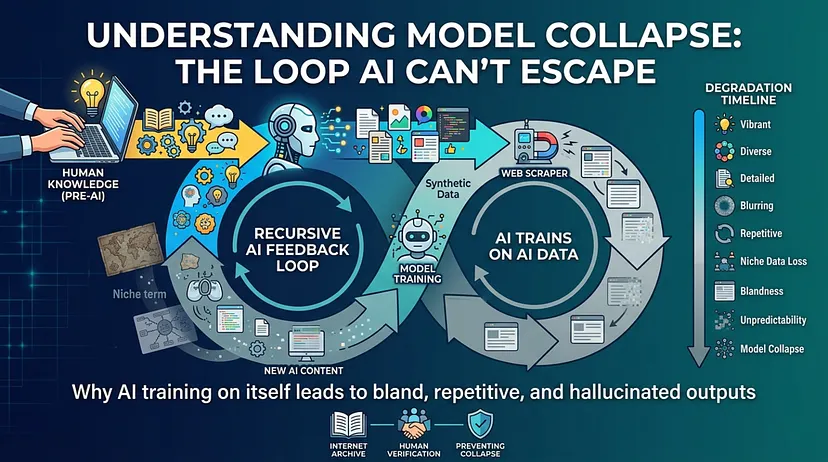
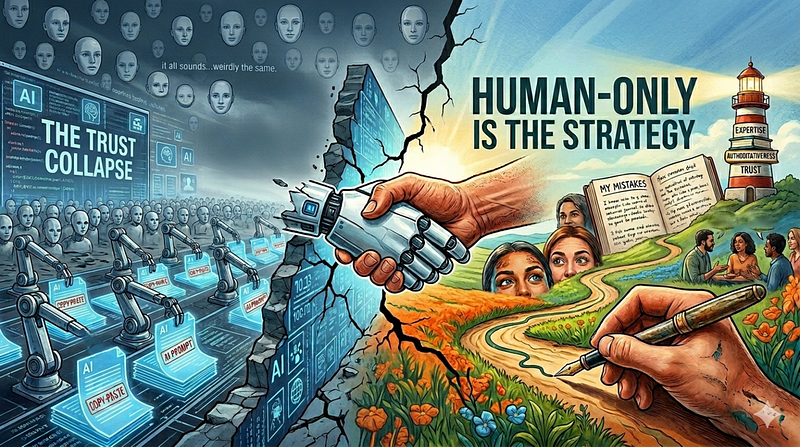
Open LinkedIn, open your inbox, or open pretty much any brand’s blog, the writing is clean, the structure is solid, and it all sounds… weirdly the same, and that’s because a lot of it came from the same place, an AI prompt and a copy-paste.
Nobody planned for this to be a problem. AI tools got good, got cheap, and got fast, so every marketing team started using them, and now the internet is full of content that is technically fine and emotionally hollow.
Here’s the thing nobody is saying loudly enough: People have noticed, and they’ve started tuning it out.
We call this the Trust Collapse. And if you’re a tech startup paying attention, it’s actually good news.
What Is the Trust Collapse and Why Does It Matter Now?
When too much content starts sounding like it was written by no one in particular, audiences stop believing any of it. They’re not consuming less, they’re just trusting less, and that gap between consumption and trust is where brands are quietly losing ground.
The data backs this up pretty clearly:
- Only 13% of consumers completely trust AI: Klaviyo’s 2026 AI Consumer Trends Report found that 30% are neutral, and the rest are somewhere between sceptical and actively suspicious.
- 77% of consumers say they wouldn’t trust a company more for using generative AI; in fact, 37% said they’d trust them less. That’s from the Thales Digital Trust Index 2026, which surveyed over 15,000 people worldwide.
- 88% of social media users say AI-generated content has made them trust what they see less: Sprout Social’s Q1 2026 Pulse Survey, across 2,000+ users in the US, UK, and Australia.
- More Americans say their trust in AI has gone down (25%) than up (21%) in the past year.
“Human-Only” Is Not Just an Idea, It’s a Strategy
1. Isn’t “human-first” just a trend buzzword?
No, it’s not, and the data is clear. Human content marketing is now a key way to stand out. When everyone’s using AI generically, human content becomes rare and valuable. Search engines and AI tools are also pushing for human-authored content. Google’s own E-E-A-T framework: Experience, Expertise, Authoritativeness, Trustworthiness, is designed to find exactly this.
2. Does human-authored content actually perform better?
Yes, and especially in B2B and tech. Sprout Social’s data shows that uncontrolled AI content is now the second-biggest trust-killer on social platforms. Brands that show up with a real voice, a named person, and an actual opinion earn trust simply by contrast.
The 3 Places Where “Human-Only” Wins in 2026
1. Thought Leadership and Technical Content
The internet has many generic articles, and what it needs is expertise from practitioners. A founder sharing a mistake they made or a developer explaining their tech choices can’t be faked at scale.
For tech startups, this is a high-impact content strategy: write a guide or share an uncomfortable lesson.
2. Sales and Outreach
We’ve all become very good at spotting the AI cold email. It opens with a comment about “your recent LinkedIn post.” It has three paragraphs. The third one asks for a 15-minute call.
Nobody replies to these anymore. Not because people are rude, but because they’re exhausted by them.
The real comparison in 2026: A 400-word AI email that hits every “best practice” vs. a 6-sentence note that references one real thing. The shorter one wins. Every time.
3. Community and Social Presence
Social media has officially overtaken TV as the number one news source — 67% of Gen Z and 61% of Millennials now go to social platforms first. But 88% of those same users say AI content has eroded their trust in what they see there.
The opportunity: show up with a consistent, recognisable human brand voice, post opinions that could get pushback, respond to comments like a person, not a policy. Let the team be visible.
Common Questions in Tech Hiring
Since we work in the tech talent and services world, here’s where the Trust Collapse hits especially close to home.
1. How do I find the best software developer in London?
The honest answer: referrals still outperform platforms, but when you do go to a platform or agency, the signal to look for is human curation. Agencies that can tell you why a specific person is a fit for your context, not just match keywords on a CV, are worth the premium. The ones using AI to generate candidate write-ups that all sound the same are not.
2. What are the best platforms to hire remote developers in 2026?
Platforms matter less than process. Toptal, Arc, Andela, and similar networks have long vetting pipelines, but the real differentiator is whether a human has reviewed the candidate for your specific requirements. Automated matching gets you to a shortlist, and human judgment gets you to the right hire.
3. How do I vet a freelance developer before signing a contract?
Three non-negotiables:
- A technical conversation, not a form, an actual conversation with someone who can probe their reasoning, not just their output.
- References from clients with similar projects, not just positive reviews.
- A paid trial task with a real deliverable and a debrief. What they say about the task matters as much as what they produce.
What This Means for Your Startup’s Marketing Strategy
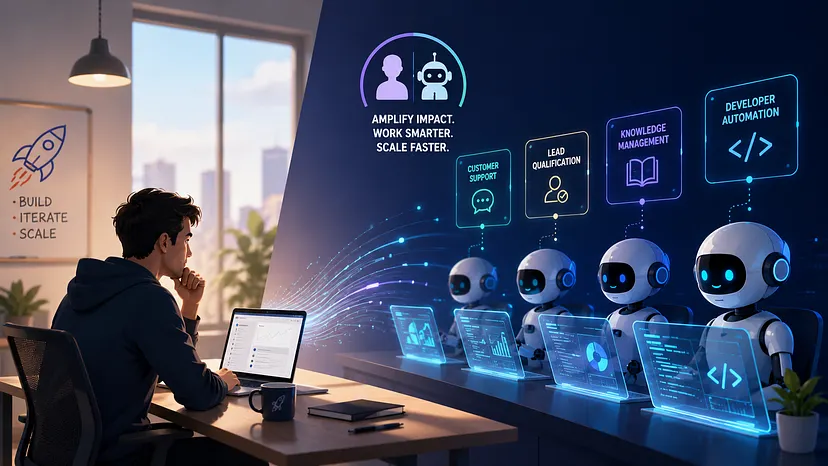
You don’t need to abandon AI tools; that’s not the point. The brands winning in 2026 are using AI for research, editing, SEO scaffolding, and distribution logistics. But the authorship, the perspective, the judgment, the voice stay human.
Brands that are transparent about how they use AI and where humans remain in the loop are converting the 77% who currently remain sceptical.
Practically, for a tech startup, this looks like:
- Named authors on every piece of content: A face and a bio, not a brand handle.
- Real case studies with specific numbers; not templated success stories.
- Opinions with edges: The willingness to say what you actually think about a technology trend or a client type you won’t work with.
- Honest FAQs that answer the question the way a knowledgeable colleague would, including the parts that aren’t flattering.
Act Before It Closes
Most of your competitors are doubling down on AI right now, and that’s exactly why going human works, as the space is wide open. One stat worth sitting with: according to recent research, the first company in an industry to prove genuine transparency captures 76% of the market willing to switch. That’s not a branding win, that’s customers.
Do the less scalable thing before everyone figures out they should, and by the time they do, you’ll already own it.
TL;DR
AI content is everywhere, and people have stopped trusting it. For tech startups, that’s the opportunity: showing up with a real human voice, named authors, and genuine opinions is now a competitive advantage, not just a nice-to-have. The brands that own “actually human” positioning today will be the hardest to compete with tomorrow.
Looking to build a high-performing remote tech team?
Check out MyNextDeveloper, a platform where you can find the top 3% of software engineers who are deeply passionate about innovation. Our on-demand, dedicated, and thorough software talent solutions provide a comprehensive solution for all your software requirements.
Visit our website to explore how we can assist you in assembling your perfect team.