
The Silicon Workforce: How Smart Startups Are Managing AI Agents Like Employees

The hiring conversation has changed, and many startup founders now think differently about the headcount. The question is no longer just “who do we hire next?” but “what do we build next and how do we manage it?”
Welcome to the era of the Silicon Workforce.
What is the Silicon Workforce, and Why Should Startups Care?
AI agents are software systems that plan, take actions, use tools, and complete tasks with varying degrees of autonomy. They are like a hire who works around the clock, never asks for time off, and scales on demand.
The numbers support this: 79% of companies have already adopted AI agents, and two-thirds of those adopters report value in increased productivity.
How Are Startups Actually Deploying AI Agents?
What roles are AI agents best suited for in early-stage startups?
Start narrow, then expand. Most startups overbuild their agents before they even have 100 users; they jump to agent orchestration.
The ROI starting points are:
- Customer support triage: An agent who handles tier-1 support tickets.
- Lead qualification: Agents can conduct discovery and flag high-intent leads.
- Knowledge management: Agents that answer employee queries about policy and processes.
- Code review and developer automation: Tools that allow a small engineering team to punch above its weight.
Managing AI Agents Like Employees: A Practical Framework
They deploy an agent, it works well for two weeks, then quietly starts producing substandard outputs. The problem isn’t the technology, it’s the absence of management.
Managing AI agents like employees means giving them clearly defined roles, measurable KPIs, and regular performance reviews.
1. Define the agent’s job description before you build.
Every agent needs a narrow, well-scoped role. An agent given a vague directive will fail the same way a new hire with no onboarding brief fails by guessing, making assumptions, and slowly drifting off-task.
Before deploying any agent, answer these questions:
- What is the one outcome this agent is responsible for?
- What inputs does it have access to? What is out of bounds?
- When should it escalate to a human and how?
2. Set performance metrics and actually track them.
When it comes to people using these systems, there are significant real-world hurdles that numbers alone don’t capture.
For a customer support agent, the right metrics might be resolution rate, escalation rate, and customer satisfaction score, not just “tasks completed per hour.”
3. Build a human fallback into every workflow.
A fallback is a non-negotiable part of responsible agent deployment.
A rule of thumb: any irreversible agent action should have a human review checkpoint.
4. Run “Performance Reviews” weekly, not quarterly.
Build a rhythm of output sampling: pull 20–30 agent outputs at random, review them against expected quality.
The Governance Question: Who “Owns” the AI Agent?
The concept of the “Agent Boss” is emerging, someone who builds, delegates to, and manages agents to amplify their impact, working smarter and scaling faster.
In startup terms, this means assigning agent ownership. One person is accountable for the agent’s performance, prompts, integration health, and escalation paths.
What Can Go Wrong? (And It Will)
It’s worth being honest about the failure modes. The three common failure modes to watch for:
- Hallucination compounding: When one agent confidently generates false information, it is transferred down to another agent or workflow as fact.
- Scope creep: When there are no rules, agents do things that are not part of their original plan.
- Silent degradation: As the context changes over time, agent performance varies without an obvious signal until a significant error appears.
Here’s Quick Answers to your Questions
1. How do we decide which processes to give to an AI agent vs a hire?
A helpful filter to decide if a process is a fit for an agent:
- It should be a high-volume process.
- It should be rule-based.
- It should be well-documented.
If a task requires hiring a human:
- Building relationships.
- Making decisions.
- Creating novel solutions to problems that cannot be fully defined in a prompt.
2. What’s the realistic cost of running AI agents at scale?
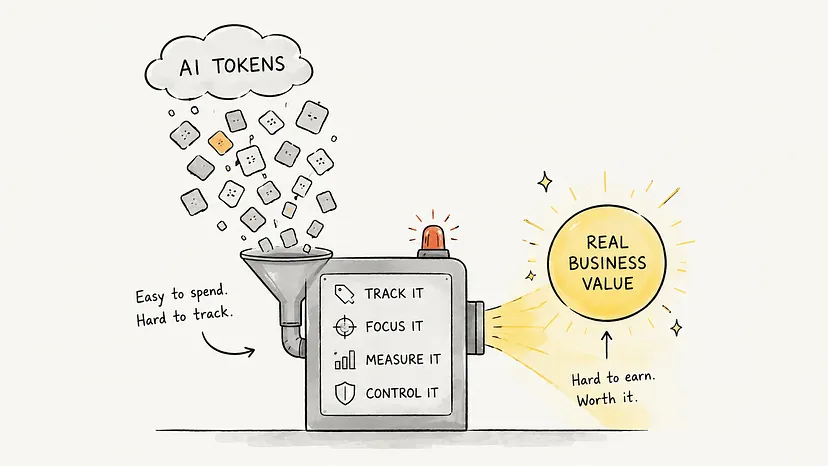
It depends on the situation and the model you are using, and to keep costs under control, it is a good idea to set a budget from the start. You should also keep an eye on how long it takes for your requests to be answered and track how many tokens you are using to predict your costs.
3. How do we handle data privacy when agents are processing customer information?
This is really important for teams that deal with private user information or have to follow GDPR rules. You should think about EU and GDPR rules and where data is stored from the beginning.
- Use access controls that are based on roles for enterprise data.
- Keep logs to check quality and for audits.
Compliance is not something we do after we have launched our product.
4. How do we vet an AI agent platform before committing to it?
Conduct a 30-day test on a workflow that does not have high stakes.
First, decide how you will measure success, then check if the observability tools are good enough. Next, see how well they work with your tools and also, find out if you can easily switch to a model if the main one changes.
You need to be able to understand what the agent is doing at each step.
Here’s the Truth
67% of executives agree that “AI agents” will drastically transform existing roles within the next 12 months.
For tech startups, the competitive window is still open, narrowing fast, and the teams that will pull ahead aren’t necessarily those with the most sophisticated agents; they’re the ones who learn to manage agents with the intentionality they’d apply to their best human hires.
TL;DR
Most startups rush to deploy AI agents, few bother to actually manage them, and that’s exactly why they fail. Treat them like employees: give them a clear role, track real performance metrics, and assign someone accountable when things go wrong. The tech is ready. The question is whether your team is disciplined enough to use it well.
Looking to build a high-performing remote tech team?
Check out MyNextDeveloper, a platform where you can find the top 3% of software engineers who are deeply passionate about innovation. Our on-demand, dedicated, and thorough software talent solutions provide a comprehensive solution for all your software requirements.
Visit our website to explore how we can assist you in assembling your perfect team.