Why some roles keep surviving cuts, and what companies quietly refuse to let go of
Layoffs can seem like sudden storms when viewed from afar. Hiring surges one week, then mass exits follow without warning. Roles vanish in uneven patterns. Even long-time staff find themselves reassigned or released. Some groups shrink overnight. Others carry on as if nothing shifted.
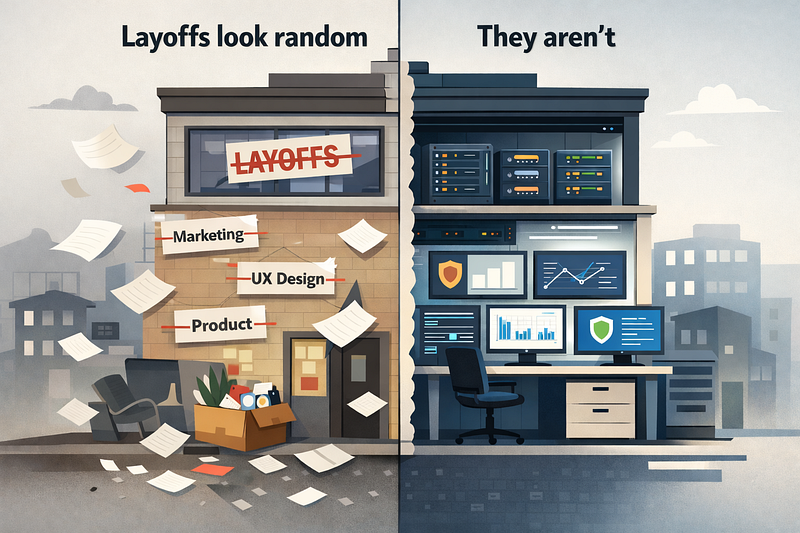
Mostly, what looks random isn’t. It just seems that way at first glance.
What drives job cuts isn’t just bad news on paper. It’s what happens inside when money gets tight. Each decision ties back to how much comes in, what things cost, and where the company wants to be later. Look at many cutbacks over time, across different firms. You begin seeing the same thing again. Not faces. But abilities that fall out first.
What matters most isn’t about who gets fired. It’s about the old habits businesses cling to.
Why layoffs feel random, but rarely are
Announcements about job cuts typically include the number of people affected, their location, or the teams that are impacted. What are the reasons behind choosing those particular positions? Seldom shared.
Without that clarity, decisions appear random.
Most tech layoffs follow three forces.
1. Revenue protection gets priority
In case of growth slowing down or margins being cut, the top management will always protect the revenue-generating systems directly. Any operation that is closely related to uptime, transactions, data integrity, or customer trust will become increasingly difficult to cut.
2. Strategic focus gets narrower
In periods of growth, companies try out new things. They introduce new products alongside the original ones, duplicate tools in various teams, and hire more staff than the market demand. In periods of decline, management gets rid of anything that does not support the core business.
3. Fixed complexity cannot be turned off
Certain tasks cannot be stopped just because the workforce is reduced. The infrastructure still needs to be operating, the data still has to be accurate, and the security still has to be in place. These factors determine who is going to continue working.
The skills that keep resurfacing, even during cuts
Even when tech giants such as Amazon, Meta, and Google cut staff — alongside smaller SaaS players — some roles keep getting hired.
Shrinking? Yes, sometimes. Vanishing? Certain talents stay relevant, regardless of economic dips. They shift shape, yes, but survive the purge.
Backend and infrastructure engineering
When product tests grow, frontend groups grow too. Yet when things shrink, they pull back just as fast. Teams handling backend and infrastructure work stay steady through those shifts and rarely see such changes at all.
Fixing these setups takes too much time and costs a lot. Without enough people watching them, things could go wrong fast.
Examples include:
- Distributed systems and APIs.
- Databases and data pipelines.
- Cloud infrastructure and reliability engineering.
Revenue takes a hit whenever checkout issues pop up or internal tools crawl. A delayed feature might wait. System hiccups? Those costs are too much to ignore.
Built for heavy loads, some backend folks stick around when layoffs hit — handling crashes, speed hiccups, system strain better than others. Their grasp of breakdown patterns makes them harder to replace once trouble strikes.
Picture an everyday company moment. A single engineer runs a key system that powers ten groups. If they leave, problems pile up for months. Paying them stays just one paycheck. That makes the path clear enough.
Data and analytics
When space shrinks, leaders start probing deeper.
What brings in cash? Who stops using the service sooner? What drains money? Where does it slip away?
Finding answers here? Only possible with solid numbers behind them.
When companies cut staff, those digging into sales numbers tend to keep their jobs. Not everyone on data teams survives the cuts, though. Data engineers, analytics engineers, and analysts who work close to business metrics often remain critical during layoffs. In some cases, data teams shrink. The people closest to revenue insights usually stay.
Picture this. When times get tough, businesses tend to reduce their marketing budgets. Yet prior to making cuts, teams lean into metrics like customer cohorts, performance tracking, revenue by source, andcost per acquisition data. That work depends on a solid analytics infrastructure.
Data roles tied to decision-making survive longer than data roles focused on exploratory dashboards or internal reporting vanity metrics.
AI tooling and applied machine learning
Even with all the noise around it, real-world AI is now a working part of daily operations across numerous businesses.
Truth sits in how it’s used. Not in studying it. That makes the difference. Teams building:
- Internal automation tools.
- Recommendation systems tied to revenue.
- Fraud detection or risk scoring.
- Support and operations tooling using ML.
These roles often sit at the intersection of cost reduction and scale. That makes them valuable during layoffs.
For example, A single machine learning tool can take over tasks once done by hand, cutting daily expenses. When staff numbers drop, such tools let work keep moving without a slowdown.
When it comes to job stability, pure research positions tend to wobble. Engineers building real-world machine learning tools that actually ship stand on firmer ground.
Security and compliance
Most teams view security as a cost. Because of that, it stays when jobs are cut.
Breaches, downtime, or compliance failures lead to expenses piling up fast. Tough times don’t stop penalties from landing.
Those working in security engineering, compliance experts, and trust roles often stay due to stability.
- Legal exposure remains constant.
- Fragile customer trust breaks easily.
- Mistakes caught late cost a lot more than the precautions taken early.
Replacing a feature might work. Yet skipping audits? That won’t slide. Laws about data protection stay firm. When trouble hits, silence isn’t an option.
Few notice it, yet security remains steady when jobs get cut.
The roles that get cut more often
Discovering what remains begins by examining what has left.
When growth experiments slow down, those jobs often go first.
These include:
- Teams building speculative features.
- Parallel tooling solving the same problem in different ways.
- Experimental product lines without proven revenue.
- Layers of management added during hypergrowth.
Pausing these jobs feels more doable. That does not mean they lack value.
If a product has not yet found strong demand, cutting that team does not break the business. It delays the optional upside.
When cutting back, firms favor certainty instead of possibility.
Why core builders stay while headcount drops
Something repeats each time layoffs happen.
Fewer people on staff now. Yet the work stays just as tangled. Tasks pile up without extra hands. The load shifts but never lightens.
Systems built over the years still need:
- Monitoring
- Maintenance
- Scaling
- Compliance
- Evolution
People who build things know how systems fit together, see where problems might pop up, and notice what fails when a piece goes missing. Getting that insight back after it’s gone takes too much time and costs too much money.
That’s the reason firms usually hold on to a smaller team, yet prioritize those who understand the system inside out.
Layoffs shrink headcount. They do not reduce responsibility.
The practical takeaway for professionals
If you are planning skill upgrades, the lesson is not to chase whatever looks popular on job boards today.
Instead, ask a simpler question- If a company lost half its budget tomorrow, would this skill still be required to keep the business running?
Skills that answer yes tend to cluster around:
- Systems that generate or protect revenue.
- Infrastructure that cannot be paused.
- Data that informs critical decisions.
- Automation that reduces ongoing cost.
- Compliance that carries legal weight.
This does not mean everyone should become a backend engineer or security specialist. It does mean depth matters more than surface-level breadth during downturns.
Learning how systems actually work, how data flows, how failures happen, and how automation replaces manual effort makes your role harder to remove.
Tech layoffs are not random. They are signals.
And the clearest signal is this. Companies will always protect the skills that keep the lights on, even when everything else is negotiable.
Looking to build a high-performing remote tech team?
Check out MyNextDeveloper, a platform where you can find the top 3% of software engineers who are deeply passionate about innovation. Our on-demand, dedicated, and thorough software talent solutions provide a comprehensive solution for all your software requirements.
Visit our website to explore how we can assist you in assembling your perfect team.