
Human-in-the-Loop 2.0: Designing Effective Review Systems for Autonomous Agents
Artificial intelligence promised that it would do everything for us — we would simply set it up. Autonomous agents would handle customer support and complex supply chain logistics. Now we know that full automation is not yet possible. The problem is not that the AI is insufficiently capable. The problem is that the interface between AI systems and humans is not good enough.
We are moving past the old paradigm, called Human-in-the-Loop 1.0, in which humans manually labeled data or caught errors. We are now entering an era called Human-in-the-Loop 2.0, where the focus is on genuine collaboration with autonomous agents. For tech startups, building an effective review system is critical — it is not only a safety feature, but also a necessity for the company’s success.
Why AI Success Now Requires Better Human Oversight
In the past, human-in-the-loop meant labeling data. Humans would spend hours drawing boxes around stop signs or tagging sentiment in tweets. Now, autonomous agents execute far more complex, multi-step tasks. Humans are no longer just teaching a model what a “cat” looks like; they are reviewing the reasoning and actions of autonomous agents operating in the real world.
An autonomous agent might browse the web, access a database, and draft an email all in one sequence. A simple thumbs-up/thumbs-down interface is not enough. Effective review systems must provide context, traceability, and intervention points — without breaking the agents’ momentum.
The Three Design Pillars of HITL 2.0
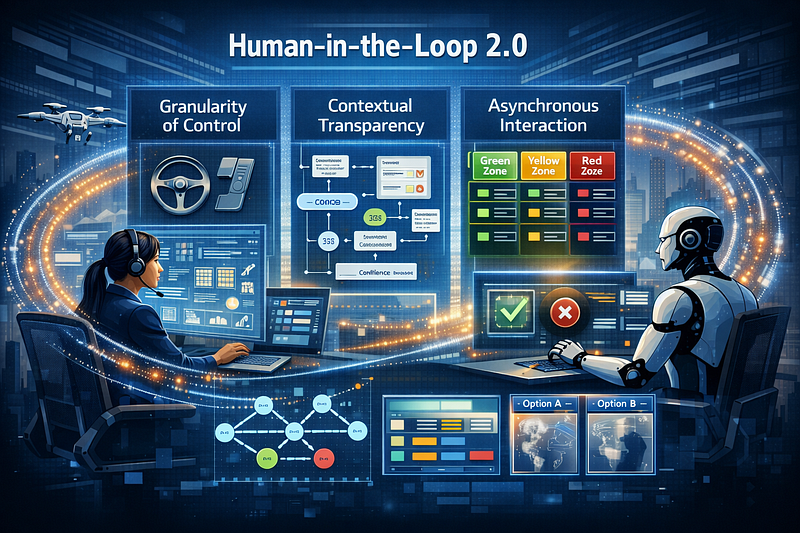
To build an effective review system, we need to focus on three design pillars: Granularity of Control, Contextual Transparency, and Asynchronous Interaction.
1. Granularity of Control: The “Brake” and the “Steering Wheel”
An autonomous agent should not run unchecked until it fails. We must design systems that calibrate levels of autonomy based on the risk profile of each task:
- Pre-execution Approval: For high-stakes actions, the agent must pause and wait for explicit sign-off.
- Post-execution Review: For low-stakes actions, the agent proceeds but flags the action for a later audit.
- Mid-stream Intervention: This is the hardest to design, but also the most valuable capability. It allows a human to step into an ongoing process and correct a sub-step before the entire task goes off the rails.
2. Transparency (The “Why” Behind the “What”)
The biggest challenge in human review is what we might call the “Cold Start” problem. If an autonomous agent presents a human with a completed report and asks for approval, the reviewer must read the entire document to spot any errors — which is inefficient.
Effective HITL 2.0 systems use traceability maps that surface not just the output, but the sources, intermediate steps, and confidence scores for each sub-task. This allows the reviewer to verify the logic rather than just the result.
3. Asynchronous Interaction
The old human-in-the-loop model assumed the human was sitting and waiting for the AI to ask a question. In a startup environment, this is unrealistic. We need to design systems where autonomous agents can “park” a task when they hit an uncertainty threshold and move on to another task. Humans can then batch-process these requests for help at their convenience.
A Practical Example: AI-Powered Sales Prospecting
Consider an autonomous agent designed for a B2B startup that identifies leads, researches their LinkedIn activity, and drafts personalized outreach. Having a human check every single email before it is sent is slow and tedious. Instead, we can design a dashboard that categorizes the agent’s work:
- Green Zone: High-confidence drafts for lower-priority leads. These are sent automatically and summarized in a daily report.
- Yellow Zone: Drafts where the agent found conflicting or ambiguous information. These are flagged for quick human edits.
- Red Zone: High-value targets where the agent suggests a strategy but requires a human to write the opening hook.
By designing the system this way, one human can effectively oversee ten times as many autonomous agents without sacrificing the personal touch that separates genuine outreach from spam.
Reducing Reviewer Fatigue
One of the key risks of working with autonomous agents is automation bias — the tendency for humans to stop paying attention and simply click “Approve” because the AI is usually right.
To combat this, we must design for active engagement. Tactics include:
- Intermittent Testing: Occasionally inserting a known error or a deliberate edge case into the review queue to verify that the human is genuinely reading the content.
- Comparative Review: Rather than asking “Is this good?”, present the reviewer with two different approaches the agent could have taken and ask them to choose — prompting genuine evaluation.
Real-Time Feedback Loops as a Competitive Advantage
For a tech startup, the review system is not just a UI — it is a data flywheel. Every time a human corrects an autonomous agent’s sub-step, that correction should be captured to fine-tune the agent’s future behavior.
We should view a human “No” not as a failure of the autonomous agent, but as the most valuable data point we have. By building a review system that captures why a human changed something, we create a system that genuinely improves over time.
Conclusion
The future of AI is not “human-less” — it is “human-leveraged.” As we build the next generation of autonomous agents, our focus must shift from making the AI 1% more accurate to making the human 100% more effective at reviewing it.
By designing for transparency, granularity, and asynchronous workflows, we can build autonomous agents that people actually trust. In the end, the successful AI startups will not just have the best models; they will have the best systems for keeping humans informed and in control. Human-in-the-Loop 2.0 is the key to making that happen.
Looking to build a high-performing remote tech team?
Check out MyNextDeveloper, a platform where you can find the top 3% of software engineers who are deeply passionate about innovation. Our on-demand, dedicated, and thorough software talent solutions provide a comprehensive solution for all your software requirements.
Visit our website to explore how we can assist you in assembling your perfect team.