
The Post-SaaS Era: Building the “SaaaS” for Next Billion Non-Human Users
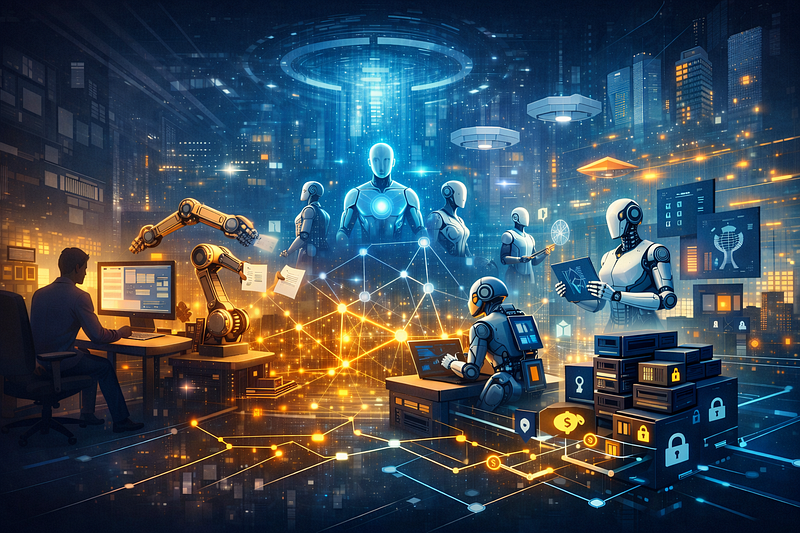
If you have been in the tech world lately, you have probably noticed a lot of excitement. Every website now has an “AI-powered” button, and every customer relationship management tool has a chatbot. As a tech startup, we realize that something bigger is happening. We are not just adding a feature to the software; we are seeing the end of the software interface as we know it.
The main change is simple: Software is about to stop being built for humans to click through and start being built for AI agents to talk to each other.
We call this SaaaS — Software as an Agentic Service.
Structural Transformation: Redesigning the Digital Factory for 2026
To understand where we’re going, we must look at where we’ve been. When factories first moved from steam to electricity, they didn’t immediately see a productivity boom. They simply swapped a steam engine for a giant electric motor and kept the factory layout the same.
It took decades for engineers to realize that electricity meant they didn’t need one motor; they could put small motors on every machine. They had to redesign the factory to unlock the real power of electricity.
In the world of software, we are currently “putting motors where the horses used to stand.” We are taking language models and shoving them into sidebars and chat bubbles within our old platforms. The real shift happens when we redesign the factory.
The Roadmap to Autonomy: SaaS, APIs, and the Rise of the Agent
We see the evolution of the industry in three acts:
- Era 1. SaaS (2000s): The era of the human user: The human is the engine; the software is the tool. You log into Salesforce or Zendesk. You click buttons. You move data from point A to point B.
- Era 2. APIs (2015): Machines talking to machines, but in a rigid, brittle way: One machine asks a fixed question (“What’s the status of Order #123?”) and gets a fixed answer back.
- Era 3. SaaaS (The Emergence): Instead of calling an API, we give an AI agent a goal: We tell it, “Identify our 10 churn risks this month and execute a win-back campaign for each based on their specific usage history.” The agent doesn’t just pull data; it reasons, navigates systems, and returns with outcomes.
The Orchestrator Thesis: Moving from Data Entry to Goal Delegation
In the SaaaS model, your favorite software tools transform. Now, you might use Salesforce as your source of truth. In a SaaaS world, Salesforce is effectively a subagent.
You won’t log in to check the dashboard. Your central “Orchestrator” calls saaas.salesforce.com with a high-level goal, “Fix the data quality in the West Coast region.” Salesforce’s own internal agents then figure out the logistics and report back when the job is done.
The company doesn’t just have an AI; the company becomes an AI.
This solves the “CEO as IT Support” problem. Today’s human agents are often overtaxed; they are asked to handle high-level strategy and low-level “plumbing” simultaneously. SaaaS introduces specialization. The Orchestrator handles the “what” and “why,” while the specialized Subagents handle the “how.”
The Logic of Niche: Why Deep Specialists Beat Generalist Models
If AI can write code for free, the advantage of having a codebase disappears. We believe four things will define the winners of the SaaaS era:
- Deep Specialists: An agent trained on EU pharmaceutical compliance will always beat a generalist model.
- The Connectors (The “talent agencies” for agents): Knowing which specialist to call for a specific, obscure task is a value-added service.
- Proprietary Data: If everyone has the same brains (LLMs), the differentiator is the ‘food’ those brains consumed. Decades of CRM patterns or private financial data become an unbeatable advantage.
- Reliability: In a world of mistakes, the agent that actually finishes what it starts without breaking is the one people will pay for.
The Agentic Economy: The Discovery and Payment Rails We’re Still Missing
We aren’t there yet. For an agentic economy to function, we need a few things that don’t fully exist:
- Agent Identity: If an agent authorizes a $50,000 refund, how does the bank know it’s authorized?
- Agent Wallets: When our Orchestrator hires a specialist subagent, how does it pay?
- The Runtime Evaluator: We need the equivalent of an anesthesiologist — a layer that monitors an agent’s “vitals” in real-time and terminates the process if it starts going off the rails.
The Death of the Seat: Why Engagement is a Dead Metric
Perhaps the most jarring change for us as builders is the death of the “seat.” SaaS made money on logins and engagement. Agents don’t have seats. They don’t attend webinars or care about your UI.
In the SaaaS world, you get paid for outcomes. If your agent resolves a ticket, you get paid. If it doesn’t, you don’t. It’s a shift from being a software vendor to being an end-to-end digital contractor.
The Agent-First Mandate: Building for the Next Billion Non-Human Users
The internet was built for humans staring at screens. The next layer is being built for agents talking to agents. As a startup, we have a choice: we can keep building software for humans, or we can start redesigning for the electric age of SaaaS.
The window to get ahead of this is open, but it’s narrowing. We shouldn’t be asking “How can we add AI to our product?”, we should be asking: “If our customers were agents of humans, what would we build from scratch?”
Looking to build a high-performing remote tech team?
Check out MyNextDeveloper, a platform where you can find the top 3% of software engineers who are deeply passionate about innovation. Our on-demand, dedicated, and thorough software talent solutions provide a comprehensive solution for all your software requirements.
Visit our website to explore how we can assist you in assembling your perfect team.