“$100,000 for a visa? That’s more than my first car!”
If this statement shocked you, don’t worry, you are not alone. From September 2025, an additional $100,000 per year, per employee fee came into effect for U.S. companies that want to take an H-1B visa to hire foreign skilled workers. This is a massive jump from the usual range of $1,700–$4,500. Suddenly, not only is the overseas hiring process seeming difficult, but it is also so costly that it is causing startups and small businesses to rethink their move.
However, the story does not end there. Instead of turning their backs on the idea of global employment, companies are finding a way to make it work by going remote. Let’s first look at the factors driving this change on one hand, and the potential effects on businesses and professionals on the other hand.
Why the $100K H-1B Fee Matters
A while ago, the H-1B Visa was considered to be a reasonably expensive way for U.S. companies to bring in talent that was located in China or India, for instance. The new $100K fee totally changes the H-1B visa market. Small companies or early-stage startups that are reliant on foreign experts in the tech industry are now faced with a financial obstacle they did not have before.
Experts warn that such a situation would cause brain drain. The cost of sponsoring visas would be made so high that the top U.S. corporations would decide not to do it, thus depriving themselves of the best talent.
From Visas to Virtual: Remote Work Becomes a Lifeline
Companies are taking a different approach due to the high visa costs. They would rather use the simpler, quicker, and less expensive method of hiring remote employees. Here’s how the numbers stack up:
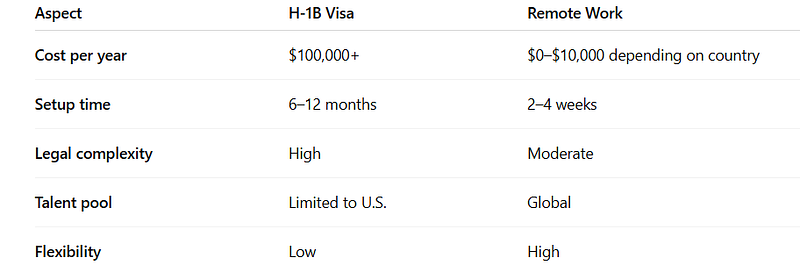
Remote work is no longer viewed only as a “perk.” The remote work model will become a strategic tool for companies to acquire global talent without paying huge sums or going through complicated immigration procedures.
India: The Remote Talent Hub
The IT and Tech industry in India has always been the center of excellence for the world. The recently imposed H-1B fee has only acted as a catalyst for the trend of remote work. Indian IT firms are thus not relocating their employees, but rather they are ramping up their local operations and providing services to the overseas clients through remote mode.
For instance, areas like Sector V in Kolkata are witnessing tech hubs building teams in India to meet U.S. client demands, without the need to get a visa.
Pros and Cons: Sponsoring Visas vs Remote Hiring
Pros of remote work:
- Saving money: No need for an expensive visa sponsorship.
- Infinite potential of talent: The top talents, regardless of location, can be recruited.
- Speed and flexibility: Get a new team up and running in less than a month, not in 3–6 months.
Challenges:
- Time Difference: Coordinating activities across different continents may be a difficult task.
- Different Cultures: Communication might require more effort.
- Legal compliance: Keeping track of the local employment laws is still your responsibility.
Despite drawbacks, remote work is still a more viable option and a secure one in the long run when H-1B visa applications become more expensive.
What This Means Going Forward
The $100K H-1B fee is not just a number. It’s causing companies to rethink their hiring methods and, at the same time, creating new possibilities for professionals from all over the world. Remote work is not just a nice-to-have anymore; it is turning into a must-have strategy for businesses to get the best talent from anywhere in the world in a more efficient way.
On the bright side for employees, the door to work in international companies has just opened, and all this without relocating. In contrast, for employers, this freedom translates into less expenditure, the power to scale teams fast, and the ability to adjust their strategies as per their requirements.
Takeaway: The H-1B visa is still alive, but the way it functions has totally changed. Companies are turning to remote work, and finding skilled professionals from all over the world is easier than ever — if you have the right sources.
Stay tuned for Part 2 of our series: Offshore & Remote Hiring Playbooks — practical steps for building a global team and choosing the right hiring model.
Looking to build a high-performing remote tech team?
Check out MyNextDeveloper, a platform where you can find the top 3% of software engineers who are deeply passionate about innovation. Our on-demand, dedicated, and thorough software talent solutions provide a comprehensive solution for all your software requirements.
Visit our website to explore how we can assist you in assembling your perfect team.