Meta’s Muse Spark: The End of Open Source for Llama?
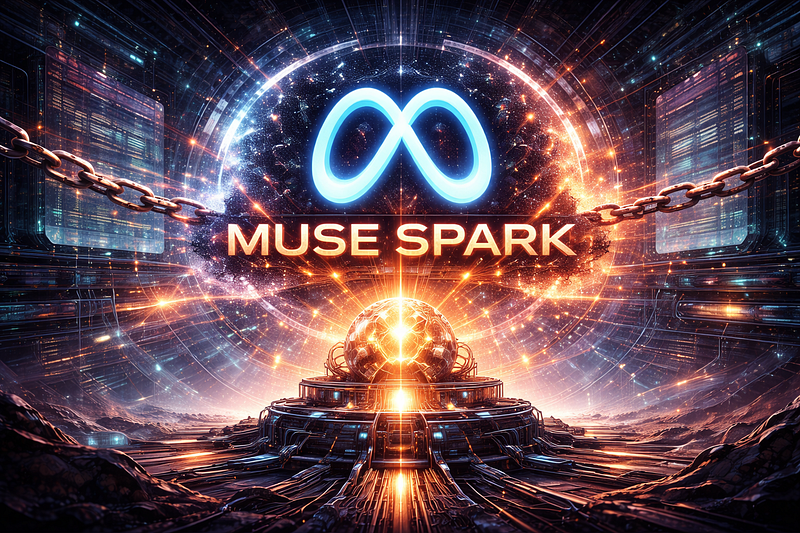
Meta just came out with its powerful model, and it did something unexpected. It locked the door behind it.
For the last three years, if you were working on something with AI, Llama was the way to go. It was free, you could download it, and it was good enough for most things. Meta was really committed to being an open source. Mark Zuckerberg even wrote a post in 2024 called “Open Source AI is the Path Forward.”
Then on April 8, 2026, Meta launched Muse Spark, its most capable model ever, but it did not release any of the weights.
So what does this mean for all the people who built things using Llama?
What is Meta Muse Spark?
Muse Spark is the model from Meta Superintelligence Labs, the internal AI division that was formed in June 2025. Meta spent a lot of money, $14.3 billion, to bring in Alexandr Wang as the Chief Artificial Intelligence Officer. The team spent nine months rebuilding Meta’s AI stack from scratch.
The result is a really good model; it is in the top five in the world.
According to the Artificial Intelligence Index, Muse Spark scored 52, which is behind some other models, but it is still really good. It is way better than Llama, which scored 18.
Where it genuinely leads:
Muse Spark is really good at some things, like health reasoning and visual understanding. It scored 42.8 on HealthBench Hard, which is better than some other models. It also did well on CharXiv Reasoning, scoring 86.4, which is better than some other models. It is also really efficient. It used 58 million output tokens, which is less than some other models.
Where it trails:
But Muse Spark is not perfect; it is not as good at some things, like coding benchmarks. It also has some weaknesses, like reasoning. The model can run in two modes: a standard mode and a “Contemplating” mode. The “Contemplating” mode is like a mode that helps the model think more deeply.
So why did Meta decide to make Muse Spark closed source?
This is the question that everyone is asking now: Is Meta giving up on open-source AI?
Not officially, but it seems like it. Meta said it hopes to release versions under an open-source license, but that is not a promise.
Three things explain why Meta decided to make Muse Spark closed source:
- Llama 4 did not do well. It damaged Meta’s credibility.
- The competition is getting tougher, and Meta needs to keep up.
- Yann LeCun, Meta’s Chief Artificial Intelligence Scientist, left the company, and that changed the culture inside Meta AI.
So what does this mean for developers who are using Llama? Should they switch to Muse Spark?
Not necessarily, but they should be prepared for uncertainty. Llama is still available, and it is still a good option for some people. If Meta’s best models are going to be closed, what does that mean for the future of Llama? Meta has not said what it plans to do, so it is hard to know what to expect.
If you are a developer, you should stick with Llama if you need to deploy it on your servers or if you are doing a lot of coding.
If you are building something that needs health reasoning or visual understanding, you might want to look at Muse Spark.
The bigger picture is that open-source AI might be in retreat
Other companies, like OpenAI and Google, are also keeping their models closed. The market for AI is growing fast, and it is projected to be worth hundreds of billions of dollars in the next few years. At that scale, giving away your model for free does not make sense.
Mark Zuckerberg once said that open-sourcing Llama would not hurt Meta’s revenue, but that was years ago. Now, Meta has spent a lot of money on an AI team, and it needs to show investors what it has got.
The bottom line is that Muse Spark is an impressive model, but the more important story is what it means for Meta’s priorities. Open-source Llama was a part of Meta’s strategy, but now it seems like that is changing.
The question is not whether Muse Spark is good; it is whether Meta can still be trusted as a platform partner. That answer will depend on what Meta does over the next year.
TL;DR
Meta launched Muse Spark this month- its most powerful AI model yet, and quietly closed the door on open source. After three years of championing Llama as free and open, Meta kept Muse Spark’s weights private. The model is genuinely impressive (top 5 globally, strong in health reasoning and visual understanding), but the bigger story is the shift in Meta’s values. If you built on Llama, it still works, but the trust is shakier now. Open-source AI may be retreating industry-wide, and Meta is no longer the exception.
Looking to build a high-performing remote tech team?
Check out MyNextDeveloper, a platform where you can find the top 3% of software engineers who are deeply passionate about innovation. Our on-demand, dedicated, and thorough software talent solutions provide a comprehensive solution for all your software requirements.
Visit our website to explore how we can assist you in assembling your perfect team.