Best AI Books for Founders and Builders in 2026
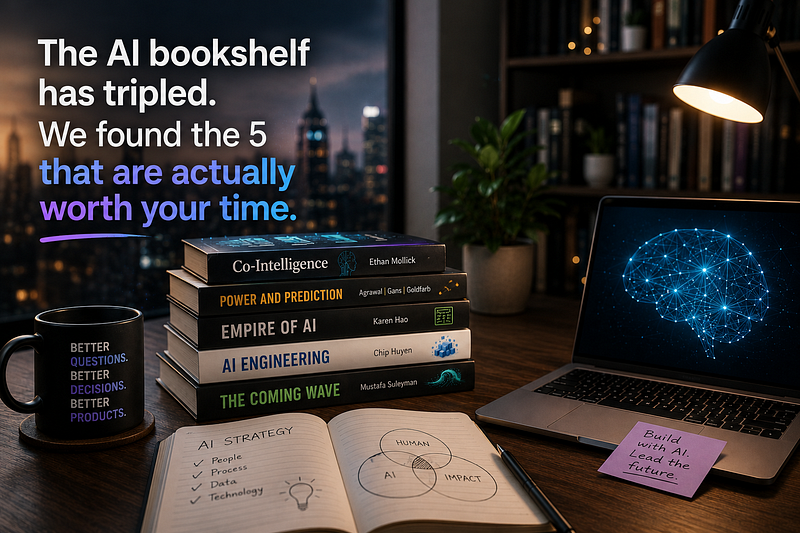
The AI section at any decent bookstore has basically tripled in the last two years. Most of it is clutter; a lot of it reads like a LinkedIn post that somehow got padded into 300 pages. But there are books buried in there that genuinely change how you think about building products, teams, and strategies right now. Those are worth your time.
At MyNextDeveloper, we spend a lot of time thinking about where tech talent and AI intersect. Whether you’re a founder trying to figure out what your engineering team should actually be building or a builder trying to keep up with a landscape that reshuffles every quarter, this list is for you. We’ve grouped it by the problem you’re trying to solve.
First, a quick note on how to use this list
Not all AI books are solving the same problem. A founder asking “how do I think about AI strategy?” needs something completely different from an engineer asking “how do I ship an AI product that doesn’t fall apart in production?” We’ve split the list accordingly.
For Founders and Strategy Leaders
1. Co-Intelligence: Living and Working with AI - Ethan Mollick (2024)
Best for: Founders who want a grounded mental model before committing to an AI strategy
What sets Mollick apart from most people writing about AI is that he actually uses it daily, in his own work, as a Wharton professor. So this isn’t theoretical cheerleading or breathless doom. It’s practical. The central question he reframes everything around isn’t “will AI replace this job?” but “how do we make this collaboration actually work?”
His “centaur vs. cyborg” framing is the kind of thing that sticks. Centaurs draw a clear line between what they delegate to AI and what they keep for themselves. Cyborgs blend AI into everything seamlessly. Neither is wrong, but knowing which one you are (and why) changes how you build. Reid Hoffman called Mollick “the leading voice of reason on the implications of AI for work,” which is high praise from someone who tends to be careful with praise.
256 pages. Finishable on a long-haul flight. If you’re a founder who hasn’t built a mental model for AI yet, start here.
Key takeaway: The founders winning right now aren’t the ones with the most sophisticated AI stack. They’re the ones who’ve figured out where AI genuinely helps, and where it quietly makes things worse.
2. Power and Prediction: The Disruptive Economics of Artificial Intelligence - Agrawal, Gans & Goldfarb (2022)
Best for: Founders thinking about where AI creates competitive moats, and where it quietly destroys them
Three economists from the University of Toronto make a deceptively clean argument: AI is fundamentally a prediction technology. And as prediction gets cheaper, the value of judgment goes up. That single reframe is worth the price of the book.
Most AI strategy writing talks about automation. This one talks about decision architecture, what happens to entire systems when you shift who (or what) makes the predictions. The electricity analogy they use is genuinely clarifying: it took decades for companies to stop bolting electric motors onto existing processes and start redesigning factories around them. We’re at a similar inflection point now.
Worth noting: Agrawal also founded the Creative Destruction Lab, one of the world’s largest AI startup incubators. The thinking here isn’t purely academic.
Key takeaway: Don’t ask “where can we plug AI in?” Ask “What decisions does our business make, and which ones should AI be making instead?”
3. Empire of AI: Dreams and Nightmares in Sam Altman’s OpenAI - Karen Hao (2025)
Best for: Founders who want to understand how the current AI ecosystem actually got built
This became a New York Times bestseller and a finalist for the National Book Critics Circle Award, and it earned both. Hao spent years reporting this, drawing on approximately 260 interviews to trace how OpenAI went from an idealistic nonprofit to one of the most powerful corporations in tech. It opens with that wild weekend in November 2023 when Sam Altman was fired and then reinstated within five days, and then pulls back to cover everything underneath: the chips, the data, the energy, the human labour most users never think about.
The drama is compelling. But the real value for founders is a structural understanding of the incentives, trade-offs, and institutional dynamics baked into the tools you’re building on top of. Knowing who built the foundation matters when you’re deciding how much to trust it.
Key takeaway: The AI ecosystem wasn’t designed neutrally. Understanding its origin story helps you make better bets about where it’s heading.
For Builders and Engineering Leaders
4. AI Engineering: Building Applications with Foundation Models - Chip Huyen (2025)
Best for: Engineers and technical founders who want to go from experiments to production-grade AI systems
This has been the most-read book on the O’Reilly platform since the book launched in January 2025. Huyen taught ML Systems Design at Stanford and founded an AI infrastructure startup before it was acquired, which means she brings both academic rigour and genuine production experience to the table. That combination is rarer than it should be.
The book covers evaluation pipelines, the prompt-vs-fine-tune-vs-API decision, retrieval quality, observability, and the engineering discipline that separates AI demos from AI products. If your team has ever shipped an AI feature and then watched it quietly degrade in production — and most teams have — the evaluation chapter alone is worth the read.
It also tackles something most AI books completely skip: the product thinking embedded in engineering decisions. Where should the human be in the loop? When does latency matter more than accuracy? These aren’t just engineering questions. They’re founder questions too.
Key takeaway: As foundation models become commodities, the differentiation is in the discipline - how well you evaluate, monitor, and iterate on what you’ve built.
5. The Coming Wave - Mustafa Suleyman (2023)
Best for: Builders who want the long view from someone who actually built the technology
Suleyman co-founded DeepMind. That background makes his concerns land differently than most. The book argues that AI, synthetic biology, and quantum computing together form a wave of technologies moving faster than any existing system of governance can handle, and it doesn’t flinch from saying so.
For founders and builders, the value is in thinking clearly about second-order effects. What happens to what you’re building when these technologies start interacting with each other? What responsibilities come with shipping AI-powered software at scale? These aren’t comfortable questions. They’re also increasingly unavoidable ones.
Key takeaway: Building without thinking about what you’re building into is a short-term strategy.
A few questions we get asked
Which book is best for a non-technical founder?
Start with Co-Intelligence (no technical background needed), and it delivers useful frameworks fast. Then move to Power and Prediction for the strategy layer.
Are there good books on hiring and building AI teams?
Honestly, not many. Most of what exists is either too generic or already out of date. The best current thinking on hiring AI engineers lives in newsletters and hiring communities, not books. Chip Huyen’s newsletter, in particular, is excellent. Watch this space.
Which book has the highest signal-to-noise ratio?
Power and Prediction is the most intellectually rigorous per page. AI Engineering has the highest practical density for technical readers. For a first read that shifts how you think without demanding prior knowledge, Co-Intelligence has the best hit rate.
Should we even be reading books when AI moves this fast?
Yes, with one caveat. Books focused on timeless principles (how decisions work, how systems get redesigned, how humans collaborate with tools) age well. Books focused on specific models or frameworks age poorly. This list skews toward the former, deliberately.
The short version
- Just starting to think about AI strategy: Co-Intelligence — Mollick
- Designing your product or business model around AI: Power and Prediction — Agrawal et al.
- Want context on the ecosystem you’re building on: Empire of AI — Hao
- Ready to ship reliable AI products: AI Engineering — Huyen
- Thinking about the long game: The Coming Wave — Suleyman
None of these books will tell you what to build. But they’ll sharpen the lens you’re using to make that call, and in a market moving this fast, that might be the more useful skill anyway.
TL;DR
There are a lot of bad AI books out there, and most of them dress up as insights but really just give vibes. We dug through the pile and pulled five that actually changed how we think, split between founders trying to figure out their strategy and engineers trying to ship things that don’t break. Start with the one that matches your current headache.
Looking to build a high-performing remote tech team?
Check out MyNextDeveloper, a platform where you can find the top 3% of software engineers who are deeply passionate about innovation. Our on-demand, dedicated, and thorough software talent solutions provide a comprehensive solution for all your software requirements.
Visit our website to explore how we can assist you in assembling your perfect team.