The $1,200 Startup: How to Build a Million-Dollar Engine on a Coffee Budget
In the era of money and fast growth, people think that a lot of capital is necessary for innovation. The common story in tech is that if you are not spending a lot of money on an office and a team of experts, you are not really in the game.
But we don’t actually agree with this.
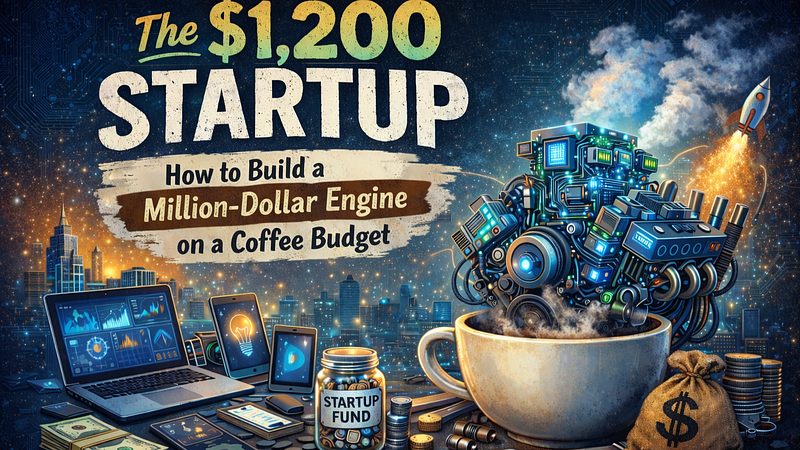
The companies that will be successful in a decade will not be the ones that raised the most money. They will be the ones who learned how to use their money. We call this the Coffee Budget Framework: an approach where $1,200, the price of a laptop or a year's worth of coffee, is all the money you need to start a million-dollar business.
Here is how we go from a prototype to a successful company.
The Strategy of Aggressive Subtractivism
Most startups fail not because they couldn’t build a product, but because they built too much of the wrong thing. When we have a $1,200 budget, we cannot afford to make mistakes for six months.
We use a concept called Aggressive Subtractivism. This means we focus on the one thing that really matters. For example, if we are building a tool, we do not build many features at first; we build the one thing that saves a user $500.
By working within a budget, we avoid building things that aren't really necessary and focus on what customers actually want.
The Modular Tech Stack: Using Existing Tools
In 2026, it’s highly cost-effective to start a software company if we’re smart about it. We don’t build everything from the ground up. We use tools that already exist.
Instead of hiring a team of experts who cost $20,000 a month, we use simple platforms like Bubble or FlutterFlow. We leverage serverless architectures like AWS Lambda or Vercel. This way, we don’t have to pay for hosting unless we have users.
By using these tools, we keep our costs low. We only pay when we grow. This isn’t about saving money, it’s about capital efficiency. We use low-code platforms and artificial intelligence as they help us build our product.
The Modular Tech Stack is about using existing tools. It helps us start and grow our software company.
Engineering Growth via Digital Handshakes
Traditional marketing is like an auction where the person with the most money wins. Rather than competing on spend, we focus on high-leverage relationships with our customers.
Instead of spending $5,000 on ads, we spend 20 hours building a free tool that helps our target audience. This tool acts like a salesperson. It generates leads while we sleep. It becomes more valuable over time, whereas an ad stops working when we stop paying for it.
The Fractional Talent Flywheel
We delay hiring until it becomes a necessity. The $1,200 startup works with a network of experts.
Instead of a full-time chief technology officer at $150,000 a year, we hire a consultant for two hours a week to review our work. Instead of a full-time writer, we use artificial intelligence to write most of our content and a freelance editor to make it perfect.
This way, we get a lot of talent without spending a lot of money. We pay for results, not for hours worked.
Solving for the Million-Dollar Equation
Building a million-dollar business is not about being lucky. It is about the math. To reach $1 million in revenue, we need to find a certain number of customers who pay us a certain amount of money each month.
When viewed this way, growth becomes a logic puzzle rather than a mystery. We just need to find the customers who really need our solution. On a $1,200 budget, we have the time to find these customers because we are not under pressure from investors.
The Psychological Edge of Constraint
The best thing about the coffee budget is not the money we save. It is the discipline we learn. When we have no money, we have to be creative. We have to talk to customers, iterate, improve our product quickly, and build something valuable.
We are not just building a startup. We are building a company that can survive on its own. In today's tech world, being able to survive is an advantage.
Looking to build a high-performing remote tech team?
Check out MyNextDeveloper, a platform where you can find the top 3% of software engineers who are deeply passionate about innovation. Our on-demand, dedicated, and thorough software talent solutions provide a comprehensive solution for all your software requirements.
Visit our website to explore how we can assist you in assembling your perfect team.