Why Experts Are Deleting Their Credentials and Getting More Clients
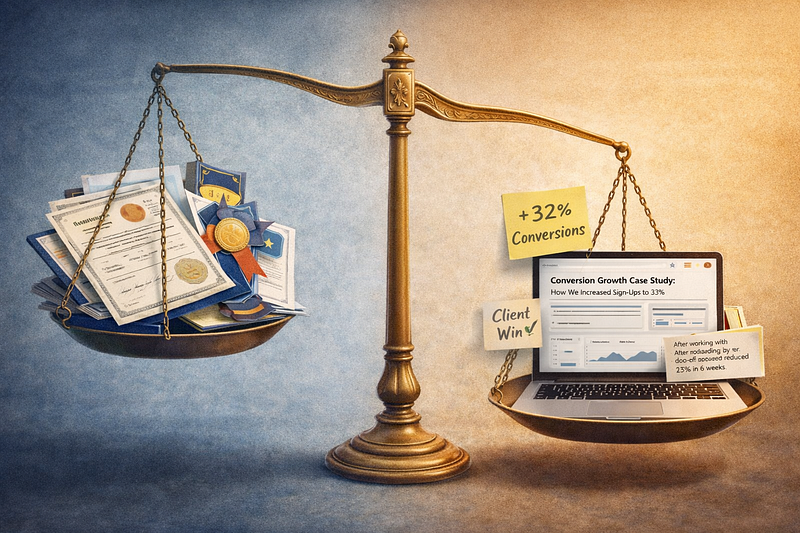
Flip open your phone, tap on LinkedIn or Twitter — watch how profiles look different now. Not so many job titles crammed into one line. Certificates? Rarely front and center anymore. College degrees tend to sit low on the page, if they show up at all.
Just because experts aren’t showing their qualifications doesn’t make them less capable. Credentials still count, yet they’re choosing not to highlight them. The reason? Attention has shifted — other things weigh more heavily these days.
like Proof.
In consulting, freelancing, and the creator economy, trust is no longer built through labels. It is built through visible results. This shift explains why many experienced professionals are quietly changing how they present themselves, and why doing so often leads to more clients, not fewer.
This article breaks down what is actually happening, why it works, and how showing your work has become more powerful than listing your certificates.
The shift from credential-heavy branding to proof-driven branding
For years, credentials were the standard shortcut to gain trust. School diplomas, job titles, certifications on a resume — these stood in for actual ability. When proof was hard to find, people leaned on those signs instead.
Yet now, we are witnessing a shift.
Today, buyers can instantly:
- Take a look at your past work.
- Read public testimonials.
- Compare you with dozens of alternatives.
- See how your mind works when it hits content and case studies.
One report from Harvard Business Review shows trust builds through steady actions, not fancy job names. Staying dependable means more than holding a title. Today, it counts most when you solve real problems instead of listing old achievements
Now it’s less about identity, more about actions taken. This is exactly what drives so many specialists to strip down their biographies.
“Certified Growth Strategist. Ex-MNC Consultant. MBA.”
to:
“I help SaaS founders increase trial-to-paid conversions. Here’s how I did it for three companies last quarter.”
The second approach gets straight to what the person actually asked. That one moves quicker than the first.
Why too many titles now reduce trust instead of increasing it
Once, titles made things clear. Now, they create doubts.
A profile with three certificates on top, five certifications, and multiple high-ranking job roles makes it sales-heavy. People scanning that kind of bio often pause without realizing why. Their mind slips into doubt mode before they even notice
“Why is this person trying so hard to convince me?”
“Are these credentials compensating for the lack of real-world impact?”
As per consumer psychology research, when signaling piles up too high, it tends to collapse under its own weight. This effect, labeled overjustification, chips away at how real something feels. Confidence earns trust — but only when proof walks beside it. Titles alone rarely convince anyone. What matters is what lies beneath the surface.
Out there, especially in consulting and freelancing work, people rarely care about your resume. What matters most? The results you deliver. Not what’s on paper — what happens after.
That’s the reason so many professionals have their qualifications ready, but not front and center. Results show up first — right on the main page — while the background details wait quietly in an “About” area.
The creator economy changed how expertise is judged
The rise of the creator economy accelerated this shift.
Today, trusted experts around marketing, design, finance, and tech:
- Don’t disclose their academic qualifications when speaking in public.
- Have never spent a day inside those famous companies.
- Built credibility by teaching in public.
Their trust comes from repeated exposure to how they think.
Watching a person lay out their thoughts —live, step by step, post after post — from detailed threads and breakdowns to audits, or tutorials, lets others see how they reach conclusions. Slowly, that pattern forms something deeper than popularity: something that researchers call “epistemic trust.” It grows not through claims but through clear thinking shown again and again.
On the split side, credentials stay fixed. They reflect a past accomplishment. What you create reveals your current thinking.
Because people trust what they can see, consultants who show their work via a clear portfolio tend to do better than others with a long list of certifications but no proof of work.
Portfolios, testimonials, and real examples do the heavy lifting
In proof-driven branding, three elements matter most.
1. Portfolios that show decision-making, not just outcomes
A solid portfolio focuses on more than outcomes. It makes clear:
- The problem
- The constraints
- The choices made
- The trade-offs involved
For example, a UX designer who explains why a layout improved conversions builds more trust than one who only shows the final screen.
2. Testimonials that describe transformation
A vague comment such as “nice to collaborate with” holds little weight. Stories showing clear phases— from struggle to result — carry real impact.
For instance: “After working with her, our onboarding drop-off reduced by 22 percent in six weeks.”
This shows actual results even when there is no official proof required.
3. Case Studies that reveal thinking
A real example breathes life into what might otherwise feel abstract. When someone reads about a past project, they begin to picture how things could unfold with them involved. According to research by Nielsen Norman Group, people lean towards process-driven explanations that walk through steps rather than those shouting expertise.
Why “showing your work” beats certificates
Certificates say you finished classes. Yet it’s your actual projects that show how well you handle challenges in practice.
What matters to clients?
- Clear expectations
- Deadlines
- Limited budgets
- Stakeholder conflicts
- Changing requirements
A certificate can’t hold all those details.
By revealing some of their real-world messy and imperfect work, professionals signal their readiness to teach others how to deal with similar issues. This is the reason why many consultants share teardown posts, failed experiments, or lessons learned as part of their marketing strategy.
Contrary to this, the admission of what did not work has been found to generate more trust than a mere enumeration of achievements. Trust is built and then reinforced by the signal of honesty and experience.
Consulting examples where proof wins over prestige
Imagine two consultants who are offering their services to the same client.
Consultant A:
- Has an MBA.
- Worked at big consulting firms.
- Does not provide any public work samples.
Consultant B:
- Gives three anonymized case studies.
- Writes weekly industry insights for the client.
- Talks about past blunders and their corrections.
Consultant A might have the best qualifications; however, Consultant B is the one who gets hired. The reason being the client has already “experienced” them through their content.
The studies from Edelman Trust Barometer, which state that people trust “people like me” and the visible practitioners more than the abstract authorities, reflect this situation.
Credentials still matter. But not where you think
This does not imply that there is no use for credentials anymore. They still play a critical role in:
- Highly regulated industries.
- Junior-level positions.
- Roles that require strict compliance.
However, the use of credentials has changed. They now play a secondary role, supporting the main argument, which is proof.
Consider credentials as footnotes. Proof is the headline.
Those experts who are aware of this situation adapt their branding to it. They lead with outcomes and thinking while allowing credentials to quietly establish the credibility of the background.
What this means for professionals today
If you rely solely on titles, you become invisible in a proof-driven market. On the other hand, if you rely only on proof, you become noticeable.
This does not mean that you have to become an influencer. What you need to do is keep a record of your work:
- Show how you solved a problem.
- Discuss the trade-offs you made.
- State iterations, not merely your final results.
Transparency is the strongest argument in a place where anybody can stand out as an authority. The professionals are not throwing away their references as they are irrelevant. They are allowing the evidence to do the talking and thus taking a backseat. And customers are paying attention.
Looking to build a high-performing remote tech team?
Check out MyNextDeveloper, a platform where you can find the top 3% of software engineers who are deeply passionate about innovation. Our on-demand, dedicated, and thorough software talent solutions provide a comprehensive solution for all your software requirements.
Visit our website to explore how we can assist you in assembling your perfect team.