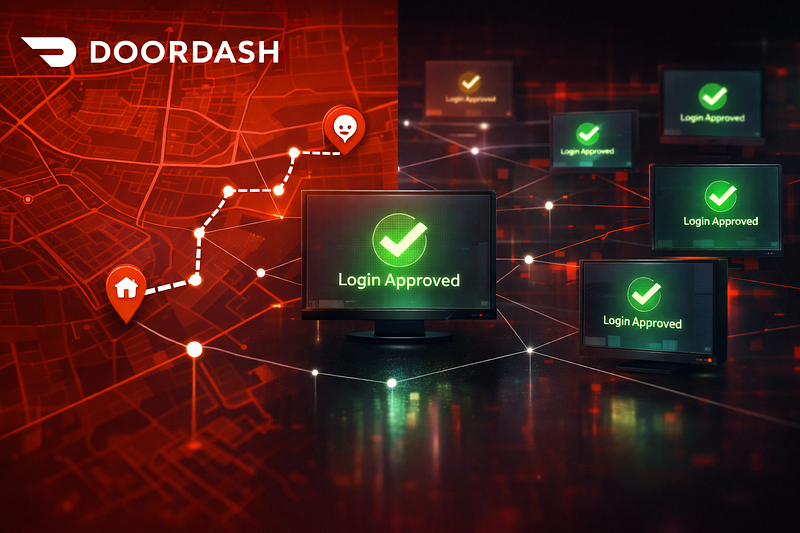
A single password led to DoorDash losing access to vast amounts of information. That small mistake opened the door wide. Someone else walked right in. What seemed minor turned into a massive loss. Data vanished without warning. The company felt the impact fast. Millions tied up in digital records — gone. One weak link broke everything open.
Something else goes on inside big tech firms, something harder to spot. Systems tend to accept old passwords without question. Hackers rarely force their way into accounts. Access comes through normal login steps.
Here’s what actually happened behind DoorDash‘s past data exposures.
The unsexy truth about modern breaches
Most folks picture hackers as people who spend hours guessing passwords. In reality, many large breaches start with something painfully ordinary. A valid username and password.
A breach at DoorDash came from stolen logins, pulled from earlier leaks on other platforms. Hackers used old passwords that people had reused across sites. Access inside the system was too loose, making it easier once they got in. Extra login steps took too long to roll out, leaving gaps open longer than needed.
This changes things. Not due to a single weak password. But about the way we architect trust into our systems.
How password reuse quietly creates attack chains
What you see is what you get with password reuse. Same code, different sites — happens more than people admit. One login fits multiple places, whether it’s work apps or shopping accounts. Similar patterns pop up everywhere, even when they shouldn’t.
Fair enough, when you think about how people see things. Handling loads of different tools is part of the day — dashboards, admin systems, data views, help desks, who even keeps track anymore. Convenience wins.
Still. Space inside the mind runs out fast. Password Manager tools often get ignored. For someone looking to exploit it, this feels like pure luck falling right into their hands.
A simplified scenario- A single password ties together a worker’s access to both an outside service and a company control panel. When that external system gets hacked — maybe without anyone at work finding out — the data slips into hidden corners online. Long after, someone hunting logins grabs what was stolen. Those details get tested on different sites.
Here’s how it all kicks off.
A single repeated password might slip past locks you didn’t know existed.
Credential stuffing (without the jargon)
Credential stuffing might seem complex at first glance. Yet underneath, it’s pretty straightforward.
Out there, hackers grab hold of a long list of old leaks — email and password pairs spilled in past hacks. Often, those leaks trace back to forgotten chat sites, niche message boards, or outdated cloud software. They then automate login attempts across popular services.
It’s not about guessing what the password might be. Instead, they run through passwords already known to work elsewhere.
A few of these passwords might actually function. Success looks like that.
When companies work internally, dangers grow. Not every tool slows down heavy usage like public apps do. Warnings can take longer to appear. Someone might check the logs hours after an event. Access sometimes stretches across areas it should not.
One weak password can open the door instead of closing it.
When one login unlocks more than it should
What costs the most isn’t breaking in. It’s how far they go once inside. Movement through systems is usually the real problem. Access spreads like a slow leak, not a smash. The damage grows where oversight fades. Stopping motion matters more than locking doors.
Once inside, hackers start hunting links. Not just passwords — Shared authentication services. Linked dashboards. Over-permissioned roles. Internal tools that trust each other by default.
What happened at DoorDash wasn’t just one small breach. Instead, it opened up wide parts of their network. After getting hold of login details, hackers moved through areas storing information about customers and businesses. Access didn’t stop where it should have.
It happens more than you might think. Lots of groups focus on moving fast, keeping things running smoothly. Access boundaries become blurry over time. Permissions accumulate. Temporary access becomes permanent.
A single working password might open doors to several separate networks, each built without expecting shared risks. What happens next unfolds quickly when access spreads beyond its intended limits.
MFA Delays Cost More Over Time
Multi-factor authentication is commonly recommended. It is also common to postpone it. There are various reasons why companies will defer MFA implementation: user friction, outdated systems, operational overhead, fear of team slowdown, etc. But the cost of delay is built up silently over time.
Without MFA, passwords are still the lone points where failure can occur. If an attacker compromises the password, there is nothing else to protect sensitive systems from the attacker’s access.
In several breaches of major companies, MFA was either nonexistent, optional, or poorly enforced in some internal tools. The experience of DoorDash fits this overall trend. The leak did not need cutting-edge attacks; it simply employed stolen credentials.
When MFA usage is delayed, attackers do not have to be sophisticated. They only have to be patient.
Human convenience always wins. Until it doesn’t
Security breaches are rarely fundamentally technical. In fact, they are often caused by people’s behavior. Employees use the same password for different accounts because it saves them time. The security team holds off on the implementation of new security measures because they think there is no rush for it, considering that shipping is more urgent. Notifications are ignored as false alarms are too frequent. Access is given to everyone because someone might need it later.
All of this works. Until it fails.
The moment of failure appears to be sudden. The reasons for it are not.
A lot of damage will have occurred by the time a breach is discovered. Unauthorized access to data has occurred. Trust has decreased. The organization gets scrutinized by the regulators. Legal fees get added up. The reputation of the brand is hurt way beyond the initial technical failure.
This is why it is not wrong to call it a “simple password trick.” However, it is incomplete. The trick works only because the systems silently support it. The trick can be applied only because the systems silently permit it.
The lesson about the system, not the scapegoat
It is very necessary to be accurate. DoorDash’s data leakage was not the result of one staff member, one password, or one act of carelessness. It was a manifestation of systemic deficiencies that exist in the majority of the developing tech companies.
The case of using shared credentials. The lack of proper access segmentation. The unsteady application of MFA. The integration of third-party services with elevated trust. The monitoring can detect breaches late instead of early.
Such mistakes are not rare. They are common.
It is not a lesson of blaming people, rather it is a lesson about asking which systems should be scrutinized that presume people will always act securely under pressure.
Why this case is significant even outside DoorDash
This is not simply a DoorDash case; it is a contemporary security pattern. As companies grow faster than their security maturity, invisible risks multiply. The breach does not originate from an extraordinary failure; rather, it is a gradual process where everyday shortcuts stack silently over a long period.
The title acts as bait because it resonates with the way breaches are perceived in retrospect. A tiny thing triggered a catastrophic event. However, the actual lesson is much broader.
Security is compromised when convenience is prioritized over caution. And when this situation becomes a fact, the cost in terms of money is already in millions.
Final Thoughts
If there is only one practical insight, it will be this. Breaches are seldom about system-breaking. They are about accessing the systems.
The most critical security flaws are those that seem to be normal until they are exposed.
Looking to build a high-performing remote tech team?
Check out MyNextDeveloper, a platform where you can find the top 3% of software engineers who are deeply passionate about innovation. Our on-demand, dedicated, and thorough software talent solutions provide a comprehensive solution for all your software requirements.
Visit our website to explore how we can assist you in assembling your perfect team.