When Offshore Backfires (Before It Even Starts)
Just imagine that you have hired a very smart engineer from Country X to handle all negotiations, make important decisions, and at the same time, you’re just thinking that you are “contracting remote work”. One day, you might find yourself getting up to a tax bill, an uninvited foreign entity registration, or even some penalties.
This cliffhanger is real. Offshore and remote hiring are a great leverage for you, but if the structure is off or you are clueless about the local rules, that can make you pay a high price. This guide helps you to build the delivery centers, structure models, and PE risk controls right from the ground.
1. The Offshore Playbook: Delivery Centers, Entities & Compliance
Expanding offshore isn’t just about “hiring talent cheaply.” It’s a lot more like setting up a mini-version of your business in another country. Here’s the simplified roadmap:
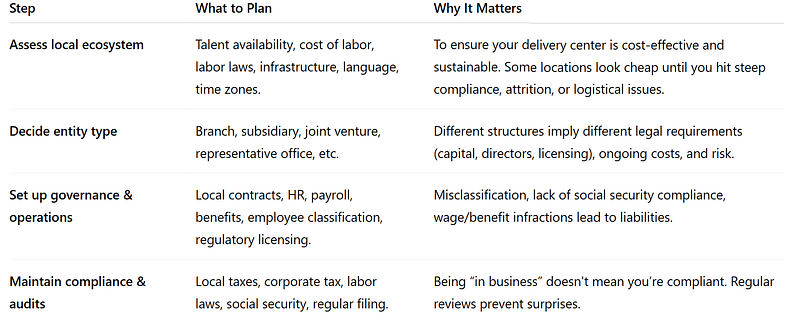
Think of this like house-hunting. You don’t just pick the cheapest place — you look at the neighborhood, upkeep, and hidden costs.
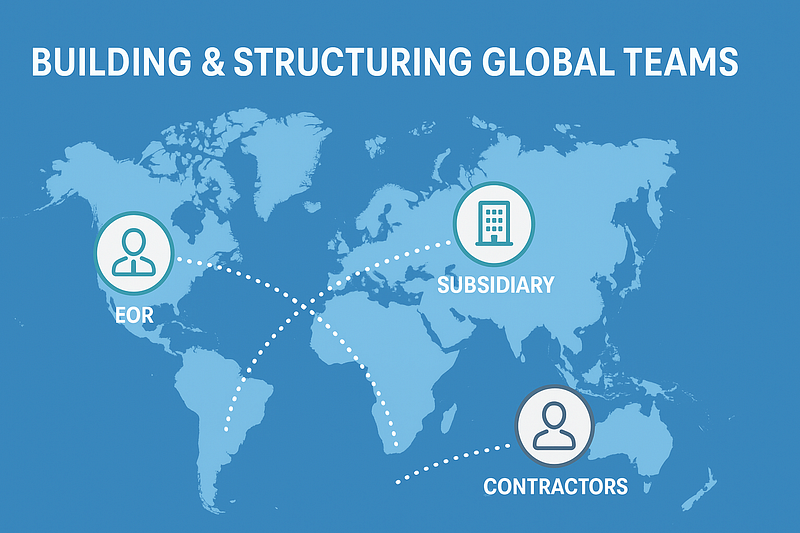
2. EOR vs Subsidiary vs Contractors: Choosing the Right Model
Here’s a comparative breakdown of three common structures. Each has trade-offs depending on scale, risk, control, and speed.
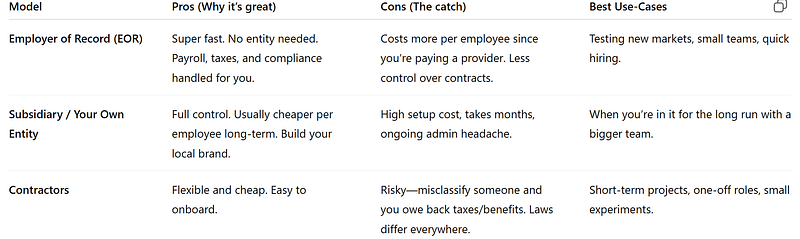
Quick analogy:
- EOR = renting an apartment. Easy, flexible, but more expensive over time.
- Subsidiary = buying a house. Costly upfront, but worth it long-term if you plan to stay.
- Contractors = Airbnb. Great for short stays, but you don’t run a business out of it.
3. Permanent Establishment (PE) Risks Explained: What Every Global Team Must Know
PE risk is probably the single most under-estimated exposure in remote or offshore models. If you cross certain lines, a foreign tax authority may consider you to have a taxable presence in that country (“Permanent Establishment”) even if you have no formal local entity. This, in turn, can lead to corporate taxes, registration/licensing, audits, and liabilities that were not expected.
That tax-speak would be: “Congratulations, we understand that you are doing business here. Pay up.”
Such a situation does not necessarily have to be triggered by a physical location; in other words, no physical office is needed. Sometimes, a single employee’s home office is sufficient.
What Triggers PE?
- Fixed place of business: If your remote worker’s home doubles as your office, and you control how they use it, it might count.
- Dependent agent activity: Someone negotiating or signing contracts on your behalf regularly — that is a red flag.
- Service PE: Continuous services in a foreign country without an office can also be considered.
What Makes PE More Likely?
- Duration: It is much safer to be engaged in one-off projects rather than in year-round work.
- Decision-making: The more authority your foreign worker has, the greater the risk will be.
- Employer control: If you dictate where and how they work, that looks like a permanent base.
- Local law: Every country has its own set of rules, plus tax treaties that can either help you or put you down.
How to Reduce PE Risk
- Try using EORs (employer of record) or local subsidiaries, as they are designed to be legal.
- Make overseas work voluntary and flexible instead of “mandatory office hours.”
- Do not give foreign staff the power to finish deals.
- Document everything — Where employees work, for how long, and what decisions they make.
- Follow the advice of a local tax professional as the rules change faster than the algorithms on LinkedIn.
Example: If your employee in Germany signs deals on your behalf, German tax authorities might say, “Hey, you’re running a German business.” And suddenly you’re on the hook for corporate tax there.
A Simple Decision Tree
One may compare the suggested ways to a quick cheat sheet for choosing the most suitable model:
- Already have a local entity? → Use it.
- Hiring just 1–5 people fast? → EOR or contractors.
- Is the position core to your business/IP? → Lean EOR or subsidiary, not contractors.
- Long-term growth in that company? → Subsidiary.
- Does the PE risk look high? → Stick with EOR or a proper local entity.
Final Thoughts: Build Smart, Not Just Fast
- Saving on costs should not be the only thing that you focus on. Compliance failures end up costing you a lot more than your payroll.
- Hybrid setups might be complicated. Having a contractor for one employee and the EOR for another in the same country may raise flags.
- Don’t forget hidden costs. Severance, social security, and benefits — they make a big total.
- The local people who are experts in their field are your best friends. Money, which usually goes on local lawyers or tax advisors, acts as insurance against ugly surprises.
The takeaway? Building global teams today is easier than ever, but the rulebook is more complex than it looks. Pick the right model, watch for PE traps, and think long-term. That way, your global expansion story becomes a growth engine — not a legal headache.
Stay tuned for Part 3 of our series: Remote Work & Taxes Explained: What Employers Must Know Worldwide
Looking to build a high-performing remote tech team?
Check out MyNextDeveloper, a platform where you can find the top 3% of software engineers who are deeply passionate about innovation. Our on-demand, dedicated, and thorough software talent solutions provide a comprehensive solution for all your software requirements.
Visit our website to explore how we can assist you in assembling your perfect team.