Are You Paying More Than You Should?
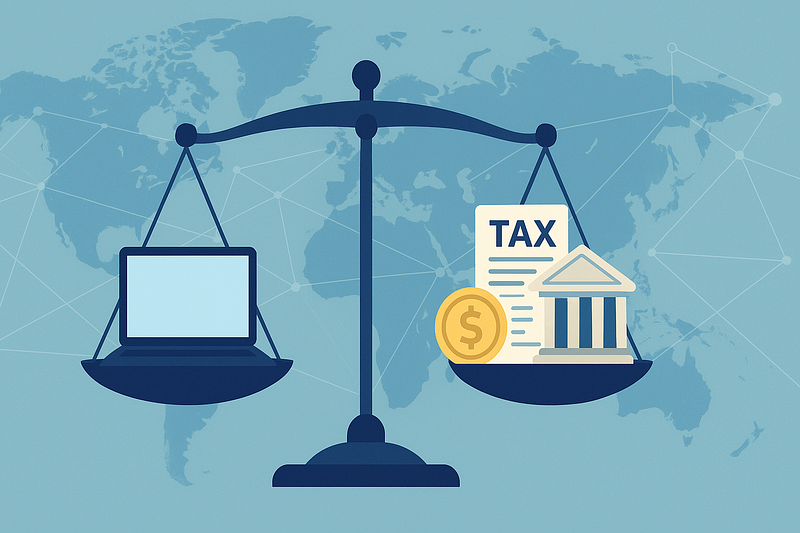
Imagine this: your company decides to hire a skilled coder who resides in Spain, while your headquarters are in the United States. One would think that the company would save a tremendous amount of money since there is no need to pay overhead expenses. But then, you get a huge tax bill from Spain, and the U.S. payroll team is completely stumped. This is the confusing realm of remote work taxation.
In this part of this series, we’ll demystify the remote work tax issues about payroll, social security, double taxation, and the OECD’s Pillar Two global minimum tax. By the end, you will be able to grasp these roadblocks and obey the law.
Remote Work & Taxes 101
Payroll Taxes: More Than Just Withholdings If your company employees are scattered across different states or countries, payroll tax might be a complicated matter for you. For example, in America, an employer must withhold Federal and State Income Tax, Social Security Tax, and the Medicare Tax from the employee, and the reference point is the employee’s place of work. The consequence of this is that while your company might have its origin in one state, you will actually have to carry out registration and then obligatorily meet tax laws from other states where your employees reside.
Social Security & Medicare: The Global Dilemma In the United States, FICA tax (Social Security and Medicare) is generally deducted at a rate of 6.2% and 1.45%, respectively. However, employees working remotely have to determine which social security system will apply, which is a larger issue. Without coordination, employees may pay into several systems and incur additional expenses for both the employer and the employee.
Double Taxation: A Common Pitfall Double taxation refers to two or more authorities taxing the same income. Such a condition may originate from circumstances where an employee works from home while their workplace is outside their country or in a different state. Double taxation is not frequent among most nations, as they have tax treaties with each other. The tax treaties reduce double taxation, though it’s not very easy to deal with such treaties. Lack of full preparation may leave both employee and employer facing unnecessary tax bills.
The Global Minimum Tax: OECD’s Pillar Two To counter the issue of multinational corporations using profit shifting and tax evasion, the Organisation for Economic Co-operation and Development (OECD) put forth the Global Anti-Base Erosion (GloBE) rules, or Pillar Two, comprising a new set of rules. The purpose of this system is to get offshore large multinationals to pay at least 15% tax on the profits they make in any country.
How It Works Pillar Two is responsible for applying a top-up tax on those cases where an MNE’s effective tax rate in a particular jurisdiction is less than 15% to bring the effective rate up to that minimum threshold. In such a way, it guarantees that MNEs will not be able to reduce their total tax payments by taking advantage of low-taxed territories.
Who Is Affected? Essentially, the conditions of Pillar Two shall apply to MNEs whose annual consolidated revenues exceed €750 million. Though the U.S. has not completely adopted the OECD’s framework, it has taken similar measures through the Inflation Reduction Act of 2022.
Meanwhile, several nations, including European countries, are in the process of integrating these rules into their tax systems.
Navigating the Tax Landscape: Best Practices for Remote Employers
- Know Your State and Local Tax Obligations: Your employees must comply with the tax rules of the areas where they live. This could mean registering your business with the state or local tax authorities and deducting the right amount of taxes from employees.
- Social Security Contributions Should Be Well-Coordinated: Know about the international agreements that may release employees from paying social security contributions in more than one country. Thus, the expenses and administrative work may be lowered.
- Leverage Tax Treaties: Make use of tax treaties between countries to avoid being taxed twice. These pacts usually offer certain ways for taxes to be credited or waived.
Final Thoughts
As remote work continues to redefine the global workforce, understanding the complexities of taxation is crucial for employers. By staying informed and proactive, you can navigate the maze of payroll, social security, double taxation, and global minimum tax regulations, ensuring compliance and optimizing your company’s tax position.
For more insights into managing remote teams and navigating international tax laws, explore our other blogs in this series.
Stay tuned for Part 4 of our series: Country Deep Dives (Practical Guides).
Looking to build a high-performing remote tech team?
Check out MyNextDeveloper, a platform where you can find the top 3% of software engineers who are deeply passionate about innovation. Our on-demand, dedicated, and thorough software talent solutions provide a comprehensive solution for all your software requirements.
Visit our website to explore how we can assist you in assembling your perfect team.