When your writing assistant becomes your workflow co-pilot — here’s what it means.
If you have ever used Grammarly, you surely would recognize it as the tool that helps people write and fix their worst errors. Moreover, it has the ability to detect tones and help make the text more fluent.
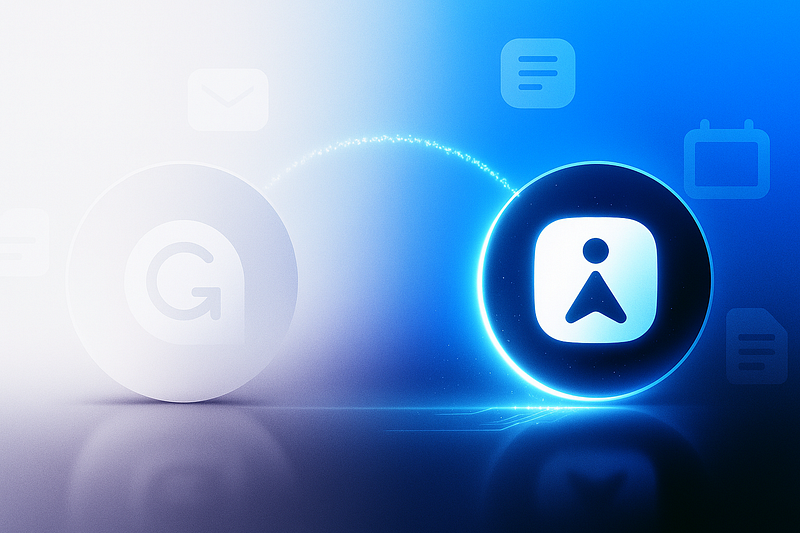
However, not that long ago, the tool’s parent company made a bold move — it is now calling itself Superhuman, and is changing its role from “writing assistant” to “the AI productivity platform for all”.
This change moves far beyond branding: it is a signal of a change in the way AI will be used in daily work.
In this article, we’ll walk you through what changed, why it matters, how it might affect you, and what to watch out for.
What’s happening: The shift explained
Change of name & broadened goal
Grammarly is taking an official stand to rename itself as Superhuman, but the Grammarly writing software will continue as the company’s product.
Mission Change: “AI which by being everywhere humans are, recognizing the way they really function, is capable of upgrading each and every human” (a quote from the CEO, Shishir Mehrotra).
The bundle now includes:
- The original Grammarly writing assistant.
- Coda (the deal was closed in December 2024) — a document/workspace tool.
- Superhuman Mail (the formerly “Superhuman” email app) — the acquisition was completed in July 2025.
- A brand new service: Superhuman Go — A proactive AI agent suite.
Strategy of the purchase & the source of the change:
- In July 2025, Grammarly purchased Superhuman, which helped it realize the dream of building the ultimate productivity platform. Earlier, with the purchase of Coda, they had obtained a layer of the collaborative workspace.
- The rebranding is an excellent move, which facilitated these three to come together under one roof, thereby making them capable of operating at a higher level, so that they can compete not just at “writing help” but also at “workflow help”.
The core proposition: AI agents, not just editors
Superhuman Go guarantees “The collaboration of several agents who will assist you in writing, researching, and even predicting feedback, besides automating tasks, and scheduling meetings, among others.”
Their technology is designed to integrate with more than 100 applications and a million-plus web/apps/sites.
The organization sees this as reaching the “productivity gap” — the situation where many AI tools reside has led to a decline in productivity. The plan here is to embed AI directly in your workflow, thus avoiding app-switching frequently.
Why it matters
- For the individual user/creator
If you are to rely mostly on the Grammarly tool for checking your emails or blog posts, you may soon find yourself using just one tool that can assist you in scheduling, drafting, summarizing, as well as coordinating across apps.
This results in less time wasted switching back and forth among the tools (writing tool → email → calendar → docs). The promise: fewer context switches = more focus.
As a content creator, marketer, or remote worker, you’ll enjoy the smooth integrated flow, especially while working on multi-step tasks (e.g., writing a blog + coordinating with an intern + creating a deck).
However, on the flip side, when new features are added, there not only comes the benefit of making the tool more user-friendly, but also the issues of extra costs, increased learning requirements, and more complicated operations. If all you ever needed was “check my grammar”, then a full productivity suite may seem like a waste of resources.
- For marketers/founders
From the perspective of branding and positioning: This move made by the company is indeed a very smart one — they are transitioning from an isolated feature (“fix my writing”) to a platform (“help me work”). This is a significant upgrade on the SaaS value chain.
If you manage content, intern workflows, and remote creators, you may soon evaluate whether this suite (Superhuman) becomes part of your stack — it could streamline writing, review, and team coordination.
On the other hand, it points to the fact that competition is getting tougher. When a tool that is widely used turns into a full platform, it naturally sets the expectation for your stack to be at the same level. Are you relying on a set of tools that are fragmented and do not communicate well? This action highlights the necessity of integration.
Deeper analysis & challenges
Strengths & Strategic Fits:
- Timing: The year 2024–25 will be the time for AI productivity, and Superhuman is now in a great place to ride that wave.
- Established user base: Grammarly is the top brand in writing support, with more than 40 million daily users and millions who rely on it.
- Clear pain point addressed: The issue that users had was moving between contexts, and the platform’s messaging is totally focused on that aspect.
- Platform play: They are taking over both workspace and inbox tools, which means they are reducing the risk of being a “single-node” player, and the path to ecosystem lock-in is getting shorter.
Key risks & headwinds
- Brand clarity: The value proposition of Grammarly was very apparent (“make your writing better”). Superhuman is broader but less revealing. Some analysts already criticize the name change as vague.
- Execution complexity: It is hard to marry several tools with AI agents and different user flows. The promise of seamless work through apps is more complex than it appears.
- Competition: Amidst the giants (Microsoft, Google, and Salesforce) pushing forward in the area of productivity/AI platforms, Superhuman has to figure out how to be different.
- User reaction: The original product has been feeling cut down, according to some long-time users. An example of such feedback:
“New Grammarly is for Editors, not Creators … I’ve been a pro user for 10 years and the updates feel like they’re trying to be everything rather than what it did best.”
- Pricing & value: Bundling features usually results in tiered pricing. If the price goes up or the product gets bloated, then the rate of acceptance may decrease.
What to keep an eye on in the future
- Adoption for marketing/remote-teams: Are the features of the platform aimed at team collaboration, content workflows (e.g., brief → draft → review → publish), or is it just “solo productivity”?
- Integration depth: Are the AI agents truly part of the tools you use (Slack, Notion, Google Workspace, etc.), or is the experience just superficial?
- Data/privacy implications: With access to inboxes, calendars, and documents — how does Superhuman handle user data, ownership, and AI training usage? The company claims “users own what they write,” and they do not train 3rd-party models on user content.
- Feature deprecation/focus: Is the old “writing correction” function still being prioritized, or will the innovation only be on the new productivity features? This is important for creators/writers.
- Competitive moves: Watch how Microsoft, Google, and niche tools react. Will Superhuman remain differentiated?
- User cost vs benefit: Mainly for smaller teams or solo marketers — does the extra layer of “agent-productivity” pay off, or is it enough to use the simpler tools?
Conclusion
The metamorphosis of Grammarly to Superhuman signifies a transition from “fix my writing” to “help me work smarter”. It is a strategic and timely change for people working in the fields of writing and marketing — and it coincides with the way we actually work through tools, tasks, and time zones.
Nevertheless, the transition from a writing assistant to a full-blown productivity platform is a bold one. It comes with great potential (fewer tools, more flow) but also with some downsides (complexity, brand dilution, high price). While making content strategies, managing teams, and storytelling, keeping one eye on the evolution of your own tool stack is a wise move.
Looking to build a high-performing remote tech team?
Check out MyNextDeveloper, a platform where you can find the top 3% of software engineers who are deeply passionate about innovation. Our on-demand, dedicated, and thorough software talent solutions provide a comprehensive solution for all your software requirements.
Visit our website to explore how we can assist you in assembling your perfect team.