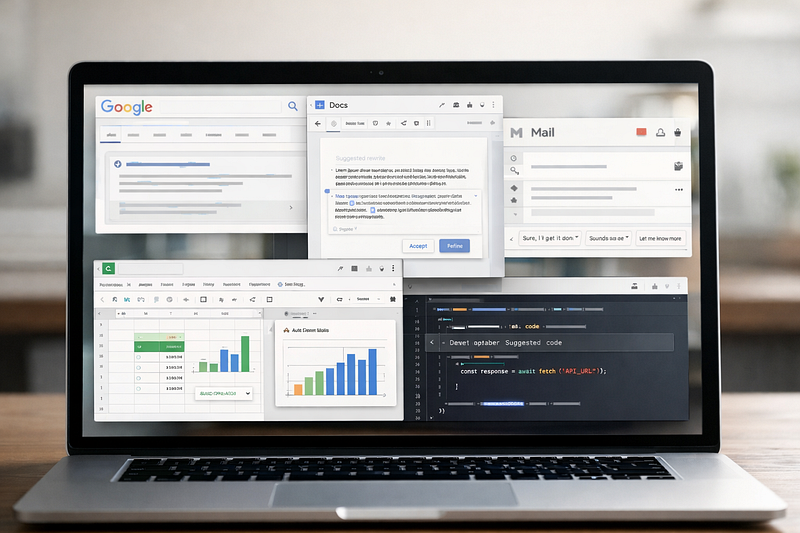
For the last year or so, Google has been up to something.
Instead of debuting one loud, headline-grabbing AI product, the company has been embedding AI in tools millions of people already use daily. Search. Email. Documents. Spreadsheets. Developer workflows.
That choice reveals more about the future of work than any one announcement.
This isn’t about AI wiping out jobs overnight. It’s about AI transforming what normal work looks like, what we need to be doing as professionals, and how performance is measured.
AI is no longer a side tool. It sits inside the workflow.
One thing stands out about Google’s latest moves with artificial intelligence. Each addition follows a similar path, quietly shaping how tools behave behind the scenes.
- Now you’ll spot short AI-written answers at the top of Search results, pulling key points together rather than just showing a row of websites.
- Gmail can draft replies based on context, tone, and past conversations.
- Docs enables users to create structured content through its ability to rewrite texts and summarize extensive documents.
- Sheets enables users to create formulas and obtain insights through their ability to enter basic text commands.
- Developer tools provide assistance to programmers by helping them complete code, find errors, and create user manuals.
What makes a difference is how optional tools act, unlike the standard ones.
Outside the workflow, AI invites tinkering. People experiment with it.
Inside the workflow, people adapt to it.
The shift from “should I use AI?” to “why wouldn’t I?”
A few years back, picking AI felt optional.
A few gave it a try. Others stayed clear.
Now things shift because of how Google operates. Finding a way around AI now takes more effort than going along with it once smart tech is built right into everyday software.
Resisting AI hints across Search, Docs, or Gmail begins seeming wasteful rather than thoughtful.
Here’s what happens when tech turns into backbone systems.
Years back, spellcheck took a similar route. Started as a choice. Soon became something else entirely. After that, people just assumed it would happen.
Back then, hitting send on a paper riddled with typos reflected laziness- yet people still neglected it since it was too much manual work.
Now, a single typo might seem small — yet it hints at a larger pattern of oversight. Mistakes pile up quietly, shaping how others see you. What feels like honesty to one person reads as neglect to another.
AI assistance is moving along that same curve.
What this means for knowledge work
When AI slips into daily tasks, how people handle thinking jobs changes — just as expected.
1. Drafting becomes faster and less valuable First drafts have become common because they are now available at any time.
A product brief, a client email, a job description, or a summary report can be generated in minutes. The value of typing has decreased because users must learn which elements to request, retain, and modify.
For example, a marketing manager might generate five campaign outlines in ten minutes. The actual work requires choosing the best approach, developing the message, and matching it to organizational objectives.
The process achieves a faster speed. Decision-making processes become more apparent.
2. Manual steps quietly disappear A few tasks people used to do manually are now being automated by AI.
- Formatting documents.
- Writing formulas.
- Summarizing meetings.
- Refactoring code.
- Searching across large knowledge bases.
On their own, each job seemed fine. Yet when lined up, they stretched the day out without warning. When these actions become routine, what people expect begins to change.
What used to take days now takes mere hours.
Turnaround time becomes part of performance, whether mentioned or not.
3. Review, validation, and decision-making grow in importance When AI generates content in seconds, it shifts where delays happen.
Now it’s not about whether we can make it happen. It becomes, “Is this correct, useful, ethical, and aligned with context?”
Those who guide, assess, shape, or deeply understand work hold greater weight now — still central, still essential. Editors, reviewers, managers, those with sharp expertise — they matter more than before.
Now they focus less on generating content and more on guiding it clearly. Quality matters most once the first drafts arrive.
A developer must examine coding logic, security measures, and system scalability when using AI coding tools. A content strategist must confirm the accuracy of facts and the appropriate tone and target audience relationship.
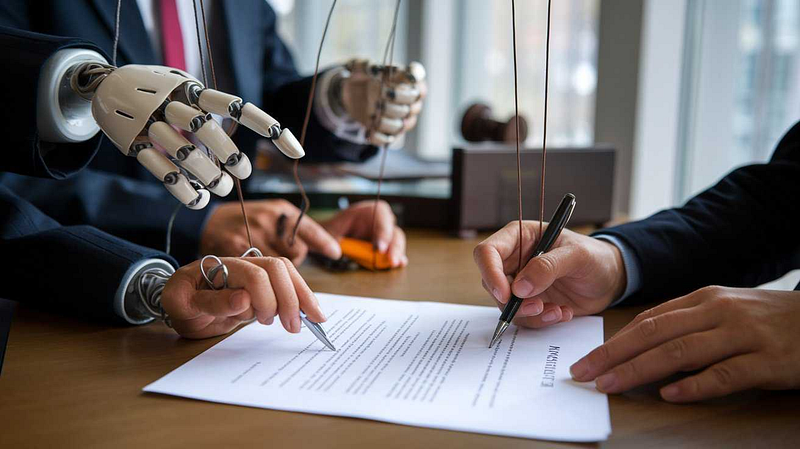
AI handles volume. Humans handle responsibility.
How hiring trends are already adjusting
This shift is evident in the recent hiring language. These days, plenty of work postings toss in lines such as:
- Experience working with AI-assisted tools.
- Ability to review and refine AI-generated output.
- Strong judgment and decision-making skills.
What stands out is what is missing.
Nowadays, only a few companies hire “AI prompt specialists” in large numbers.
They are now hiring experts skilled in AI, keeping standards high while protecting ethics, integrity, and honesty. Still looking for people who work with machines but never sacrifice what matters. Anyone joining must balance smart tools with real responsibility.
Systematic productivity standards for entry-level positions show an upward trend. The senior positions require employees to demonstrate their capacity to manage work results and take responsibility for their actions.
Someone who refuses to incorporate AI might struggle to meet speed expectations. Someone who relies on AI without any intervention might struggle with trust and accuracy.
Balance becomes the skill.
Performance expectations will change before policies do
Timing stands out when you pay attention.
- Technology shifts first.
- Expectations shift second.
- Last but not least, the formal policies.
Folks who run teams notice shifts, thanks to Google’s integrated tools, despite old-school job descriptions staying put.
If an analyst turns in a sharp report early, almost half the usual hours using AI, the speed becomes the reference point.
Others might avoid AI altogether. Still, comparisons exist.
This happens when the rules shift in silence.
Why “AI-assisted” becomes the baseline, not a bonus
Back then, working with AI seemed to offer a leg up. What once seemed impressive now just reads as normal behavior.
One day, knowing how to work with AI might feel as normal as using a spreadsheet, search engine, or any collaborative tool does now. Over time, people may wonder how they managed without it. What once seemed new will simply become part of the background. Familiarity tends to make complex things feel ordinary.
Google’s strategy makes this clear. Right now, folks aren’t being pushed to adopt a new way of thinking.
It's currently in the process of updating existing tools that users have established trust in.
The future will determine whether people will use artificial intelligence to assist their work tasks. The work assessment needs to determine whether the person operating it possesses sufficient knowledge to oversee the system.
The professionals who achieve success will not be those who produce the highest volume of work. The successful people will possess expertise on essential matters while recognizing which details they should disregard and which automated systems they should doubt.
The future of work will progress towards that direction.
Looking to build a high-performing remote tech team?
Check out MyNextDeveloper, a platform where you can find the top 3% of software engineers who are deeply passionate about innovation. Our on-demand, dedicated, and thorough software talent solutions provide a comprehensive solution for all your software requirements.
Visit our website to explore how we can assist you in assembling your perfect team.