At the beginning of 2026, the technology sector encountered a problem. It wasn’t a shortage of chips or a breach of information; it was an alteration in what artificial intelligence could do. Anthropic’s newest collection of programs, made available on January 30, 2026, wasn’t simply a more effective conversational AI — it was a ‘virtual colleague’ that created a worldwide financial shock.
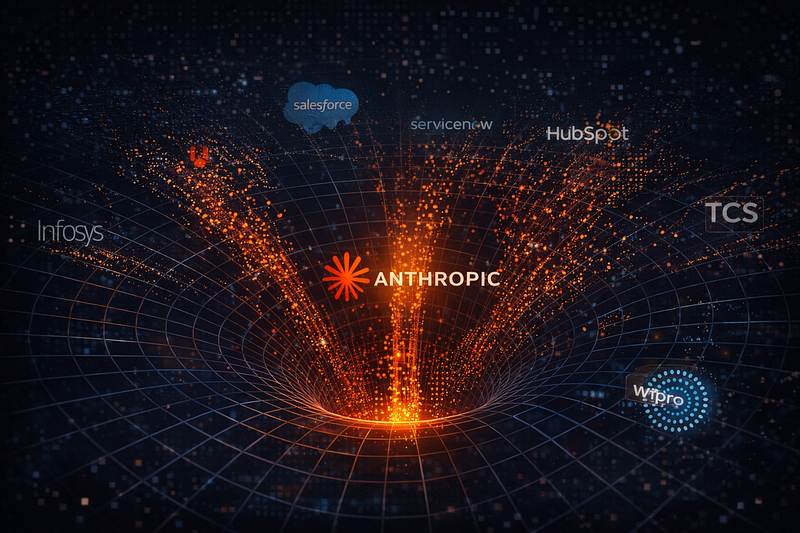
In a single day, shares in software and service businesses lost approximately $285 billion in value. From New York to Mumbai, the point was obvious: Investors weren’t questioning whether AI was able to assist people; they were questioning if AI would take the place of the software people deployed.
The Reason: Claude “Cowork” and the 11 Add-ins
The worry was based around Claude Cowork, an agent-based scheme made to devise and carry out several actions by itself. Instead of a chatbot that anticipates your prompt, these agents can ‘think’ through an aim, examine documents, and finish a job from beginning to end.
The true ‘market killer’ was a group of 11 free-to-use add-ins that came with it, and which were directed at highly profitable trades:
- Law: Making automatic evaluations of agreements and adherence to rules — jobs that are the chief source of revenue for firms worth many billions of dollars.
- Data Study: Cleaning and handling data in moments, creating a danger to specific software-as-a-service systems.
- Running: Dealing with client assistance and sales processes without the requirement for distinct, costly program subscriptions.
Reasons for the Market’s Alarm
The drop in prices wasn’t simply a quick, instinctive response — it showed a fundamental repricing of how we value software. For a long time, the SaaS — or Software as a Service — business depended on costing by the “user”, meaning that if a business had 100 staff, it would pay for 100 licenses.
The AI Problem: If one AI worker can achieve what ten people can, the client will only require one “user”. This puts at risk the income of huge companies such as Salesforce, ServiceNow, and Adobe, all of which saw their shares fall about 7% after the announcement.
Sridhar Vembu, Zoho’s chief executive, said “AI is the pin that is popping the inflated SaaS balloon,” and also claimed that the sector — which has usually put more money into marketing than into engineering— is at last dealing with consequences.
Worldwide Effects: How India Is Affected
The effects quickly reached the Indian IT industry, for a long time the world’s ‘back office’. On February 4th, 2026, the Nifty IT index fell 6% — its worst day since the 2020 outbreak.
- Infosys had its stock fall over 7%, wiping out billions in market value.
- TCS and Wipro felt the same pressure, with investors concerned that the ‘billable hours’ system — employing thousands of engineers to look after systems — was growing obsolete as AI can debug and deploy code autonomously.
The Truth: Is Software Finished?
Though the figures appear bad, the past shows this is a development, not a disappearance. Each important tech change — from Mainframe to the Cloud — at first caused fear, but by the end made it more worthwhile.
- Consolidation, not fear: We won’t probably have less equipment, but better ones. The ‘thin wrappers’ — programs which merely give a lovely UI to another’s AI — will die, but strong, integrated systems will do well.
- People as a Control: Anthropic itself makes clear that ‘agentic’ results still need a person in the process. AI can write a law document twelve times quicker than a person, but it can’t be in a courtroom or understand the fine points of business.
- New Jobs: As the Cloud gave us DevOps, the Agentic Period will give us AI Orchestrators— people who run groups of AI agents.
Putting aside the stock market graphs and the news about a “SaaS-apocalypse”, the true story is of a basic change in the way we use computers. Anthropic’s Claude Cowork is not simply a more intelligent chatbot; it is a “System of Action”.
This is a useful look at how the technology functions in practice and what that means for what you do every day.
- From “Assistant” to “Operator”
The main difference is the File System and Tool Access. Before, AI existed within a web browser window. To get use from it, you’d need to copy-paste information, request an answer, and then put that result back manually into your work by hand.
The Change in Practice: Using Cowork, you give Claude access to a particular directory — say /Project-Alpha.
The Old Method: “Claude, this is a CSV. Tidy the data and provide the code to correct the dates.” (You would then execute the code on your own).
The New Method: “Claude, review all the CSVs in this directory. Make the date formats uniform throughout, remove duplicates, and make a summary Excel document with a pivot table.” (Claude completes the task directly within your directory).
2. Practical Applications in Industry The market was alarmed as Cowork’s 11 open-source free plugins aim at profitable, manual jobs. Here’s what this looks like in reality:
Legal & Compliance Rather than a trainee solicitor spending six hours on “NDA Sorting”, the Legal Plugin can:
- Examine fifty incoming NDAs.
- Point out sections that deviate from the usual company standards.
- Produce a “Redline” copy for the human lawyer to confirm.
Consequence: Businesses may no longer pay for costly legal-tech subscriptions if they can operate this locally for $20 a month.
Finance & Admin The Finance Plugin is able to open a directory of 100 untidy “receipt_scan_123.jpg” files, read the supplier and amount, rename them to YYYY-MM-DD_Supplier_Amount.pdf, and update a Master Expenses spreadsheet.
Consequence: This will automate the “basic work” that at present employs thousands of accounts assistants.
Software Engineering Built on the backbone of Claude Code, Cowork can now handle “Maintenance Debt.” You can point it at a repository and say, “Update all our outdated dependencies and fix any resulting breaking changes.”
Implication: The “Billable Hours” model of outsourced IT maintenance is under extreme pressure.
The “Per-Seat” Crisis: If a company used to buy 50 licenses for a data-entry tool, but now one AI agent does that work, they only buy 1 license. The software company’s revenue drops by 98% — this is what caused the “SaaSpocalypse.”
How to Pivot: The Shift to “AI Orchestration”
For people working in technology, the law, or in finance — if that’s you — the aim should be to be the Orchestrator (the person managing the AI that does the task), rather than the Executor (the person doing the task).
- A new skill you’ll need is Task Decomposition: being able to split a large piece of work into ten smaller steps that an AI agent is sure to get right.
- Another new Skill: AI Governance. Instead of “doing” the legal review, you are “auditing” the AI’s review to ensure zero hallucinations.
- Being put on the waitlist means you’ll need a Claude Max plan at the moment — that’s about $100 to $200 each month. The pricing’s changed; it’s now for “AI compute tokens” and not for “software seats”.
Final Thoughts
The $285 billion market drop reflects a reality where intelligence is becoming a utility, like electricity. You don’t pay for a “specialized lightbulb” (SaaS) if the electricity (AI) can light the room itself.
Looking to build a high-performing remote tech team?
Check out MyNextDeveloper, a platform where you can find the top 3% of software engineers who are deeply passionate about innovation. Our on-demand, dedicated, and thorough software talent solutions provide a comprehensive solution for all your software requirements.
Visit our website to explore how we can assist you in assembling your perfect team.