What if a deadly disease could be cured in half the time — and at a fraction of the cost — just by training an algorithm? Welcome to the future of pharma.
1. The Drug Development Conundrum: Why Current Approaches Are Not Working
It costs 10–15 years and over $2.6 billion to get a new drug to the market. Most cash is in
- Round after round of screening of molecules against thousands of chemicals, where most never get past the first round of screening.
- Year-round experimentation by trial and error in the laboratory setting, with indeterminate outcomes and extremely low automation
- Increasingly high failure rates of late-stage trials in which drugs that do well early on either fail to act or produce unexpected side effects on human patients, leading to huge economic losses
It’s slow, dangerous, and likely outdated. That’s where AI steps in.
2. The Algorithmic Revolution in Biotech
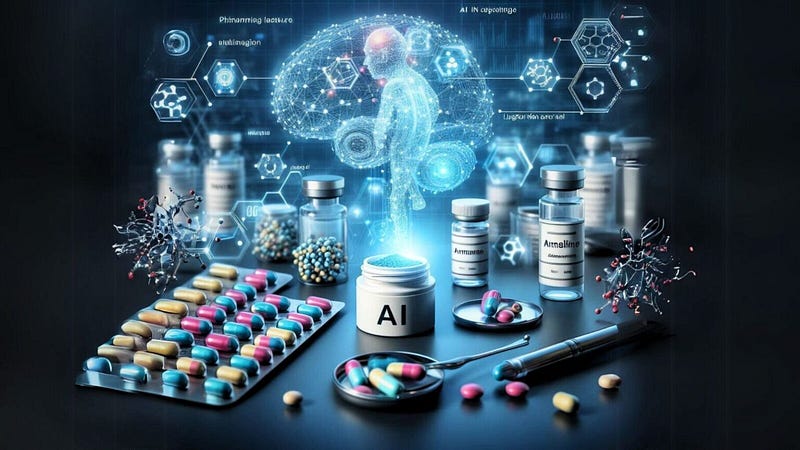
AI is transforming drug discovery by assisting researchers to
- Anticipate molecular behaviour prior to lab testing
- Choose candidate compounds from the large chemical libraries
- Perform virtual clinical testing using digital twins
Companies like Insilico Medicine and BenevolentAI are already leveraging deep learning algorithms to create new drugs, some of which have already reached human trials in years rather than decades.
3. Why Startups Are at the Forefront
They are faster to adopt than big pharma, tech-savvy, and agile. Here’s why they’re going all in on AI:
- Speed: AI reduces the time interval between target identification and candidate selection
- Cost-Efficiency: Smaller, smarter teams, faster pivots
- Investor Interest: VCs are investing millions in AI-first pharma companies
Startups are not only discovering drugs—startups are redefining the pharma playbook.
4. Use Cases: Applications of AI in Drug Discovery in Real Life
Some pioneering real-world applications are
- COVID-19: AI identified antiviral medications by scouring huge biomedical databases and accelerating drug trials on compounds such as remdesivir.
- Rare Diseases: AI uncovers gene-disease associations for more poorly characterized diseases, accelerating orphan drug discovery.
- Oncology: AI predicts drug resistance and tailors cancer therapy based on patient genomics for better outcomes. Startups are increasingly using AI at stages from pre-market R&D to post-market surveillance.
5. Tech Stack Behind the Science
These platform-based products are fueled by a robust backend of
- Natural Language Processing (NLP): Scours and integrates vast quantities of biomedical literature, clinical trials information, and patents to uncover findings that would take years for human scientists to tally.
- Graph Neural Networks (GNNs): Encode complex relationships between chemicals, genes, proteins, and diseases to find potential drug targets and compound interactions.
- Generative Models: Utilize deep learning to generate entirely new molecular structures that satisfy some characteristics (e.g., solubility, target affinity, toxicity), making it possible to adopt de novo drug design.
- Reinforcement Learning: Continuous optimization of drug candidate profiles from simulation-guided real-world response, enhancing potency, safety, and bioavailability.
It’s not only AI, but a complex tech environment with layers, designed for speed and accuracy.
6. Challenges and Ethical Red Flags
While a vast opportunity exists, AI-pharma also holds high-risk challenges:
- Biased Datasets: Poor input = poor drug recommendations
- Black Box Models: Difficult to interpret decision-making reasoning
- Regulatory Hurdles: FDA and EMA necessitate new paradigms for AI-synthesized drugs
- Privacy of Data: Patient information must be protected by all means possible.
Startups must walk a fine line between innovation and integrity, especially in an industry that touches lives.
Conclusion: The Algorithm Will See You Now
Artificial intelligence for drug discovery is no longer science fiction, but the future of biotech. The pharma start-ups are leading the way, unfettered by red tape. For scientists, investors, and physicians alike, the message is the same: adapt or perish. The next miracle drug may not be in a petri dish.
It will most likely be an algorithm.
Looking to build a high-performing remote tech team?
Check out MyNextDeveloper, a platform where you can find the top 3% of software engineers who are deeply passionate about innovation. Our on-demand, dedicated, and thorough software talent solutions are available to offer you a complete solution for all your software requirements.
Visit our website to explore how we can assist you in assembling your perfect team.