
How to Raise Funding for Your AI Startup in 2026
AI is still where the money is, and somehow, despite record-breaking funding rounds and valuations that make your eyes water, it’s also gotten harder to raise for an AI startup. Not impossible, just harder.
Here’s the honest version: investors haven’t stopped writing checks. They’ve just gotten a lot more selective about whom they write them to.
The question founders should really be asking isn’t “Can we raise?” It’s “Do we deserve to?”
The Funding Landscape Right Now
AI is still the loudest conversation in venture capital globally. Private AI investment hit $72 billion in 2025 and keeps climbing. But most of that money is landing at a small number of companies: infrastructure plays, foundation model developers, the usual suspects.
For everyone else, the picture is more nuanced:
- Yes, investors are actively looking for AI startups
- No, slapping “AI-powered” on your deck won’t cut it anymore
- What you’ve actually built matters more than what you claim
The era of getting funded because you used the word “AI” three times in a pitch is over.
What Actually Makes an AI Startup Fundable?
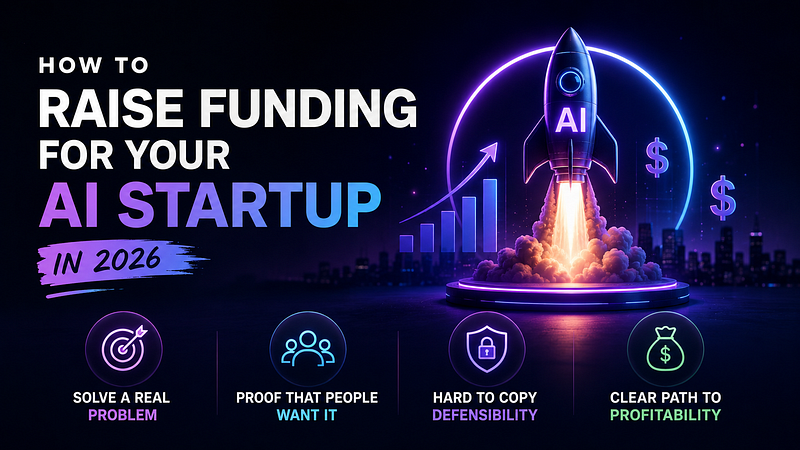
A real problem - not a solution, looking for one
The most common trap AI founders fall into: they build the tech first, then go hunting for a problem to pin it to. Investors see through this immediately.
The questions they’re asking are pretty simple:
- What problem are you solving?
- Who wakes up every morning frustrated by this?
- Why does solving it require AI?
A startup automating contract review for law firms? That’s a real, expensive, recurring pain. A startup with “an AI chatbot for everything”? That’s a tagline, not a business.
The problems worth backing are painful, costly, and happen constantly.
Proof that people actually want it
Investors care far less about your projections than your present. Before you pitch, you want to show something that says the market has already voted:
- Paying customers (even a handful)
- A pilot that’s going well
- A waitlist that keeps growing
- Users who come back month after month
They’ll ask: How many active users? What’s your 3-month retention? How fast is MRR growing? Small numbers are fine. Fake enthusiasm is not.
Something that’s genuinely hard to copy
Starting an AI company in 2026 is easier than ever. Which means defensibility matters more than ever. Investors are looking for moats, proprietary data, deep industry relationships, workflows that took years to figure out, and distribution that isn’t just “we’ll run ads.”
If someone with a decent engineering team could rebuild your product in three months, that’s a problem.
Laying the Groundwork Before You Pitch
Build a pitch deck that’s honest, not impressive.
A good AI pitch deck answers six things cleanly:
- What problem exists?
- How big is the market (realistically)?
- Why is your solution different?
- What have you already done?
- How do you make money?
- Why is this team uniquely positioned to do it?
Investors spend maybe three minutes on a deck. Clarity beats cleverness every time.
Know your numbers cold
The basics - MRR, CAC, LTV, burn rate, gross margin are non-negotiable. But for AI startups, investors are also digging into model inference costs, compute efficiency, and unit economics. Many AI companies scale fast but burn capital even faster. If you can show you’ve thought through the economics, you stand out.
Where the Money Is Coming From
Traditional VCs are still a major source, but most have sharpened their focus on AI infrastructure, healthcare AI, enterprise automation, and agentic systems. A warm introduction to 30 well-matched investors will always outperform 500 cold emails.
Angel investors are often the best first call at pre-seed. Faster decisions, genuine advice, flexible terms, and many of the best AI companies got their first check from an angel before a VC ever came calling.
Corporate strategic investors are increasingly active. Big companies want AI that fits their roadmap, and they can bring more than capital -customers, distribution, and technical resources.
Accelerators still matter, especially for early-stage founders. Cloud credits alone can meaningfully reduce infrastructure costs when you’re just getting started.
Why Some AI Startups Can’t Raise
Usually, it comes down to one of these:
- No clear business model: “We’ll figure out monetization later” doesn’t fly anymore.
- Weak product-market fit: Building on what your AI can do rather than what customers need is a tell.
- Inflated market claims: Saying your TAM is $500B when it’s really $40M breaks trust fast.
- No founder-market fit: Investors want to know you actually understand the industry you’re disrupting, not just that you read about it.
A Few Questions Founders Always Ask
How much should I raise?
Enough to hit your next meaningful milestone: product-market fit, revenue growth, geographic expansion. Don’t raise to survive. Raise to make something real happen.
Will investors fund me without revenue?
At pre-seed and seed, yes, if you have something else compelling. Exceptional user growth, proprietary technology, a team with real credibility, and a deep understanding of an underserved market. Revenue is one signal. It’s not the only one.
How long will fundraising take?
Usually three to six months. Start before you need to. Running a fundraise on a 30-day runway is one of the worst positions you can be in.
What It Actually Comes Down To
The money is still there. Investors are still backing AI companies at scale. What they’re not doing anymore is funding hype.
The founders who are winning right now are the ones solving problems that genuinely hurt, showing that customers have already started caring, building things that are hard to replicate, and making a credible case that this can become a real business.
That last part is the whole game now. Not “Is this AI?” but “Can this actually work?”
If your answer to that is a confident yes, backed by evidence, the funding conversation gets a lot easier.
TL;DR
AI funding in 2026 is still very much alive, but investors have just gotten smarter about where it goes. Having AI in your product is no longer a differentiator; what matters now is a real problem, real demand, and a real path to profit. Build something that genuinely works, show early proof, and the money follows.
Looking to build a high-performing remote tech team?
Check out MyNextDeveloper, a platform where you can find the top 3% of software engineers who are deeply passionate about innovation. Our on-demand, dedicated, and thorough software talent solutions provide a comprehensive solution for all your software requirements.
Visit our website to explore how we can assist you in assembling your perfect team.