How Generative AI Is Moving Beyond Text: The Rise of Multimodal Models
Just last year, the world was awed by the written wizardry of ChatGPT.
We saw computers compose essays, write code, and even debate philosophy — all in perfect, assertive language. It seemed like the pinnacle of AI innovation.
But here we are in 2025, and that “text-only” era of generative AI already seems quaint.
Because now, AI no longer merely writes — it sees, hears, and generates.
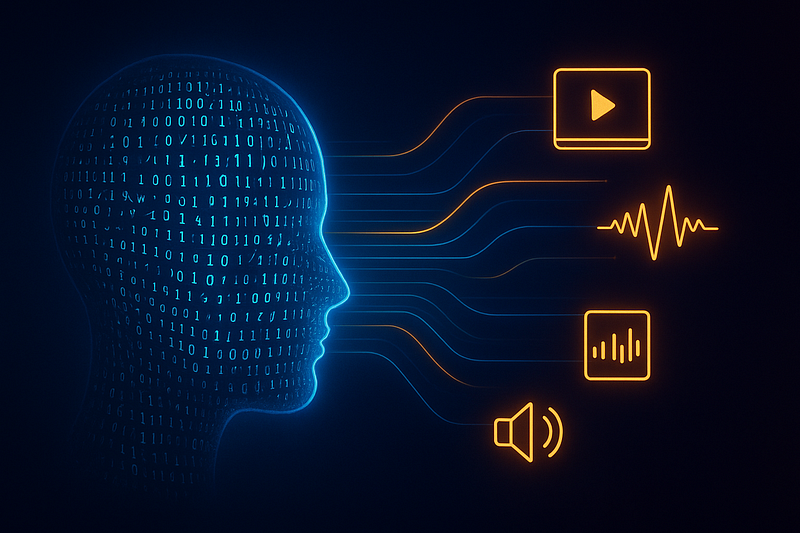
Come and join the era of multimodal AI — a new generation of models that can simultaneously process words, images, audio, and video, interweaving them into harmonious and meaningful experiences.
It’s the next breakthrough in human-machine collaboration, and it’s transforming the way we perceive intelligence itself.
From Words to Worlds — The Leap Beyond Text
For years, AI’s comfort zone was text.
Language models like GPT, Claude, and Gemini learned to predict the next word with astonishing precision.
But the human world isn’t just made of words — it’s a symphony of senses: visuals, voices, movements, emotions.
The limitation became obvious: how could a text-only model truly understand a meme, analyze a photograph, describe a painting, or interpret the tone of a voice?
That’s where multimodal AI enters the stage — models that comprehend and produce between multiple data types. They don’t merely read; they observe, listen, and synthesize.
Ask a multimodal model to analyze a photo of a broken circuit board — it won’t just describe the image; it might suggest what’s wrong and how to fix it.
Show it a video clip, and it could summarize the narrative, detect emotions, or even edit the footage for you.
It’s not science fiction anymore. It’s already here.
The Brains Behind the Breakthrough
Multimodal models combine various neural architectures — such as vision transformers (for visual inputs), speech encoders (for audio inputs), and large language models (for reasoning and text generation) — into a single system.
Which means they can:
- Interpret a query that mixes text and images (“What’s so humorous about this meme?”)
- Answer in various forms (“Here’s a caption, and also a thumbnail design for it.”)
- Learn relationships between senses — like how the words “blue sky” connect to actual shades of blue in an image.
These systems mimic the way humans experience the world: through interconnected senses, not isolated data streams.
It’s like we’ve been teaching AI to read books all this time — and now, suddenly, it can watch movies and listen to music too.
The Pioneers of the Multimodal Era
The fight to command this new frontier is intense — and intriguing.
- GPT-5 from OpenAI is evolving into a generalist model, capable of processing text, images, and audio within a single conversation. Upload a photo of your whiteboard notes, and it’ll summarize, edit, and create slides on the fly.
- Google’s Gemini 2 combines text and video comprehension with search and reasoning — picture an AI capable of interpreting YouTube videos and referring to factual context in real time.
- Anthropic’s Claude 3.5 emphasizes reliability and explainability while introducing image reasoning — less sexy, but firmly rooted.
- Runway, Pika, and Sora are transforming AI video creation, empowering creators to convert words into cinematic video.
And on top of the giants, startups are sprouting all over the place — creating AI-driven design software, video editors, healthcare assistants, and creative agents with multimodality as their foundation.
In brief, the AI arms race is no longer about larger text models. It’s about models that perceive the world the way people do.
The Real-World Impact — When AI Sees and Hears
Let’s pull back and consider how this shift impacts daily life and business.
1. The creative industries are being redefined.
Authors, filmmakers, and musicians are working alongside AI as co-creative partners.
A director can write a description of a scene — “sunset in Tokyo, neon reflections on rain-washed streets” — and software such as Sora or Runway can make it a visual reality in seconds.
AI isn’t merely robotizing creativity; it’s fueling imagination.
2. Learning becomes immersive.
Picture a biology instructor asking an artificial intelligence to describe DNA replication — not in paragraphs, but in an animated simulation read aloud in real time.
Students won’t only read descriptions; they’ll observe and listen, discovering the way our brains instinctively like.
3. Healthcare is upgraded to sensory input.
Multimodal AI can scan a patient’s voice tone, face, and medical scans to identify early indicators of illness.
It’s not replacing physicians — it’s providing them with superhuman vision.
4. Customer support changes.
In the near future, support AIs will comprehend screenshots, videos, or even voice notes — resolving your tech problem before you’ve finished explaining it.
5. Accessibility goes to new levels.
AI can read images to the blind, translate sign language for the deaf, and even provide adaptive interfaces in real time.
The Double-Edged Sword of Multimodality
With every leap in technology, there are shadows.
When AI can produce videos that appear indistinguishable from reality, the boundaries between fiction and reality become increasingly blurred. Deepfakes, disinformation, and digital identity theft are already becoming a reality.
Then there’s the cost of computation — multimodal training requires staggering amounts of energy and resources, and thus sustainability issues.
And maybe the most thorny challenge: data bias.
AI is trained on what we provide it — and if the training data contains stereotypes, they become ingrained in all modalities, not merely language.
The remedy? Transparency, regulation, and ethical frameworks that keep pace with the technology itself.
Because the more capable AI gets, the more we have to bear responsibility for deciding how it’s used.
The Philosophical Shift — Toward Machine Perception
Here’s the quietly revolutionary part:
We’re no longer creating machines that merely think — we’re creating machines that perceive.
AI isn’t limited to symbolic reasoning anymore. It’s starting to sense patterns in the same multidimensional fashion that humans do — visually, audibly, linguistically.
It’s the difference between seeing a thunderstorm described and being in the rain.
And that has deep implications: it could mean AI systems that form intuition, empathy, or creative sensibility — not because they’re experiencing like humans, but because they experience the world in a richness that once was exclusively ours.
The Future — From Multimodal to Omnimodal
Current models are multimodal — they can process more than one type of input.
But the future is omnimodal — machines that merge seamlessly all data types that humans provide: text, images, voice, touch, environment, and even biometric data.
Picture your AI helper that can watch from your AR glasses, recognize your tone, read your emails, feel your stress level, and intervene actively to assist — without compromising your privacy and intent.
That’s not an upgrade. That’s a new human-machine interface.
Final Thoughts
The move from text to multimodality by generative AI closes a book — and opens something much larger.
It’s tempting to view AI as an invention. But the fact is, it’s becoming a new medium — one that doesn’t just speak words, but images, sound, and experience.
As we venture into these new frontiers of creativity, the most influential question is no longer “What can AI do?”
It’s “What can we imagine — together?”
Looking to build a high-performing remote tech team?
Check out MyNextDeveloper, a platform where you can find the top 3% of software engineers who are deeply passionate about innovation. Our on-demand, dedicated, and thorough software talent solutions provide a comprehensive solution for all your software requirements.
Visit our website to explore how we can assist you in assembling your perfect team.